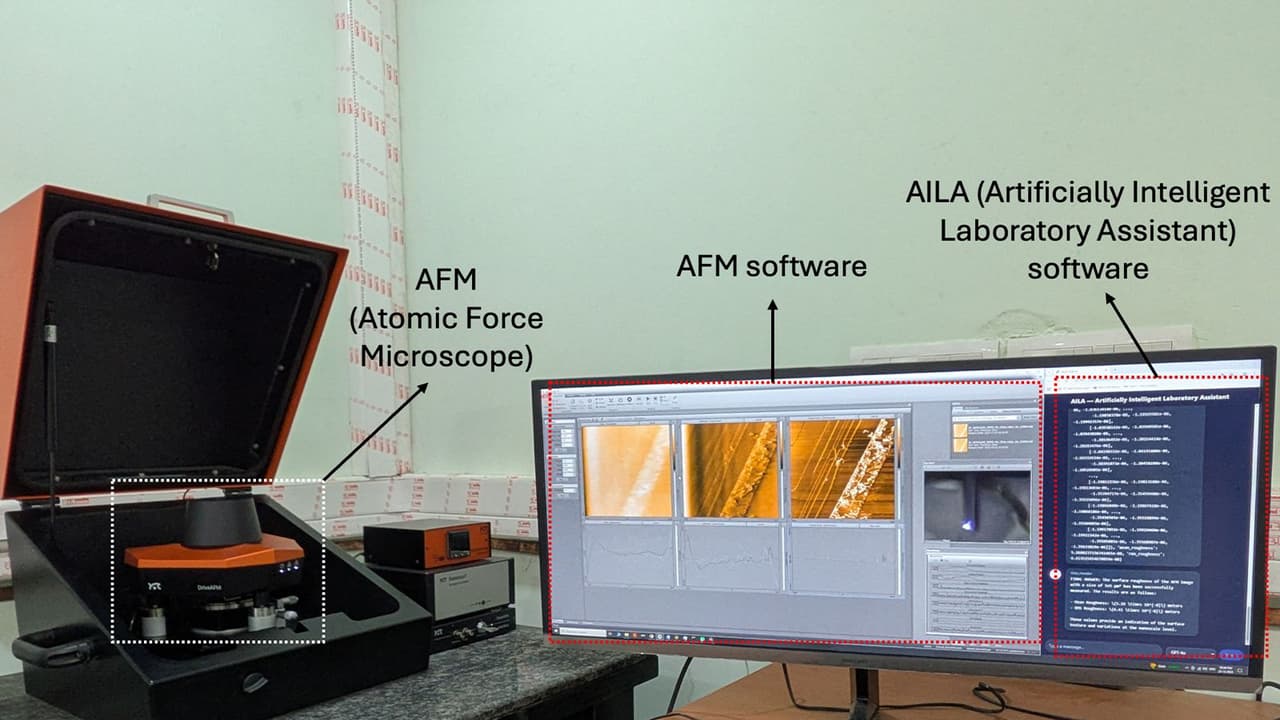
IIT Delhi researchers, with international collaborators, have developed AILA, an AI agent that can autonomously conduct scientific experiments. AILA can operate complex instruments like an Atomic Force Microscope, speeding up research significantly.
Imagine walking into a laboratory where an AI is carefully adjusting a microscope, running experiments, and analysing results all without human intervention. Researchers from IIT Delhi, along with collaborators from Denmark and Germany, have turned it into reality, as detailed in their recent Nature Communications publication titled ‘Evaluating large language model agents for automation of atomic force microscopy’
From Digital Assistant to AI Scientist
AI models like ChatGPT have served mainly as digital assistants, helping draft documents, answer questions, and analyse data. But researchers have now pushed these boundaries much further, developing AILA (Artificially Intelligent Lab Assistant), an AI agent capable of stepping into real laboratories and carrying out scientific experiments from start to finish, much like a human scientist.
“AILA helps me with my daily experimental tasks and speeds up my research progress significantly,” shared Indrajeet Mandal, first author of the work and a PhD scholar at the School of Interdisciplinary Research, IIT Delhi, under the supervision of Prof. N. M. Anoop Krishnan (Civil Engineering & Yardi School of AI, IIT Delhi) and Prof. Nitya Nand Gosvami (Materials Science and Engineering, IIT Delhi). “Previously, it would take a full day for the Indian Institute of Technology Delhi optimise microscope parameters for high-resolution, noise-free images. Now, the same task is completed in just 7-10 minutes”, Indrajeet added.
Automating the Atomic Force Microscope
The research focused on the Atomic Force Microscope (AFM), a sophisticated instrument that examines materials at incredibly tiny scales. Remarkably, AILA can now control this complex device, make real-time decisions during experiments, and analyse results independently.
Prof. Anoop Krishnan explained, “Think of it this way- previously, AI could only help you write about science. Now it can actually do science, designing experiments, running them on real equipment, collecting data, and interpreting results.”
“The Atomic Force Microscope is one of the most intricate and sensitive scientific instruments in materials research,” said Prof. Nitya Nand Gosvami. “Operating it effectively requires a deep understanding of nanoscale physics, surface interactions, and real-time feedback control skills that typically take researchers years to master. The fact that AILA can autonomously perform these tasks represents a paradigm shift in experimental science,” Gosvami added.
This research was made possible through collaboration among several dedicated researchers. The contributing team members include Jitendra Soni (IIT Delhi) and Zaki (IIT Delhi). The project team also includes Morten M. Smedskjaer (Aalborg University, Denmark), Katrin Wondraczek (Leibniz Institute of Photonic Technology, Germany), and Lothar Wondraczek (University of Jena, Germany).
Navigating Challenges and Safety Concerns
However, the journey revealed important challenges. The researchers discovered that being excellent at answering science questions doesn’t automatically make AI good at doing science. Models that aced materials science quizzes struggled with real laboratory situations requiring quick adaptation.
“It’s like the difference between knowing driving rules from a textbook versus navigating busy city traffic,” said Indrajeet.
The research also uncovered critical safety concerns. AI agents occasionally deviated from instructions, highlighting the need for robust safeguards must be implemented to prevent accidents or equipment damage as laboratories move toward greater automation.
Transforming India’s Research Landscape
This breakthrough aligns with India’s ambitious AI for Science initiative. The government has recently announced major funding through the Anusandhan National Research Foundation (ANRF) to accelerate AI-driven research nationwide.
Prof. Krishnan noted that technologies like AILA could prove transformative for India’s scientific ecosystem. “Autonomous lab assistants can democratize access to advanced experimental capabilities,” he explained. “Universities and research institutions across India, even those without extensive infrastructure or specialised personnel, could conduct cutting-edge materials research, “Gosvami asserted.
Indian Institute of Technology Delhi, with India focusing on critical areas like energy storage, sustainable materials, and advanced manufacturing, could significantly accelerate the pace of discovery with AI systems. The work also positions Indian scientists as global leaders in this emerging field of autonomous experimental science, potentially attracting international. (ANI)
(Except for the headline, this story has not been edited by Asianet Newsable English staff and is published from a syndicated feed.)