New Delhi: Scientists have developed an environmental indicator for assessing the risk of collisions between satellites in Low Earth Orbit, called the Crash Clock. The Crash Clock measures the time it would take in a hypothetical scenario, where active space operators around the world stopped executing collision avoidance manoeuvres (CAMs). When there is an anticipated conjunction or close approach between two satellites, one of them moves out of the way. The Crash Clock reflects the degree to which humans are dependent on errorless operations in orbit. The Crash Clock is set at 2.8 days as of June 2025, while in January 2018, it was 121 days.
This means that within three days of the hypothetical halting of CAMs, satellites in orbit will begin to collide. If there is loss of space situational awareness capabilities, then satellites will begin to collide in three days. This is because of the deployment of megaconstellations, or large number of small satellites. The Crash Clock is an indicator of the orbital carrying capacity, or the number of satellites that can be safely deployed in orbit at a time. The Crash in Crash clock stands for Collision Realisation and Significant Harm. A catastrophic software issue or a major solar storm could severely impact space situational awareness.
Orbital House of Cards
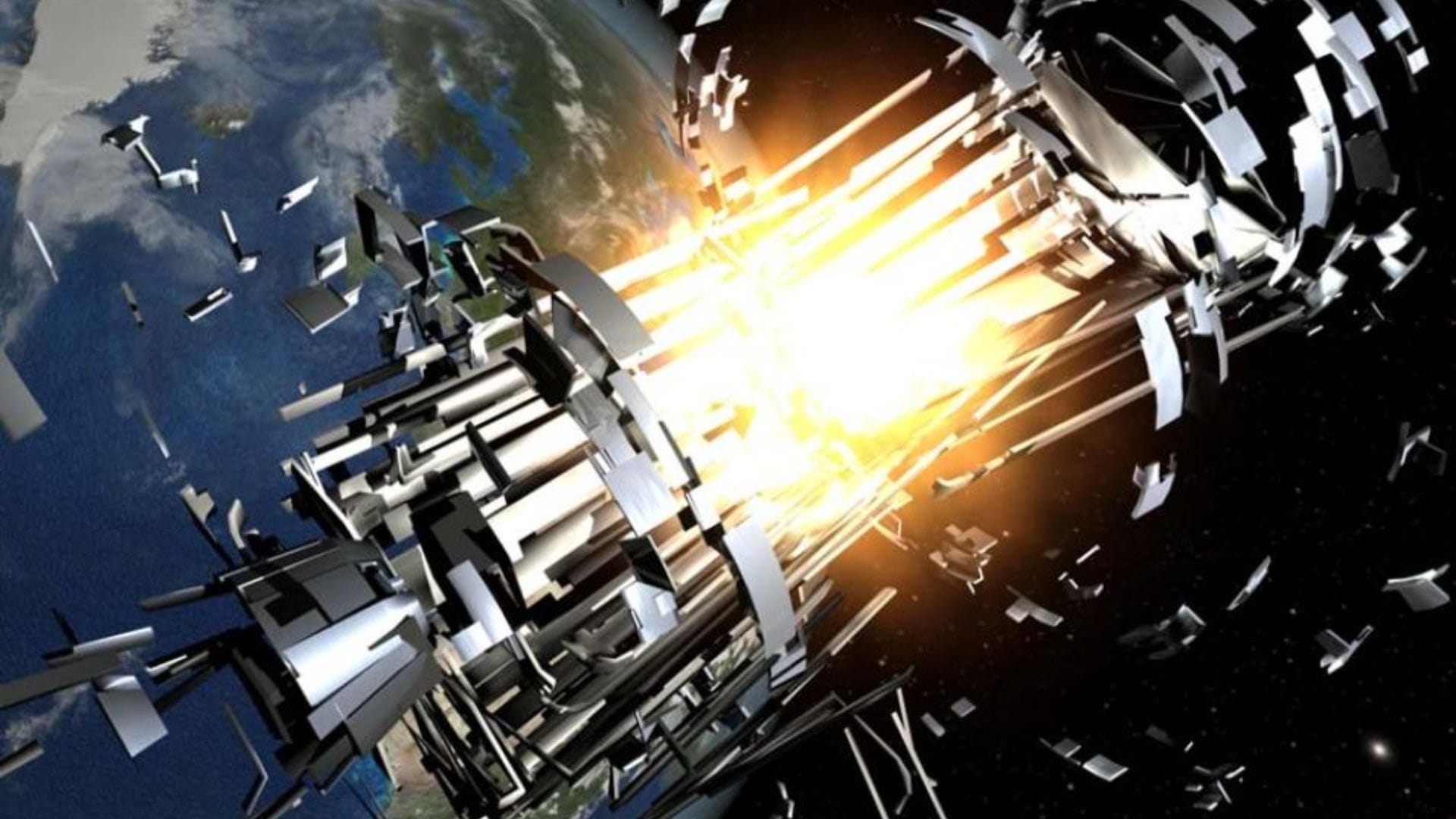
As the proliferation of satellites in Earth orbit increases, so does the chances of collision. A single collision can produce hundreds of pieces of space debris, that then becomes an environmental hazard for the other assets in Earth orbit. A series of collisions could cause a positive-feedback loop, known as the Kessler Cascade, that can render entire orbital regimes unsuitable for satellite use for decades. The values are derived based on sophisticated simulations. The Crash Clock is being further developed and refined, with a pre-print version of the paper hosted on Arxiv.