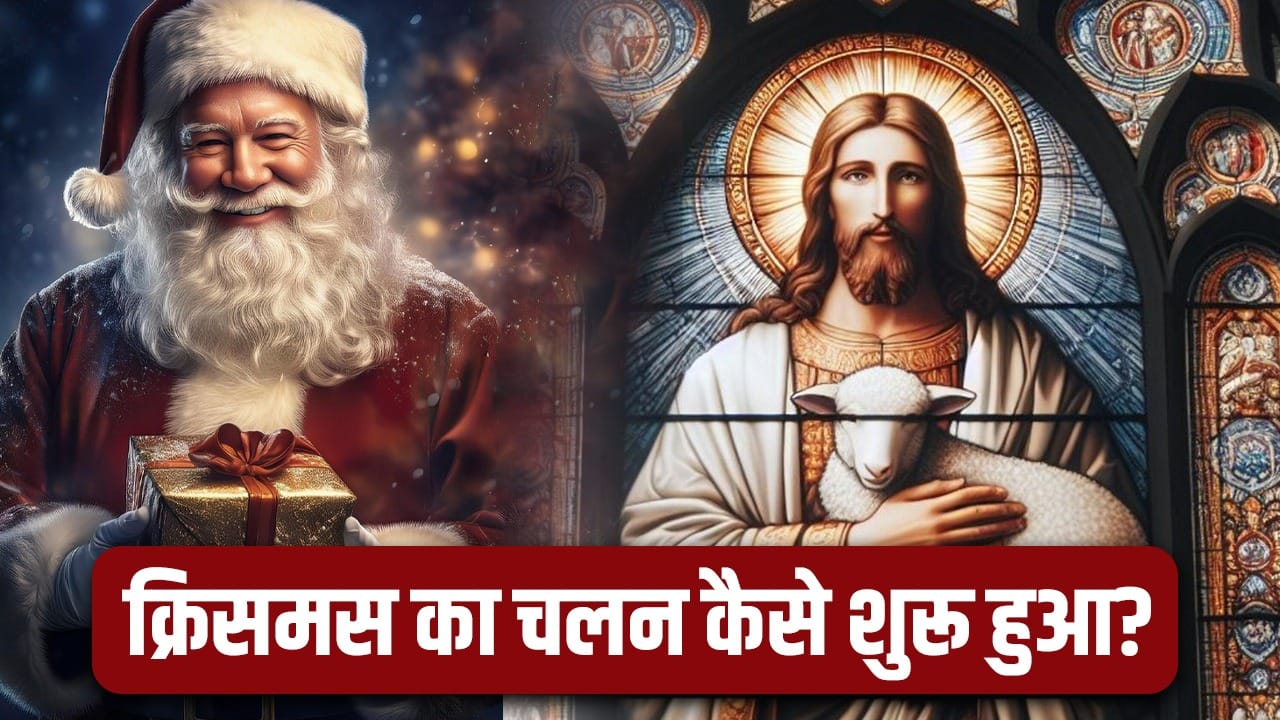
Most scholars believe that Jesus was born around 4-6 BC.
Christmas History: Amidst the preparations for Christmas, Christianity has come into discussion.Christianity is one of the most influential religions of human civilization. Its origin is linked to the life and teachings of Jesus Christ. Historically, most scholars believe that Jesus was born around 4-6 BC and that his public teachings appeared around 2730 AD. After the crucifixion of Jesus and the subsequent proclamation of the Resurrection by his followers, Christianity gradually began to form as an organized religious tradition. Therefore, if we talk about the existence of Christianity, then this religion has been actively present in human history for more than two thousand years.
There was a long debate on Does God Exist in Delhi between famous lyricist Javed Akhtar and Islamic scholar Mufti Shamail Nadvi. It is another matter that this important conversation ended without any result. In the name of this debate and Christmas, let us know how old is the existence of Christianity and when did the tradition of celebrating Christmas begin?
How old is the Christmas tradition?
Christmas is celebrated on December 25 as the birthday of Jesus Christ, but the interesting thing is that the exact date of birth of Jesus is not clearly mentioned in the Bible. The tradition of celebrating the birthday of Jesus on December 25 was established after many centuries. In the early 1st and 3rd centuries, Christian society mainly focused on the resurrection of Jesus and Easter. The celebration of the birth of Jesus was not very prominent. According to some research, the birth of Christ began to be commemorated on different dates in different Christian communities in the second half of the third century. In the fourth century, the Christian community of Rome started celebrating December 25 as the birthday of Jesus. There is also a practical and cultural reason behind this.
The roots of Christmas are approximately sixteen-seventeen hundred years old.
During the Roman Empire, there were festivals associated with Sol Invictus (Victory to the Sun) and the winter solstice. Gradually the Christian leadership replaced these existing festivals with Christmas, so that the new religion could be easily accepted in the society. That is, the form in which the Christmas festival of December 25 is visible to us today, has its roots about sixteen-seventeen hundred years old.
The modern tradition of Christmas gradually included a decorated Christmas tree, the image of Santa Claus, giving gifts to children, carols (hymns/songs) and family feasts and community prayers. Today, Christmas has become not only a religious festival but also a cultural and social celebration in many countries, in which even non-Christian communities participate.
Non-Christian communities also take part in Christmas.
How to understand the debate over Christmas and God together?
Christmas is often seen only as a religious festival, but if we look deeper, it is also part of a larger debate going on within human civilization. Does life have any spiritual meaning or not? According to Christian tradition, the core messages of Christmas are love, forgiveness, compassion and hope. Here, Jesus Christ is considered to be the son of God and it is said that he came into the world so that he can show man the path of freedom from sin and despair.
Nativity among the poor, messages to shepherds and ordinary people, and the ideal of non-violence and love figure prominently in Christmas stories. In such a situation, even if a person does not believe in God, the moral and humanitarian teachings of Christmas such as empathy, shared happiness, charity and humanity can be considered valuable in themselves. From the point of view of thinkers like Javed Akhtar, Christmas can be seen not only in a religious form, but as a cultural and human festival.
Families come together, people give gifts and take time out for each other, the lonely and vulnerable in society are helped. All these values are not limited to any one religion. In this way, one can welcome the socio-human aspect of Christmas even if one does not agree with the existence of God.

The solid tradition of celebrating Christmas on December 25 was firmly established by about the fourth century.
Dialogue between theist and atheist
Debates about God often turn confrontational, whereas if we embrace the spirit of peace and harmony of Christmas, this debate can turn into dialogue. Theists can understand that the atheists’ questions are not merely an insult to God, but part of the search for truth. And atheists can recognize that for theists, religion is not just superstition but also a source of solace, community, and morality. When both sides listen to each other, tolerance and understanding increases in society, which is also consistent with the core message of Christmas.
Balance between God, science and faith
In today’s scientific world, the debate on God is not only a debate of emotions, but also of knowledge, logic and experience.
- What does science say…Science talks about things that can be tested through experiment, observation and evidence. The question of God is generally considered beyond the direct reach of science, because it is a metaphysical question, that is, it is difficult to prove or disprove by thorough measurement in the laboratory.
- Role of Trust:For a believer, the existence of God is more a matter of experience and belief than a scientific equation. Like finding peace in prayer, having an epiphany, or sensing meaning in the order of the universe.
- Role of logic:Atheists rely more on logic and evidence. For them, unless something is proved by solid evidence, it is against scientific principles to accept it as true. In this background the debate of people like Javed Akhtar becomes important. They remind us that asking questions, examining traditions, and resisting superstition are just as important as respecting the beliefs of others.
Essence of Christmas – Remain compassionate even amidst questions
If we look at history, we come to know that Christianity has been a part of human society for almost two thousand years. The solid tradition of celebrating Christmas on December 25 was firmly established by about the fourth century.
With time, many cultural layers were added to it, making it a global festival.On the other hand, thinkers like Javed Akhtar remind us of another important legacy of questioning. Is there really a God? If so, what is it like? If not, what would be the basis of morality, love and compassion? These are questions to which there is no single universal answer, but thinking about them makes us more conscious and honest human beings.
On the occasion of Christmas, we can try that whether we are believers or atheists, follow any religion or none, but we should strengthen within ourselves the spirit of humanity, compassion, equality and search for truth. The debate on the existence of God can continue. It is possible that some people may see God everywhere and some may not see Him anywhere. But it is in our hands to try to make this world a little better, a little fairer and a little more humane. Perhaps this is the biggest message of Christmas – rising above blind faith or blind disbelief, and living life with wisdom and compassion.
Also read: Why were the British irritated with the Aravalli hills, the stronghold of the rebels?