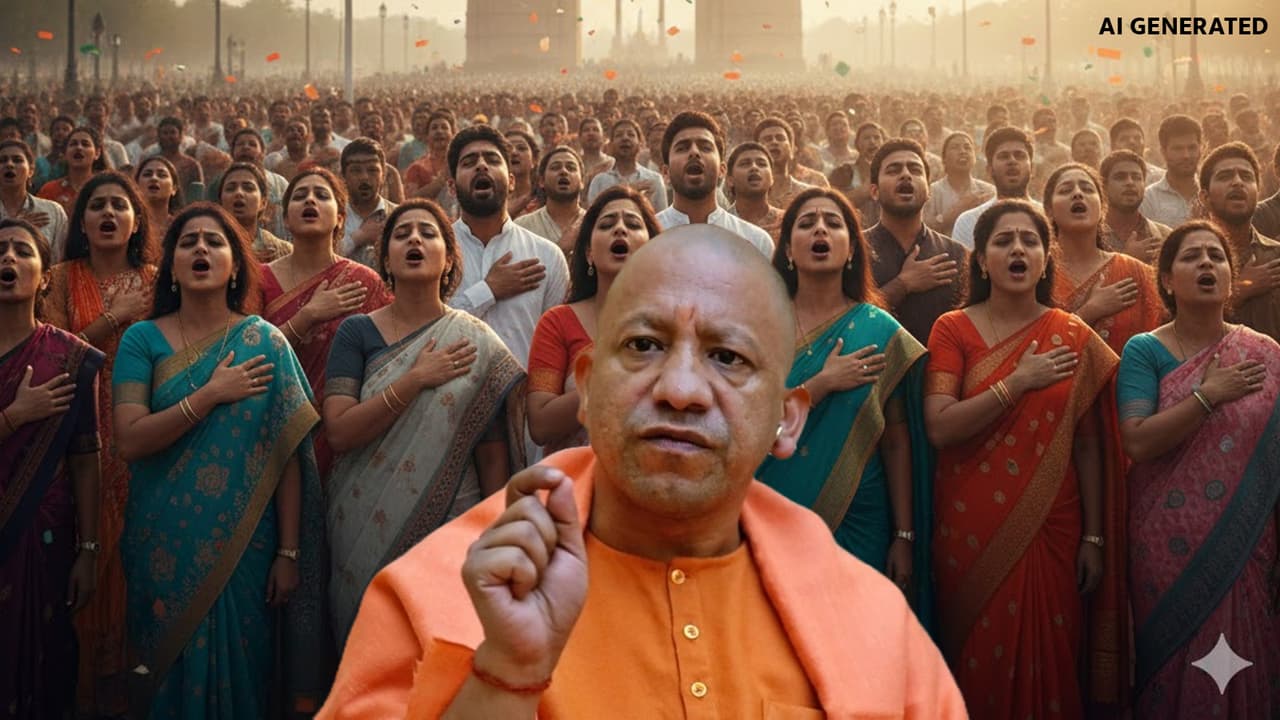
While discussing the 150 years of Vande Mataram in the Assembly, CM Yogi Adityanath held Congress and Jinnah responsible for cultural divide and partition of the country. He called it a dangerous experiment of appeasement politics.
Lucknow. Chief Minister Yogi Adityanath initiated a special discussion in the Assembly on the completion of 150 years of Vande Mataram. He held Congress and Mohammad Ali Jinnah responsible for the cultural division of India and ultimately the partition of the country. The Chief Minister said that the agreement made on Vande Mataram was not in respect of any religious sentiment, rather it was the first and most dangerous experiment of Congress’s appeasement politics.
Politics of appeasement at the root of Vande Mataram controversy
CM Yogi said that the agreement on Vande Mataram was actually a step to promote separatism. This deepened the cultural divide and later laid the foundation for the partition of the country. He said that as long as Mohammad Ali Jinnah was in Congress, there was no controversy regarding Vande Mataram.
As soon as he left Congress, Jinnah made Vande Mataram a political weapon.
The Chief Minister said that after separating from Congress, Jinnah made Vande Mataram a tool of Muslim League politics. The song remained the same, but its political agenda changed. A deliberate attempt was made to give it a communal colour.
Congress leadership chose vote bank, not the nation.
CM Yogi said that on October 15, 1937, Jinnah raised slogans against Vande Mataram from Lucknow. The Congress President at that time was Pandit Jawaharlal Nehru. After this, in a letter written by Nehru to Subhash Chandra Bose on 20 October 1937, it was said that this issue was “alarming” the Muslims. The Chief Minister called it an open acceptance of the appeasement policy of the Congress.
Decision to remove portions of Vande Mataram in 1937
The Chief Minister said that on October 26, 1937, Congress decided to remove some parts of Vande Mataram. It was called “harmony” at that time, but in reality it was a sacrifice of national consciousness. Patriots protested against this by taking out morning processions, but instead of standing with the nation, the Congress leadership stood with the vote bank.
Vande Mataram protest was purely political
CM Yogi said that on March 17, 1938, Jinnah demanded that Vande Mataram be completely changed, but Congress did not strongly oppose it. This boosted the morale of the Muslim League, intensified separatism and marked the beginning of agreement on cultural symbols.
There was neither religious dispute nor question of faith.
The Chief Minister clearly said that the protest against Vande Mataram was neither religious nor related to faith. It was completely political. He said that Vande Mataram was sung in every session of the Congress from 1896 to 1922. There was neither any fatwa nor any controversy. This song continued to resonate on every stage even till the Khilafat Movement.
Maulana Azad was also a supporter of Vande Mataram
CM Yogi said that leaders like Maulana Abul Kalam Azad were supporters of Vande Mataram. The problem was not with religion, but with the politics of some people.
Congress’s decline started from 1923
The Chief Minister said that during the Congress session in 1923, Mohammad Ali Johar opposed Vande Mataram for the first time. This protest was also not religious, but inspired by Khilafat politics. When Vishnu Digambar Paluskar sang the entire song, Johar left the stage.
Congress retreated from the national anthem by forming committees
CM Yogi said that leaving the stage was Johar’s personal decision, but bowing down to Congress became its policy. Instead of standing firmly in favor of the national anthem, the Congress formed committees and in 1937 it was decided that only two verses would be sung and that too would not be mandatory. He called it national surrender.
Recognition of fragmented Vande Mataram even in the Constituent Assembly
The Chief Minister said that the fragmented Vande Mataram which was recognized by the Constituent Assembly on January 24, 1950, was also the result of the appeasement policy of the Congress. The nation embraced the song, but Congress had already cut it.
Vande Mataram is not just a song, it is the soul of India.
CM Yogi said that Vande Mataram is not just a song but the soul of India. From the secession movement of 1905 to the freedom struggle, it has been the mantra of Prabhat Pheris, Satyagrahas and revolutionaries.
Vande Mataram echoed in every phase of the freedom movement
The Chief Minister said that Rabindranath Tagore called Vande Mataram the soul of India and Aurobindo Ghosh called it a mantra. Vande Mataram was written on the first foreign tricolor hoisted by Madam Bhikaji Cama. Madanlal Dhingra’s last words were also Vande Mataram.
Attempt to weaken nationalism today
CM Yogi said that the compromise made with Vande Mataram was not just an insult to the song, but a deep blow to the national direction of India. He warned that even today some political forces are trying to repeat the same divisive thinking.
Meaning of Vande Mataram: Resolve, security and prosperity
At the end of his address, Chief Minister Yogi Adityanath said that the meaning of Vande Mataram is not only to salute the motherland but also to take a pledge for its protection, prosperity and glory. He said that building a self-reliant and developed India is possible only by learning from the historical mistakes of appeasement.
Call to read Anand Math and adopt 150 years as a resolution
The Chief Minister called upon the House to understand the national consciousness by studying Bankim Chandra Chattopadhyay’s ‘Anand Math’ and adopt 150 years of Vande Mataram as a resolution for the future.