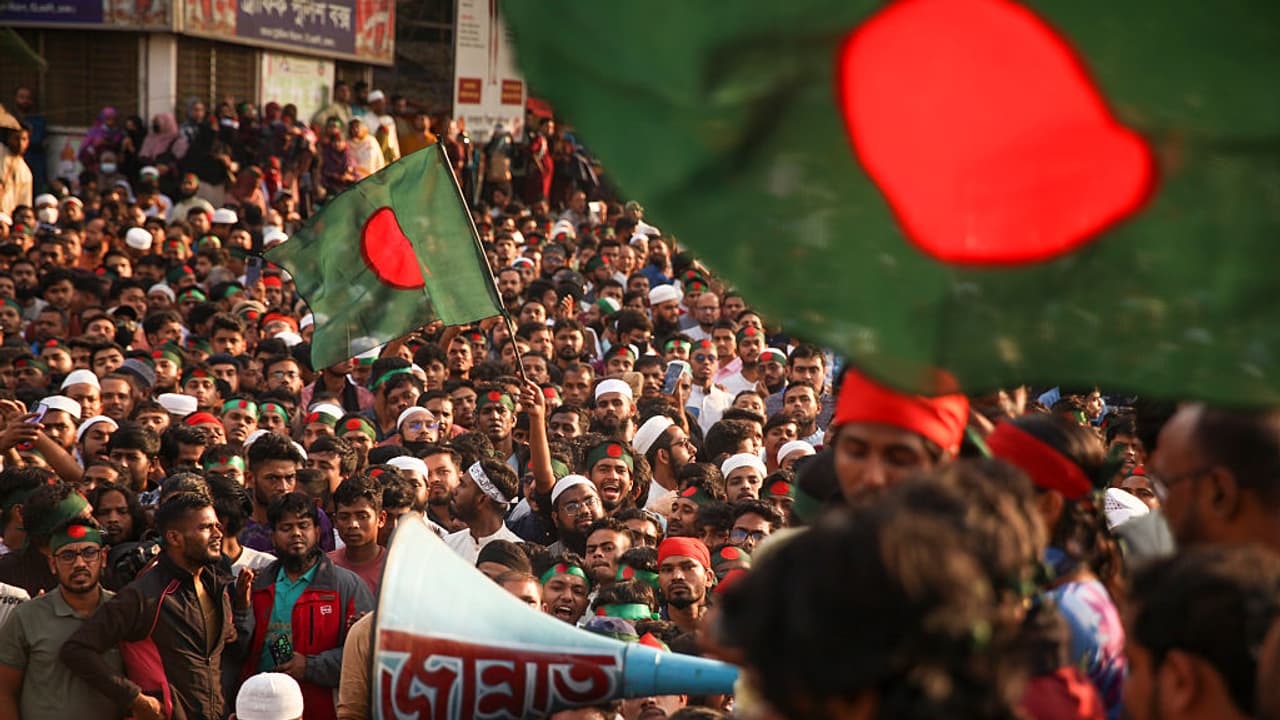
Bangladesh reels after radical activist Sharif Osman Hadi is killed in Dhaka. Rising violence, anti-India anger, media attacks and expert warnings raise concerns for Delhi ahead of polls.
New Delhi: Bangladesh is once again grappling with fear and uncertainty after the killing of radical activist Sharif Osman Hadi — an incident that has set off alarm bells in New Delhi, given the long, porous border the two countries share and the fragile political climate in Dhaka.
Hadi, a fiercely anti-India voice and a polarising figure in Bangladeshi politics, was shot in the head by masked assailants in Dhaka on Friday while launching his election campaign. He later succumbed to his injuries during treatment at a hospital in Singapore. His death has added another volatile layer to a country already struggling to steady itself after a year of unrest.
Who Was Sharif Osman Hadi?
Sharif Osman Hadi rose to prominence during Bangladesh’s 2024 student uprising, a movement that ultimately led to the ouster of former Prime Minister Sheikh Hasina and her subsequent escape to India for safe haven. As spokesperson of the Inquilab Mancha platform, Hadi became known for his radical rhetoric and strong anti-India stance, earning both fervent supporters and bitter enemies.
His killing has not only triggered anger and speculation within Bangladesh but has also reopened uncomfortable questions about rising extremism, political violence, and the country’s direction ahead of elections scheduled for February.
Indian Security Concerns: ‘A Bid to Provoke India’
Asianet Newsable English spoke to security and foreign policy experts to assess the wider implications of Hadi’s killing for India-Bangladesh relations.
Major General Sudhakar Jee (Retd) issued a stark warning, framing the violence as part of a broader strategy.
“The basic aim of the happenings in Bangladesh is to provoke and draw India into a long-drawn conflict.”
He urged restraint while stressing preparedness, advising India to avoid reactive moves.
“Wait and watch, keep its reconnaissance, surveillance, intelligence resources deployed to generate proactive options and prevent occurrence of any black-swan event. India must avoid long drawn conflict at all cost.”
For Indian security planners, the fear is not just instability next door, but the possibility of chaos spilling across the border.
Rising Anarchy and Anti-India Sentiment
Dhananjay Tripathi, associate professor at the South Asian University (SAU), said the developments are deeply worrying.
“It should be worried because anything happening in the neighbourhood is always a cause of concern and particularly the kind of things happening in Bangladesh in last one year or so, are quite alarming.”
He pointed to a pattern of violence that has persisted even after Sheikh Hasina relinquished power.
“The kind of violence that we have witnessed even after Sheikh Hasina relinquishes power. There was an attempt to target Hasina’s activists, and minority.”
Tripathi highlighted a troubling narrative emerging after Hadi’s death.
“These are a worrying kind of situation for India as India shares a long boundary with Bangladesh. In the death of Sharif Osama, there is a blame by a section of Bangladesh people that those who are at responsible position that the person who killed Osama has actually fled to India.”
Media Attacks, Minority Violence, and Diplomatic Strain
The fallout has gone beyond political rivalries. Bangladeshi media houses accused of being “pro-India” have come under attack, protests have erupted outside the Indian High Commission in Dhaka, and violence against minorities has resurfaced.
“Yesterday, we saw that some of the media houses were also attacked – blaming them of being pro-India, we have also seen protest around Indian high commission in Dhaka. All of these are worrying sign,” Tripathi said.
With elections approaching, the timing could not be worse.
“Bangladesh is supposed to be go for an election in February and this kind of violence is a worrying sign. We should be very careful and watchful of whatever is going on in Bangladesh.”
India, he added, has much at stake.
“It is something happening within Bangladesh but it will might have because we have investment in Bangladesh and also share a long border with them.”
Fear of Spillover: Proxies and Cross-Border Threats
The concern, Tripathi warned, is not limited to unrest within Bangladesh.
“When we share a long border with Bangladesh there is always a possibility that anti-India elements that we have seen recently also have made a targeted attack.”
He cautioned that prevailing anarchy could be exploited.
“The worry is the kind of anarchy is prevailing in Bangladesh that might be used by anti-India elements to do lot of anti-India activities, not merely in Bangladesh but there is a possibility that they might try to create trouble in India, using their proxies etc.”
Interim Government Appeals for Calm
Facing mounting pressure, Bangladesh’s interim government under Muhammad Yunus issued a strong appeal against violence, condemning mob attacks, intimidation, and attacks on the press.
“We strongly and unequivocally condemn all acts of violence, intimidation, arson, and destruction of properties. This is a critical moment in our nation’s history when we are making a historic democratic transition.”
The government warned against forces seeking to derail that process.
“We cannot and must not allow it to be derailed by those few who thrive on chaos and reject peace.”
Linking the elections to Hadi’s legacy, the statement said:
“The upcoming elections and referendum are not merely political exercises. They are a solemn national commitment.”
Press Freedom and Minority Safety Under Spotlight
The interim administration also addressed attacks on journalists and minorities, striking a conciliatory tone.
“This promise is inseparable from the dream for which Saheed Sharif Osman Hadi. Honouring his sacrifice and memory demands restraint, responsibility, and abiding commitment to reject hatred. To the journalists of The Daily Star, Prothom Alo and New Age: we stand with you.”
In a rare direct condemnation, the government added:
“We are deeply sorry for the terror and violence you have endured. The nation has witnessed your courage and tolerance in the face of terror. Attacks on journalists are attacks on truth itself. We promise you full justice. We wholeheartedly condemn lynching of a Hindu man in Mymensingh.”
“There is no space for such violence in new Bangladesh. The perpetrators of this heinous crime will not be spared. At this critical hour, we call upon every citizen to honor Saheed Hadi by rejecting and resisting violence, incitement and hatred.”