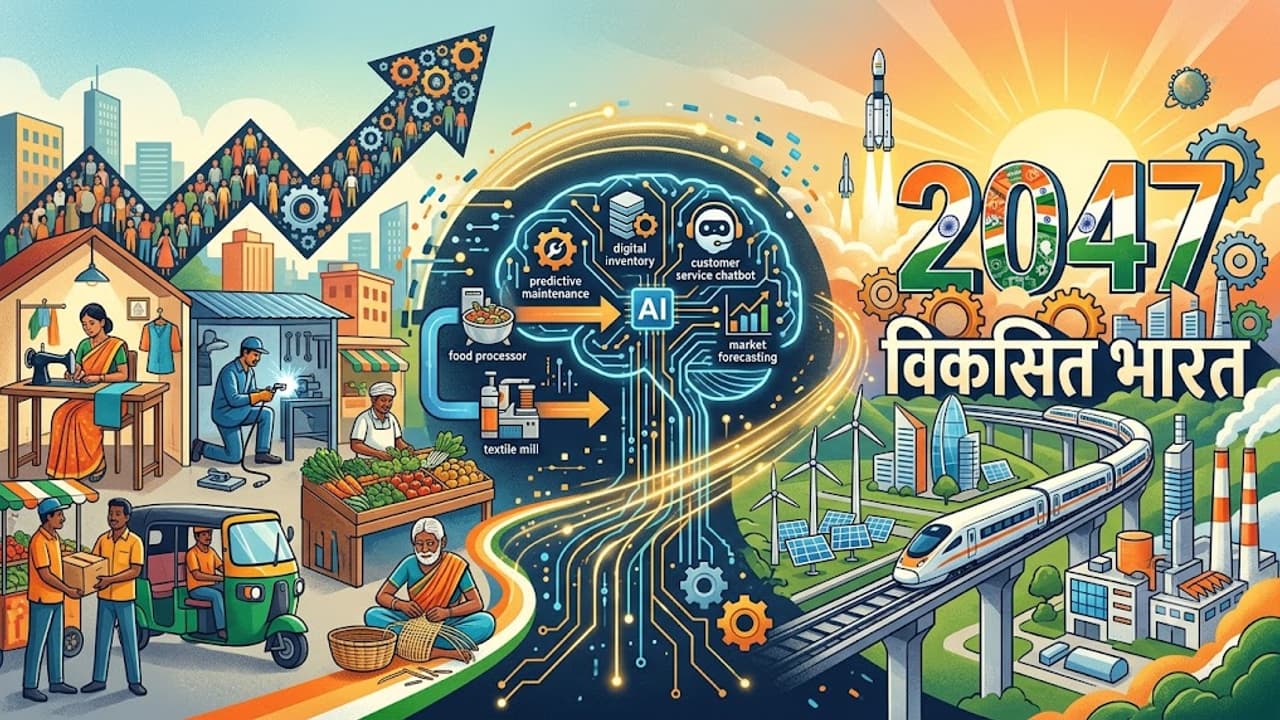
On MSME Day, India’s micro, small and medium enterprises stand out as a key force behind economic growth, employment and innovation. Policy reforms, easier credit, digital formalisation and entrepreneurship schemes have strengthened the sector over the past decade.
India’s MSME story is, in many ways, India’s own story. On MSME Day, the occasion is not merely to celebrate a business category but to recognise the millions of small entrepreneurs who have quietly sustained livelihoods, local production and social mobility across the country for decades. In India, this story begins long before the acronym “MSME” entered official vocabulary; it begins with the village artisan, the repair shop, the small trader, the food processor and the family-run workshop that kept local economies alive with limited capital and almost no institutional backing.
From invisibility to policy recognition
For a long time, India’s small enterprises were economically indispensable but administratively under-recognised. The MSMED Act, 2006 marked the first major step in giving these enterprises a formal legal identity through classification criteria linked to investment in plant, machinery and equipment. However, a decisive shift came in 2020, when the Government of India revised the definition to make it more universal and adopted a composite criterion based on both investment and turnover, while removing the distinction between manufacturing and services increasing the ambit of investment for MSMEs to range between ₹1 crore to 50 crore and turnover between ₹5 crore; up to ₹250 crore. This revision was more than a technical exercise. It acknowledged that growing firms should not be penalised for scaling up and that the policy ecosystem must support expansion, competitiveness and formalisation rather than trap enterprises in artificial ceilings.
Why MSMEs are the backbone of the economy
The phrase “backbone of the economy” is often overused, but in the case of MSMEs it is fully deserved. The sector contributes around one-third of India’s GDP, accounts for a significant share of manufacturing output, and contributes strongly to exports. It also supports employment for tens of crores of Indians, making it one of the country’s largest sources of livelihoods after agriculture.
These numbers matter politically as much as they matter economically. Every constituency in India has an MSME story: a coir unit, a machine shop, a tailoring centre, a transport operator, a food processing cluster, a digital service startup or a women-led self-help enterprise trying to become market-ready. When MSMEs grow, employment expands locally, migration pressure eases, household consumption improves and social aspiration rises. When MSMEs struggle, the effects are immediate and visible in jobs, incomes and community stability.
The decadal transformation
Over the last decade, the policy direction for MSMEs has become more explicit, more digital and more tightly aligned with the national economic strategy. The Union government has pushed on four broad fronts: credit access, formalisation, entrepreneurship promotion and competitiveness. The result is a far more active ecosystem for small business than India has known in the past.
On credit, the architecture of support has widened. Collateral-free and guarantee-based lending has been strengthened, and the framework for supporting larger loans to eligible borrowers has expanded. Flagship programmes such as MUDRA and Stand-Up India have widened the pipeline for first-generation entrepreneurs, women, SC/ST borrowers and nano-enterprises that often evolve into formal MSMEs over time.
Crucially, this shift is visible in outcomes, not just in policy intent. Pradhan Mantri Mudra Yojana, launched in 2015, has over the years enabled more than 52 crore loans, channeling roughly ₹32.6 lakh crore into crores of tiny enterprises in trading, services and manufacturing – each loan nudging an informal activity towards a more stable, bank-linked business. The Prime Minister’s Employment Generation Programme has assisted upwards of 9.6 lakh micro-units with more than ₹25,000 crore in margin-money subsidy, translating into an estimated 78 lakh new jobs across rural and semi-urban India. Stand-Up India, by steadily scaling sanctioned amounts to in excess of ₹61,000 crore and expanding women accounts to nearly two lakh, has converted targeted credit into thousands of SC, ST and women-led enterprises that would otherwise have remained outside the formal lending system. Taken together, these schemes tell a coherent story: government-backed credit has flowed in unprecedented volumes to the grassroots, supported several lakh new MSME units with tens of thousands of crores in financial assistance, and turned those numbers into livelihoods, local production and more inclusive wealth-creation on the ground.
On formalisation, Udyam Registration has been one of the most consequential reforms in the MSME space. Introduced with PAN and GST-linked verification, it simplified the registration process and brought enterprises into a system where credit, procurement support and scheme benefits could be delivered with greater precision. Udyam Assist extended this logic by helping informal micro-enterprises move towards recognition and credit inclusion.
On entrepreneurship and livelihoods, the Prime Minister’s Employment Generation Programme has remained a key instrument, with expanded project limits making it possible to support larger and more viable units. In parallel, programmes such as PM Vishwakarma have explicitly recognised that India’s traditional artisans must not be left outside the development story, and that heritage skills belong within the modern MSME framework.
On performance and competitiveness, newer initiatives have signalled a shift from fragmented support to systemic performance improvement through institutional strengthening, market access and state-level reforms. Cluster development, lean manufacturing, quality certification and marketing support all reflect a growing policy understanding that MSMEs must be made globally competitive, not merely locally survivable.
MSMEs in the age of AI and deep tech
The next chapter of the MSME story will be written in the language of technology. Artificial intelligence, data systems, automation, digital design, advanced materials and Industry 4.0 are no longer themes relevant only to large firms or venture-funded startups. They are becoming central to the survival and competitiveness of MSMEs as well.
This transformation is already visible at multiple levels. Many MSMEs have adopted digital payments, online catalogues, social media marketing, cloud-based accounting and basic enterprise software to improve efficiency and reach new customers. Some manufacturing and export-oriented units are moving into higher-value use cases such as predictive maintenance, quality analytics, demand forecasting and digitally managed supply chains.
But the real challenge is scale. A relatively small slice of urban or export-linked MSMEs is experimenting with AI-enabled tools, while a much larger universe of micro enterprises is still at the stage of basic digitisation. That gap could become a new inequality. If AI and deep tech remain confined to a narrow upper layer of firms, India risks creating a two-speed MSME economy: one part integrated into future markets, the other trapped in low-productivity survivalism.
This is where public policy must intervene with imagination. The language of AI must be translated into practical, affordable and local use cases for small businesses: a vernacular chatbot for customer service, low-cost software for inventory prediction, plug-and-play machine sensors for workshops, digital quality control for food units, and simple compliance tools for small manufacturers. Technology adoption for MSMEs will succeed only when it is designed not as a prestige agenda but as a productivity agenda.
The challenges that still hold MSMEs back
Despite steady progress, the sector continues to face structural constraints. Credit remains uneven in practice, especially for first-generation entrepreneurs without collateral, long banking histories or sophisticated documentation. Delayed payments from corporates and government buyers continue to choke working capital, even though new receivables financing mechanisms are meant to improve the situation.
Technology adoption is also limited by low awareness, inadequate skilling and the cost of upgrading machinery or software. Regulatory complexity remains another burden; small firms still lose time navigating registrations, inspections, taxes and compliance requirements that are manageable for large firms but disproportionately costly for small ones. Market access is an equally serious constraint, because many MSMEs struggle to build brands, achieve certification, standardise quality and enter higher-value domestic or export markets.
The latest policy direction
Recent policy developments suggest that the Government of India is gradually moving from a scheme-by-scheme approach toward an ecosystem approach. Expanded credit support, deeper formalisation, larger entrepreneurship support frameworks, promotion of faster receivables financing, and continued support for cluster development together point in that direction. The emphasis is increasingly on combining finance, skilling, digitisation, market access and productivity improvement rather than treating each as a separate silo.
This direction is encouraging, but its success will depend on last-mile delivery. The real test is not the number of announcements but whether a small entrepreneur in a district town can access credit without harassment, register without confusion, find technology support without middlemen and resolve delayed payments without endless litigation. National ambition will matter only when it is matched by district-level administrative responsiveness.
A road map for Viksit Bharat 2047
If India is serious about building a developed economy by 2047, MSMEs must be placed at the centre of that mission. The future roadmap should begin with universal, data-enabled access to affordable credit, supported by strong guarantees and cash-flow based lending models that use GST, UPI and invoice histories rather than relying excessively on traditional collateral. Formalisation must be made genuinely attractive through simplified compliance, predictable taxation and integrated digital systems that reduce transaction costs for entrepreneurs.
The second pillar must be technology democratisation. India needs an MSME Tech Mission that links technology centres, incubators, engineering institutions, startups and state governments to deliver practical AI and deep-tech tools to small enterprises at scale. This should be combined with skilling programmes for owners and workers, subsidised access to software, cloud tools and cybersecurity, and sector-specific innovation support for manufacturing, services, agribusiness and traditional crafts.
The third pillar is market power. MSMEs need support to meet standards, build brands, join procurement chains and expand exports in sunrise sectors such as electronics, renewables, defence components, food processing and pharmaceuticals. Lean manufacturing, quality certification, design support and digital commerce platforms should become mainstream instruments of competitiveness rather than niche schemes.
The fourth pillar is inclusion. Women-led, SC/ST-led, artisan-led and rural MSMEs must be treated as central to growth, not peripheral to it. Schemes must combine finance with mentoring, toolkits, digital access, branding and market linkages so that social justice and economic expansion reinforce one another.
MSME Day should therefore be more than a ceremonial observance. It should be a reminder that India’s path to Viksit Bharat 2047 will not be built by large corporations alone. It will be built in workshops, market streets, rural enterprises, industrial clusters and digital micro-firms across the country. The first generation of Indian MSMEs sustained the nation with grit and improvisation. The next generation can power India’s rise with productivity, innovation and global ambition—if policy, finance and technology finally move at the same speed as entrepreneurial aspiration.