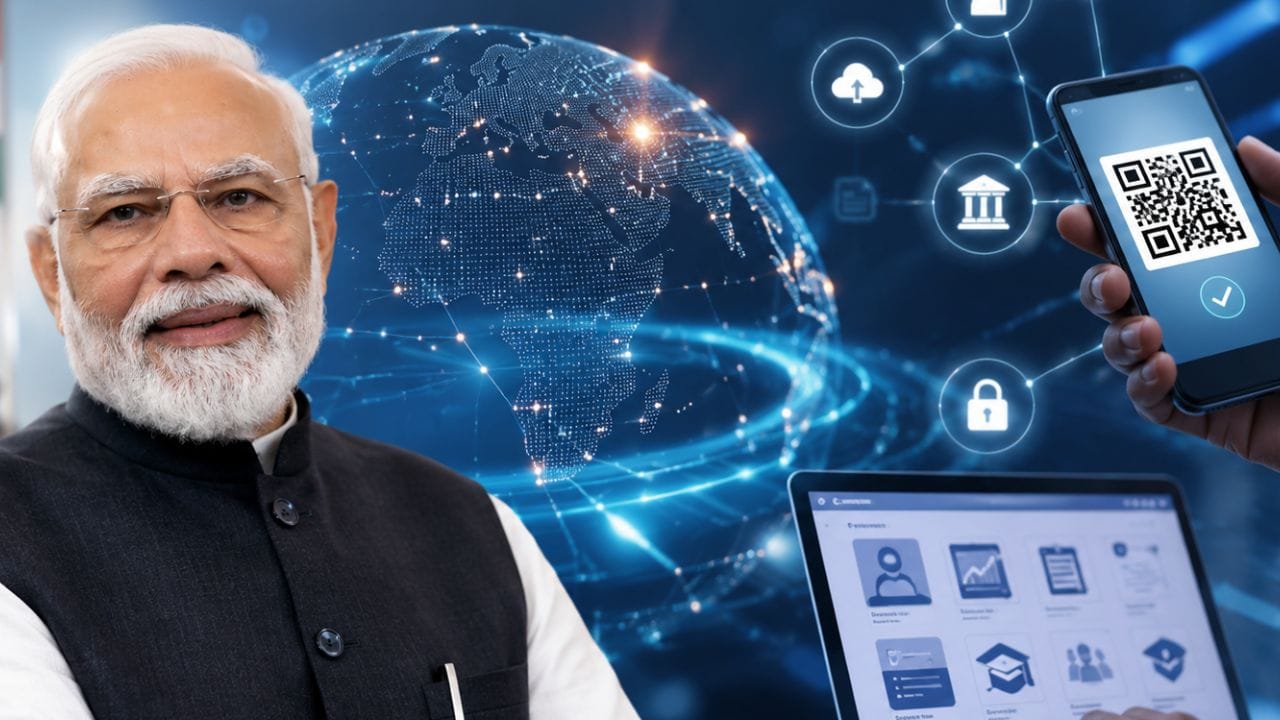
digital india
If you have made a payment by scanning the QR code from your phone after having your morning tea, then you are unknowingly a part of the big change that has changed the face of India in the last decade. India’s ‘Digital India Programme’ is going to complete its 11th year on 1st July 2026. In these 11 years, India has not only been a consumer of technology, but has also emerged as the world’s biggest leader in terms of Digital Public Infrastructure (DPI). According to the latest government data, India’s digital ecosystem is so strong today that 24 countries of the world have signed MoUs (MoUs) with India to adopt it.
UPI is ringing abroad also
There was a time when the common Indian had to stand in long queues even for minor banking facilities. Today the situation is that about 49 percent of the total real-time digital transactions around the world pass through India’s UPI alone. This technology is no longer limited to just our borders. UPI has gone live in more than eight countries from United Arab Emirates (UAE), Singapore, France, Mauritius to Sri Lanka. Due to this, India’s hold in the global fintech market has become very strong and making payments internationally has also become much easier than before.
Home delivery changed rural India
The success of Digital India is not limited to just money transactions. Its real impact has been seen in those rural and backward areas of the country, where earlier access to basic services was a challenge. Platforms like Aadhaar, DigiLocker, CoWin, e-Sanjeevani, Diksha and Umang have made it very easy for the common citizen to access health, education, agriculture and government welfare schemes. These citizen-centric services have presented a new and successful model of digital governance to the world at the international level. Now government services are directly reaching the common man’s phone.
Digital economy plays a big role in the growth of GDP.
From an economic point of view, this technology has become an important wheel of the country’s economy. At present the contribution of digital economy in India’s total GDP is about 12 to 14 percent. Experts estimate that this figure may increase to 20 percent (ie one-fifth) in the next decade. This program has not only increased digital access through nine different pillars, but has also created huge investment and new employment opportunities in the country in the fields of startups, Artificial Intelligence (AI), cloud computing as well as cyber security.
The strongest basis for the goal of developed India
Digital empowerment has now also become a part of global diplomacy. During its G20 presidency in the year 2023, India had launched ‘India Stack Global’ and ‘Global DPI Repository’, the impact of which is visible today in the digital identity and data exchange agreements signed with 24 countries. As the country is moving towards the goal of ‘Developed India 2047’, this framework of Digital India is proving to be the biggest means of technological self-reliance, inclusive development and empowerment of every citizen.