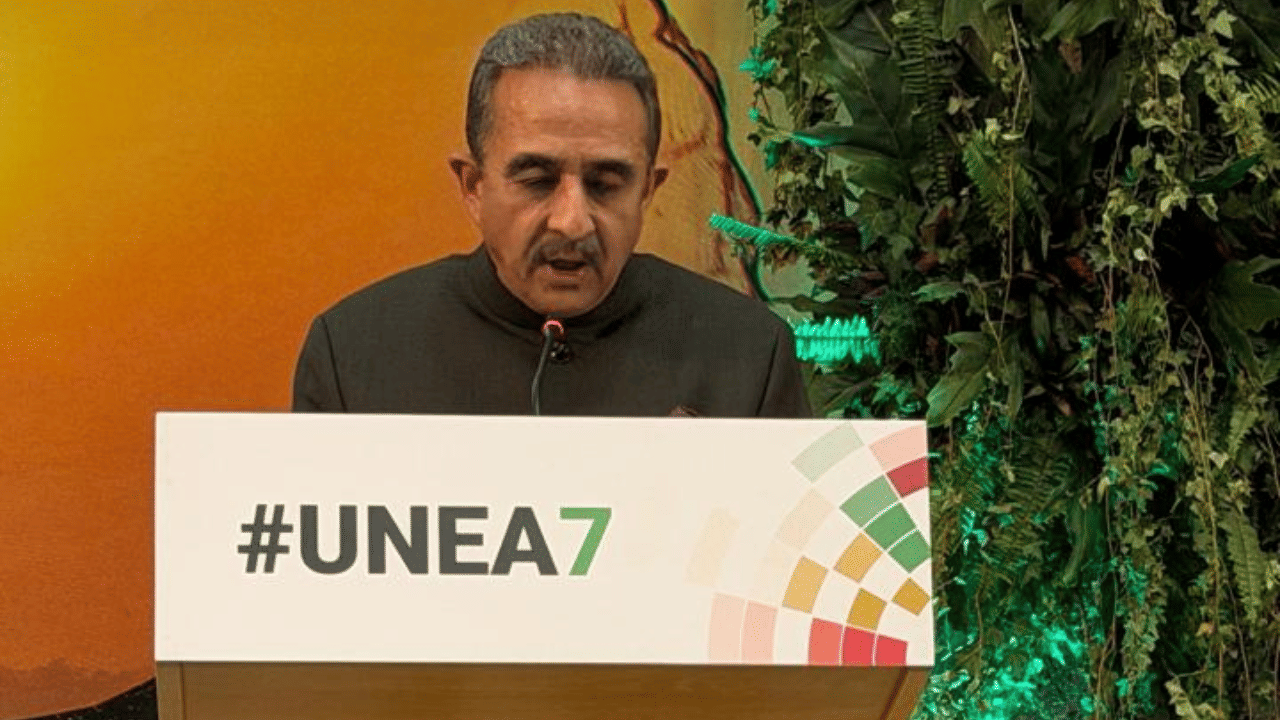
Union Minister of State for Environment, Forest and Climate Change, Kirti Vardhan Singh, delivered India’s national statement at the High-Level Segment of the 7th United Nations Environment Assembly (UNEA-7) in Nairobi on Thursday. He outlined India’s people-centred approach to environmental action, its strong domestic achievements and its unwavering commitment to the principles of Equity and Common But Differentiated Responsibilities and Respective Capabilities (CBDR-RC).
Singh thanked Kenya and UNEP for hosting the assembly and noted that the UNEA-7 theme, Advancing Sustainable Solutions for a Resilient Planet, aligns closely with India’s traditional ethos. He said the theme reflects India’s long-standing belief in living in harmony with nature and its national vision of inclusive, sustainable and climate-resilient development.
Union MoS Shri Kirti Vardhan Singh delivers India’s National Statement at High-Level Segment of #UNEA7, in Nairobi, Kenya.
India reaffirms Commitment to People-Centric, Equitable Global Environmental Action.@byadavbjp #MissionLiFE
📝https://t.co/w4CNV9iAj7 pic.twitter.com/al6QmOGJqX
— PIB | MoEFCC (@EnvironmentPib) December 11, 2025
The minister spotlighted Mission LiFE, calling it a global movement led by Prime Minister Narendra Modi that encourages mindful consumption and sustainable lifestyle choices. India’s environmental goals, he said, arise from the country’s varied landscapes and the public demand for clean air, safe water, healthy ecosystems and a secure future for the next generation.
Reiterating India’s core principles at UNEA-7, Singh said effective global environmental solutions must remain rooted in Equity, CBDR-RC and national circumstances. These principles, he emphasised, build ambition, foster trust and strengthen multilateral cooperation.
Highlighting India’s progress, Singh noted that the country has already achieved 50% non-fossil installed electricity capacity, surpassing its target. He said India’s energy transition including solar, wind, hydropower, biofuels, green hydrogen, offshore renewables and storage is transforming the country’s energy landscape. Flagship schemes such as PM Surya Ghar and PM-KUSUM are helping households and farmers access clean, affordable energy.
He also emphasised India’s ecological restoration efforts, including large-scale afforestation drives. Singh highlighted the nationwide campaign Ek Ped Maa Ke Naam, under which more than 2.6 billion saplings have been planted. He also cited river rejuvenation initiatives such as Namami Gange and India’s progress in circular economy policies through Extended Producer Responsibility frameworks.
Singh reaffirmed India’s leadership in global alliances such as the International Solar Alliance, Global Biofuels Alliance, Coalition for Disaster Resilient Infrastructure and the International Big Cat Alliance — platforms that reflect India’s commitment to the Global South.
India has also piloted a resolution on integrated fire management at UNEA-7. In conclusion, Singh said India views environmental action as a pathway to dignity and well-being, guided by the philosophy of Vasudhaiva Kutumbakam, ie, the world is one family.