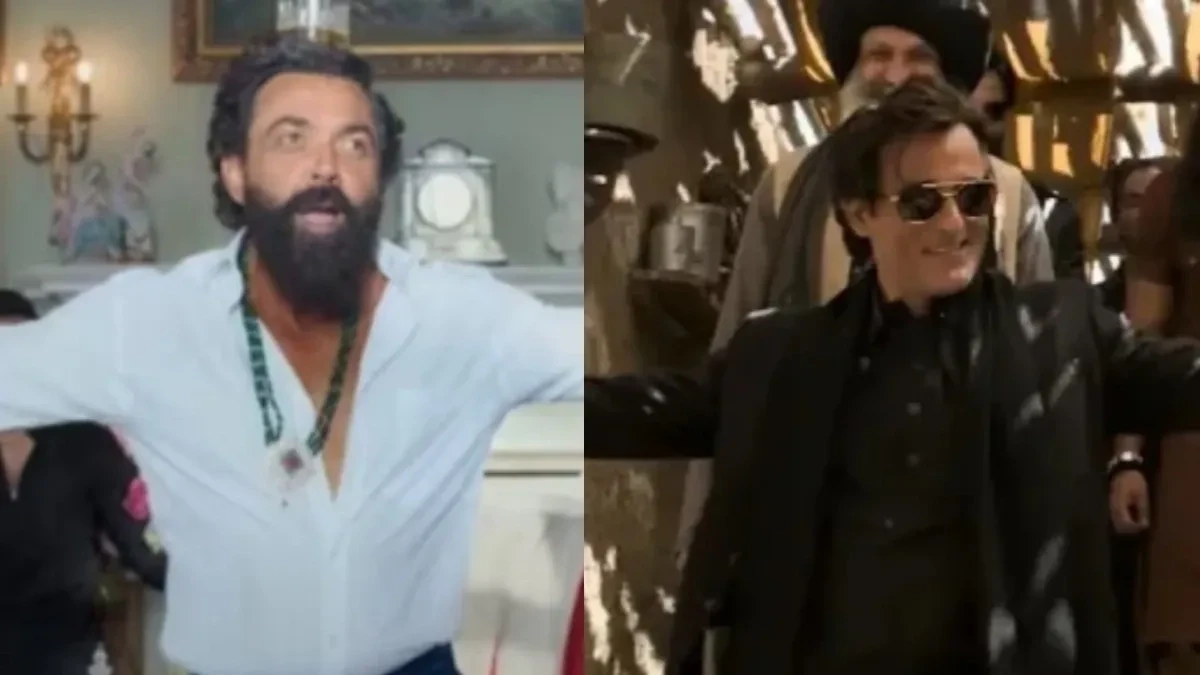
A new debate has taken over film circles and social media timelines, all thanks to two strikingly different villains. Bobby Deol’s Abrar Haque in Animal and Akshaye Khanna’s Rehman Dakait in Dhurandhar have become the centre of discussions about style, screen presence and the power of a single defining moment.
Viewers are weighing who delivered the heavier blow and which song sequence left a longer-lasting mark.
Both actors have seen their careers revived through these dark, layered roles. Fans repeatedly return to three talking points: the style each villain carries, the emotional force behind the performances and whether the characters depend on a standout scene to grab attention.
Bobby Deol’s act in Animal created a cultural ripple almost immediately. Abrar Haque’s walk, his intense stare and the unsettling calm he maintained made him a figure people tried to imitate. The Jamal Kudu moment, in particular, turned into a sensation-shared endlessly online and recreated in public events. Audiences believe this sequence shaped the character’s identity, giving him an eerie, unpredictable charm. For many, Abrar’s appeal lies in the shock he consistently brings to the narrative.
Akshaye Khanna’s Rehman Dakait, however, won hearts through a completely different approach. His performance rests on restraint-sharp eyes, tightened expressions and an intimidating stillness. The character speaks very little, and yet the silence creates a sense of danger. Viewers felt the tension rise with every small gesture, turning his presence into something quietly terrifying.
What stood out for many fans is the emotional texture Akshaye brings. Rehman Dakait isn’t built around a single viral moment; instead, his impact grows through a steady build-up. Even without dramatic scenes or loud dialogue, his portrayal has been praised for the raw feeling it carries. Supporters insist that the depth in his expressions and body language is what makes the performance linger.
Still, Dhurandhar delivered its own big entry moment. The swagger-filled introduction on the Arabic track “FA9LA” exploded online after the film’s release. The clip showcased Akshaye Khanna in a commanding light, adding a stylish layer to an otherwise brooding character. Viewers felt that the entry enhanced the arc, allowing the character to evolve more organically.
With both films out, comparisons became inevitable. Fans began placing Abrar Haque and Rehman Dakait side by side-evaluating shock value against emotional intensity, flamboyant style against controlled aggression. Many believe these negative roles have opened a fresh chapter for both actors, proving how impactful well-crafted antagonists can be.
And as discussions continue, one debate refuses to settle: the gripping unpredictability of Jamal Kudu versus the fierce swagger of FA9LA. Both moments have dug their place deep into pop culture, ensuring the villain face-off remains alive in public memory.