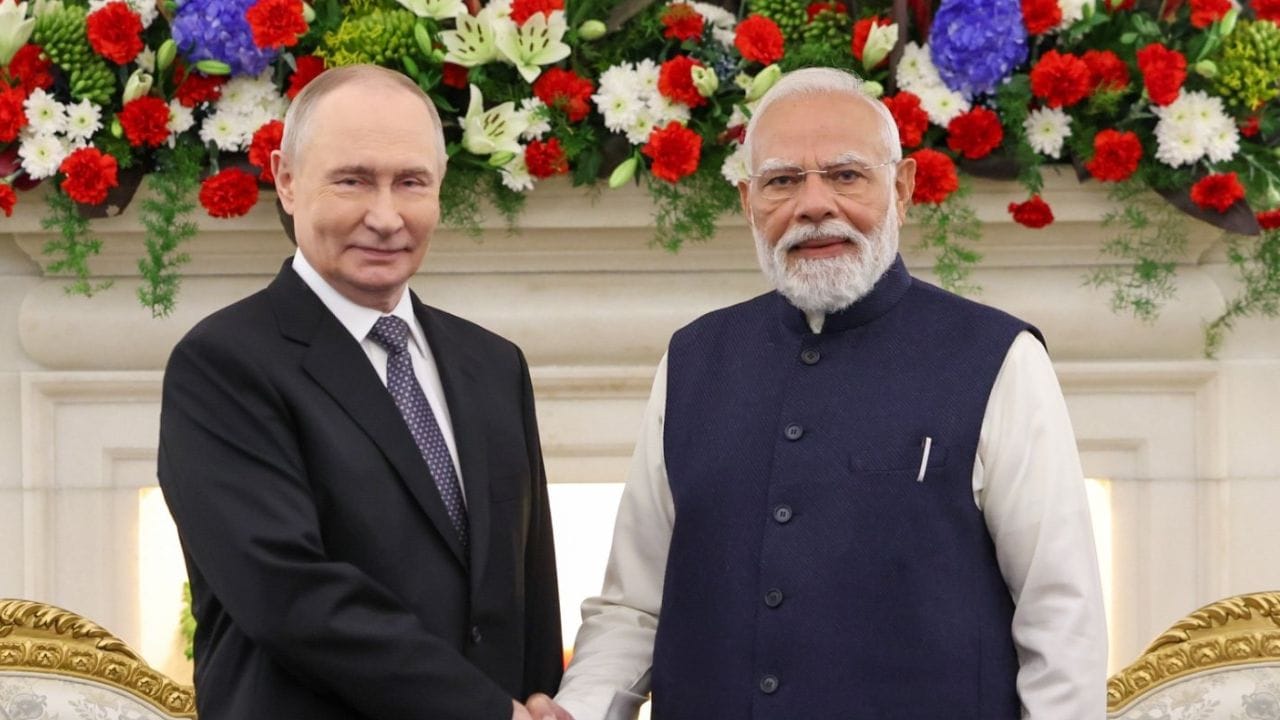
Prime Minister Modi and President Vladimir Putin
Russian President Vladimir Putin had recently come on a two-day visit to India, in which the countries have agreed to further strengthen their trade partnership beyond the scope of oil and defence. This was Putin’s first visit to India after the start of the Russia-Ukraine war. The deal that was made with Putin’s visit. How can that change the equations of the Indian economy? Also, can the impact of the tariffs imposed by America be less than this? Let us understand both these aspects.
Russian President Putin was in India between 4 December and 5 December 2025. During this period he made many important agreements with India. Which includes trade, energy and technology. Which will impact the Indian economy in the medium to long term. Both the countries have set a target of taking bilateral trade to 100 billion dollars by the end of this decade.
Sugandha Sachdeva, founder of SS WealthStreet, said in a Mint report that the outcomes of the summit are a big step towards further expanding the India-Russia partnership in strategic, economic and high-tech areas. This will change the supply chain, strengthen defense cooperation and India’s exports will see a huge expansion in the next decade.
Talk on these sectors
- Trade and economic partnership- Prime Minister Narendra Modi and Russian President Putin reiterated their commitment to expand trade in a balanced and sustainable manner. Both countries emphasized on increasing India’s exports to Russia, strengthening industrial cooperation and developing new technological and investment partnerships in high-tech sectors. Both countries welcomed the adoption of the Program for the Development of Strategic Areas of India-Russia Economic Cooperation till 2030.
- Energy Partnership- Putin assured India of continuous supply of energy. Both countries described extensive cooperation in the energy sector as a strong pillar of their strategic relationship.
- Defense cooperation- India and Russia agreed to jointly manufacture spare parts and other essential components of defense equipment in India under Make-in-India. This will include technology transfer and joint ventures. So that the needs of the Indian Army are met and it can also be exported to third countries.
- Nuclear energy cooperation- The two countries discussed the possibility of building a second nuclear power plant in India with Russian-designed reactors.
- New fertilizer factory- According to PTI, RCF, IPL and NFL have signed an MoU with Russia’s Uralchem to set up a new greenfield urea factory at a cost of $1.2 billion.
Will the impact of America’s tariff increase be less?
This summit took place at a time when India is facing 50% tariff burden on its exports to America. US President Donald Trump has imposed punitive tariffs on Indian goods due to India buying Russian oil. Experts believe that the India-Russia agreement will bring benefits for the economy in the medium to long term, but the India-US trade agreement is still very important to curb the country’s trade deficit and the weakening of the rupee.
V.K., Chief Investment Strategist, Geojit Investments. Vijayakumar said that the target of $100 billion trade by 2030 is a bit optimistic. Many important agreements will create opportunities to increase trade. Removing non-tariff barriers is also an important step. But the problem is that there is not a strong rupee-ruble settlement system and the SWIFT ban on Russian banks is another hindrance. India-Russia agreements are good, but they cannot compensate for trade tensions with the US. A balanced India-US trade agreement is extremely important to prevent trade deficit and rupee depreciation. However, it is clear that India-Russia relations are now moving beyond their traditional energy and defence.
Also read- From medical education, free tourist visa to shipping, deals made with Russia in these sectors