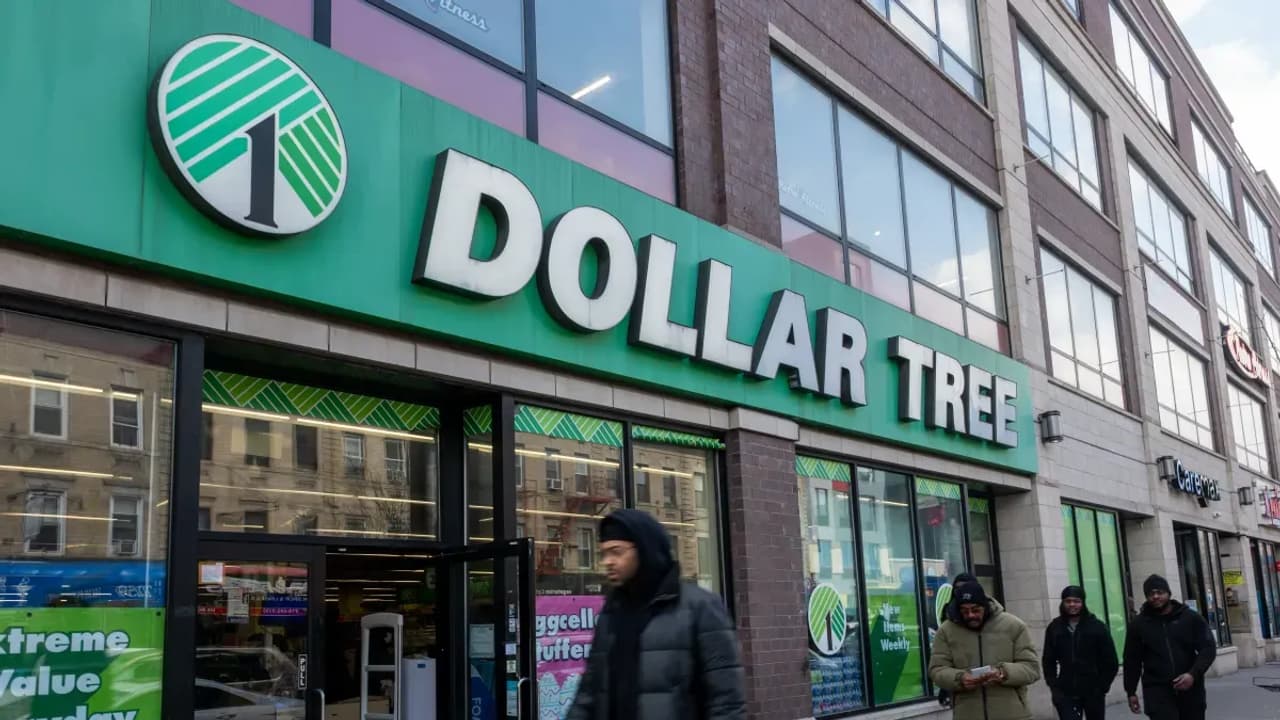
Dollar Tree, on Wednesday, in a post-earnings call, noted that its growing multi-price assortment is resonating with shoppers by helping them meet their needs.
- CEO Mike Creedon said that it has been vital for the company to ensure that multi-price skews attract more customers towards higher-income segments.
- Creedon noted that Dollar Tree added three million more households to shop in the third quarter this year compared to last year.
- Nearly 60% of these incremental shoppers came from higher-income households, those earning over $100,000.
Dollar Tree, which was known for its all-in-all $1 product offering, has now adopted a multi-price-point strategy, which is helping the struggling discount store attract customers mainly from higher-income households who are also on the hunt for lower-priced products.
Shopping at Dollar Tree now means scouring aisles that offer its traditional $1-price products as well as items ranging from $3 to $7, and sometimes even $10. This strategy has pushed the company’s margins up and is reviving the once-famous dollar store from its recent ruins.
Dollar Tree on Wednesday, in a post-earnings call, noted that its growing multi-price assortment is resonating with shoppers by helping them meet their needs and desires in the budget-constrained environment of today, which many consumers are finding themselves.
CEO Mike Creedon said that it has been essential for the company to ensure that multi-price skews attract more customers towards higher-income segments, which seems to be working.
Moving Away From Traditional Offering
Following the pandemic, which squeezed the company’s margins and hit profitability, Dollar Tree has been slowly raising prices within the budget-friendly range to rebuild its bottom line. The company said that the third-quarter results showcased October finishing strong, driven by momentum in its multi-price assortment and a great Halloween.
“Multi-Price is about evolving our assortment over time to include new, more relevant, and attractively valued items that we could not offer at a fixed price point of $1 or $1.25,” Creedon said.
The company said that the Halloween assortment generated over $200 million in sales, a record. “But to see the full impact of multi-price, let’s go back to Halloween 2022, when multi-price was still in its infancy,” Creedon said.
He noted that in 2022, multi-price represented about 3% of units sold, 10% of sales, and 7% of merchandise gross margin across its full Halloween assortment.
“Fast forward to 2025, on a 25% larger base of sales, where multi-price accounted for roughly a quarter of our total Halloween sales and merchandise gross margin, but only 8% of Halloween units sold,” he said.
Creedon highlighted that across Halloween this year, each multi-price item that “we sold generated three and a half times more profit than each non-multi-price item we sold.”
Higher Income Households: A Regular At Dollar Tree Now
Dollar Tree has always positioned itself as an affordable shopping destination for everything from daily-need products to apparel and footwear. The stores have been located in areas that tend to be more middle-class or lower-income.
But who are the biggest new shoppers for Dollar Tree currently? Creedon noted that Dollar Tree added three million more households to shop in the third quarter this year compared to last year. “Approximately 60% of these incremental shoppers came from higher-income households, those earning over $100,000,” he said.
While 30% came from middle-income households (those earning between $60,000 and $100,000), the rest came from lower-income families (those earning under $60,000).
Core Customers Still Important
Dollar Tree, however, emphasized that it is not shifting focus from its core customers, who make around $60,000 a year. “The strength of our business is still in that core customer, their purchase frequency, their comp dollars,” Creedon said.
The discount store said it was gaining market share and attracting new shoppers while continuing to serve its large base of core customers. Dollar Tree added that the core customer really had its highest comparables.
What Is Wall Street Thinking?
Wells Fargo on Wednesday said it is positive on the setup for Dollar Tree, given the potential for a strong holiday season, 2026 fiscal tailwinds, and a tariff ruling call option.
In September, Creedon said tariffs were its biggest challenge, and the expected impact from tariffs on the company’s costs had shifted to later in the year. The idea of raising prices this year was also to mitigate tariffs that took effect since the Trump Administration took office.
While Truist Securities noted that bears will focus on slightly negative traffic in the quarter, the firm believes Dollar Tree was impacted by in-store disruptions and by the natural outcome of more multi-price-point products. Given the earnings growth potential and ability for shares to re-rate higher, Dollar Tree remains one of Truist’s favorite stocks for 2026.
Retail sentiment on Dollar Tree improved to ‘extremely bullish’ from ‘bearish’ a month ago, with message volumes at ‘extremely high’ levels, according to data from Stocktwits.
Shares of Dollar Tree have gained over 50% this year compared with peer Dollar General, which has gained nearly 45% year-to-date.
For updates and corrections, email newsroom[at]stocktwits[dot]com.<