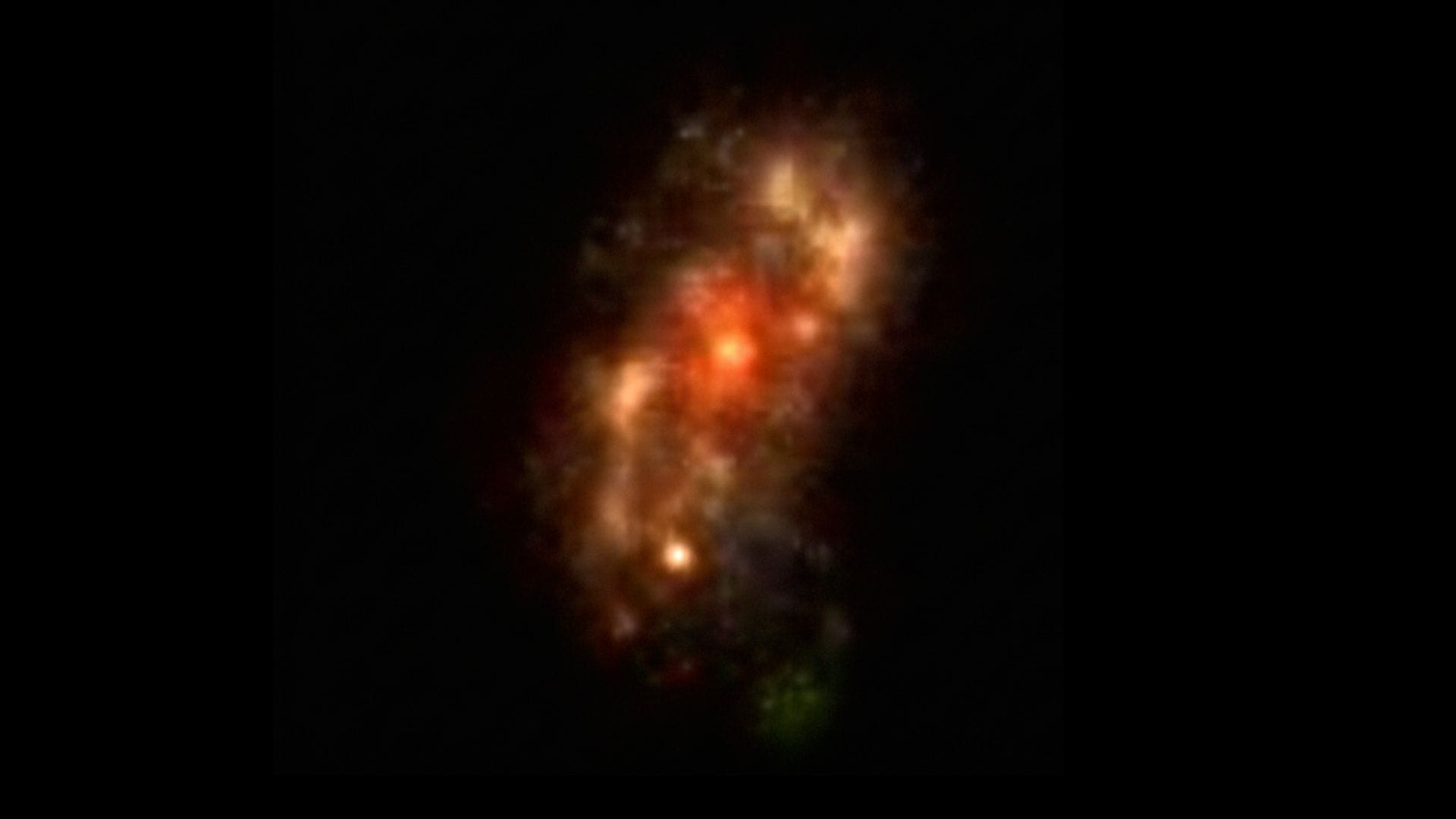
New Delhi: Indian astronomers have discovered a massive spiral galaxy that emerged within 1.5 billion years of the Big Bang. A paper describing the research has been published in Astronomy and Astrophysics. Lead author of the paper Rashi Jain says, “We’re seeing this galaxy as it appeared just 1.5 billion years after the Big Bang. Finding such a well-formed spiral galaxy at this early epoch is quite unexpected —it tells us that sophisticated structures were being built in our universe, much earlier than we thought possible.” The galaxy is located in the southern constellation of Sculptor, and was discovered in Webb observations.
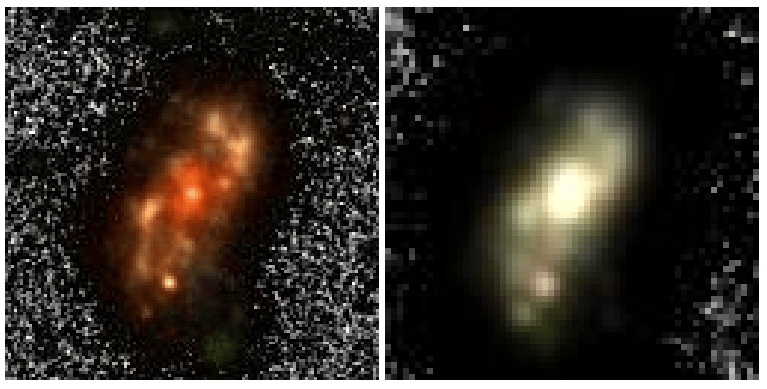
Alaknanda in UV and Optical frequencies. (Image Credit: TIFR),
The galaxy has been named Alaknanda after the Himalayan river, one of the two primary headstreams of the Ganga, with the other being Mandakini, which is the local name for the Milky Way. The name honours India’s cultural heritage as well as the resemblance of the distant galaxy to the Milky Way. A pair of well-defined spiral arms can be resolved in the galaxy, wrapping around a central bulge. The galaxy spans about 30,000 lightyears in diameter. There are also features similar to star forming regions in the spiral arms that are visible in nearby galaxies. The galaxy is a distant version of face-on ‘grand design’ spiral galaxies with well-defined spiral arms.
Alaknanda challenges conventional theories of galaxy formation
Scientists believed that the early Universe contained chaotic and clumpy galaxies, that merged together over billions of years to form the spiral galaxies. Alaknanda with 10 billion solar masses and well-defined spiral arms is only a few hundred million years old. The observation is similar to discovering a full-sized elephant in the wild that is only a few months old. The discovery of Alaknanda adds to a body of evidence gathered by Webb that indicates that galaxy evolution proceeded at a much earlier pace than previously believed, driven by processes that are not yet known.