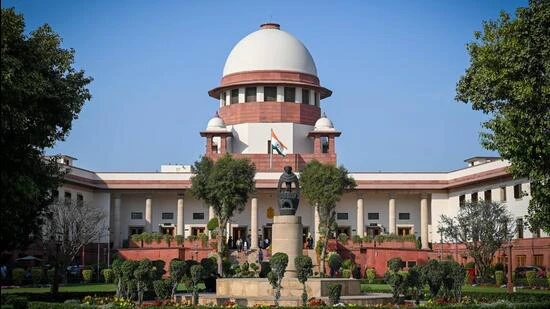
The Supreme Court on Tuesday ruled that a Muslim woman, who has been divorced, is legally entitled to recover cash, gold and other articles given to her or her husband by her parents at the time of marriage, delivering a verdict aimed at strengthening the financial security and dignity of divorced Muslim women.
Such items, the court underscored, must be treated as the woman’s property and returned to her once the marriage ends.
A bench of justices Sanjay Karol and N Kotiswar Singh said that the provisions of the Muslim Women (Protection of Rights on Divorce) Act, 1986 must be interpreted in a manner that fulfils the constitutional promise of equality and autonomy, rather than being read narrowly through a purely civil-dispute lens.
“The construction of this Act, therefore, must keep at the forefront equality, dignity and autonomy and must be done in the light of lived experiences of women where particularly in smaller towns and rural areas, inherent patriarchal discrimination is still the order of the day,” the bench held.
Emphasising that courts act as constitutional institutions committed to upliftment and gender-justice, the judgment stressed that statutory interpretation cannot be detached from social realities.
“The Constitution of India prescribes an aspiration for all, i.e. equality which is, obviously, yet to be achieved. Courts, in doing their bit to this end, must ground their reasoning in social justice adjudication,” the bench noted.
It referred to Section 3 of the 1986 Act that specifically entitles a divorced Muslim woman to “all the properties given to her before or at the time of marriage or after her marriage by her relatives or friends or the husband or any relatives of the husband or his friends.”
The court relied on Daniel Latifi Vs Union of India (2001), in which a constitution bench affirmed the 1986 Act while underscoring that divorced Muslim women must be provided with fair provision to ensure financial independence after divorce.
The ruling came as the bench allowed the plea of a Muslim woman, directing her former husband to remit ₹17,67,980 into her bank account – an amount calculated towards dower (mehr), dowry, 30 bhori (tolas) of gold ornaments and other gifts, including household items such as a refrigerator, television, stabiliser, showcase, box bed and dining furniture. It directed that payment must be made within six weeks, along with an affidavit of compliance, failing which the husband will be liable to pay 9% annual interest.
The money reflected the total valuation of property and assets given at the time of the couple’s marriage in August 2005. The couple separated in 2009 and ultimately divorced in December 2011, after which the woman invoked Section 3 of the 1986 Act seeking recovery of these items.
Setting aside the Calcutta high court’s 2022 decision that had denied her the full amount, the bench criticised the high court for relying disproportionately on evidentiary confusion surrounding entries in the marriage register, instead of considering the social-justice purpose of the law.
The bench noted that the high court had disregarded the testimony of the marriage registrar that an erroneous entry had been corrected to reflect the true record, while relying on the father’s earlier deposition given in some other proceedings.
According to the top court, the issue presented two possible interpretations but warranted intervention of the apex court because the high court had “missed the purposive construction goalpost and instead proceeded to adjudicate the matter purely as a civil dispute.”