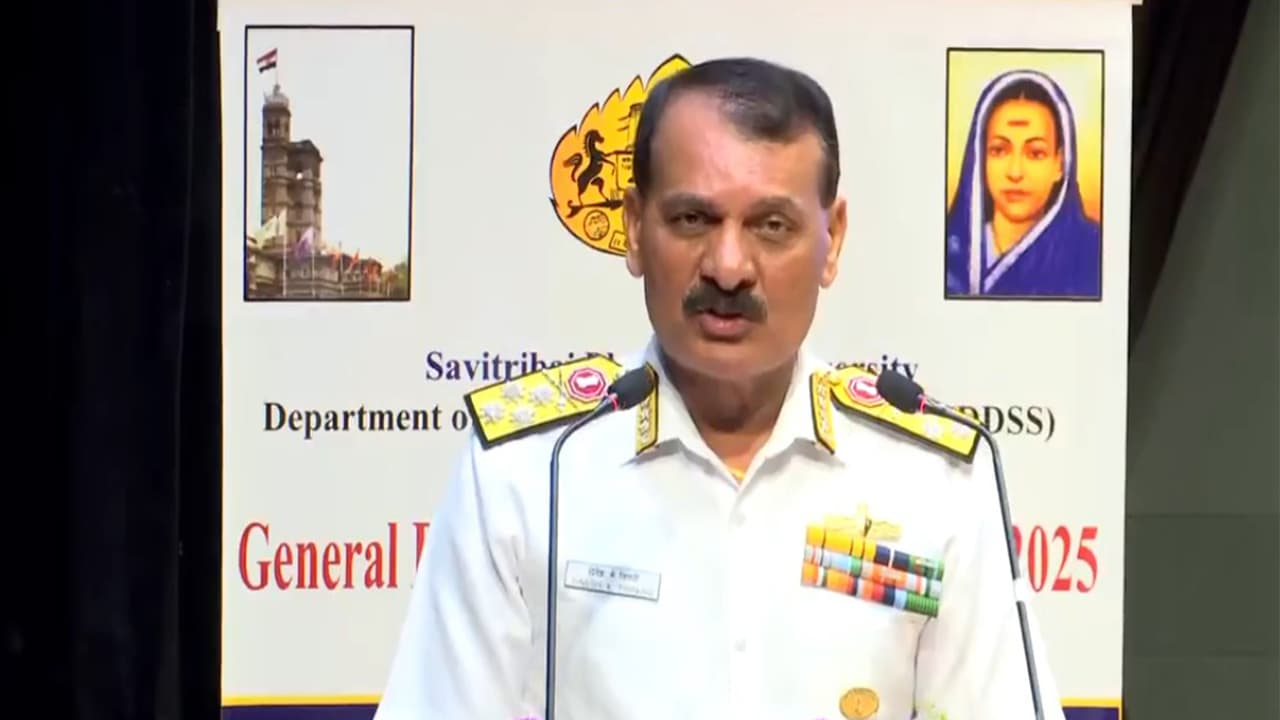
Navy Chief Admiral Dinesh K Tripathi said India’s maritime strength is central to its economic and strategic goals, including becoming a USD 5-trillion economy and a ‘Viksit Bharat’ by 2047, which will be achieved ‘at, from, and by the sea’.
India’s maritime strength will be central to achieving its economic and strategic ambitions in the coming decades, Chief of Naval Staff Admiral Dinesh K Tripathi said, stressing that the country’s rise to a USD 5-trillion economy and its goal of becoming a Viksit Bharat by 2047 will be shaped “at, from, and by the sea.”
Speaking at the Gen BC Joshi Memorial Lecture at Savitribai Phule Pune University on Monday, Admiral Tripathi underlined that India’s geography, protected by mountains in the north and surrounded by oceans on three sides, has historically given it a natural maritime character. “If you look at our geography, you’ll realise that with high mountains to the north and oceans on three sides, India’s connection with the world has been inherently maritime and will continue to be so in the years ahead,” the Navy Chief said.
A ‘Sobering Reminder’ from History
However, he noted that past kingdoms’ land-centric focus allowed European powers with superior seafaring capabilities to dominate the seas and eventually “subjugate our land,” calling it a “sobering reminder” of the cost of maritime neglect. “The landward focus of our kingdoms meant that when the European powers with superior maritime capabilities came into this area, they were able to dominate the seas and eventually subjugate our land. It is a sobering reminder that the seas that once sustained India’s ascent later led to its weakening,” he said.
Maritime Trade and India’s Economic Goals
Emphasising the scale of global ocean-based commerce, the Navy chief noted that maritime trade has grown more than fivefold in recent decades, reaching 12.3 billion tonnes in 2023, and that ships are now larger than ever. “Enhancements and advancements in the maritime sector over recent decades have ensured that global sea trade has increased by more than 5 times, reaching over 12.3 billion tons by 2023, with ships becoming larger than ever before. Therefore, today, when the sea accounts for 95% of our trade volume, our aspirations to be a five-trillion-economy by 2027, the world’s third-largest economy by 2030, and ultimately becoming a Viksit Bharat by 2047 would be achieved at, from, and by the sea,” Tripathi added.
Harnessing Maritime Resources for Transformational Rewards
He added that properly harnessing India’s vast ocean resources, through “clarity, purpose and imagination”, can deliver “transformational” rewards, boosting economic growth, strengthening strategic capacity, and accelerating the nation’s progress toward becoming a developed country by 2047. “Maritime domain is so important, it is only pragmatic to view it through the lens of resources, rewards, and risks. Resources become meaningful only when they are harnessed with purpose, and that leads us to the rewards before us. If we harness these vast maritime resources with clarity, purpose and imagination, the rewards before us are nothing short of transformation. Rewards that can elevate our economy, strengthen our strategic capability and accelerate India’s journey to becoming Viksit Bharat by 2047,” the Navy Chief said
Admiral Tripathi said viewing the maritime domain through the “lens of resources, rewards and risks” is essential as India seeks to expand its global footprint and safeguard its economic interests in increasingly contested waters. (ANI)
(Except for the headline, this story has not been edited by Asianet Newsable English staff and is published from a syndicated feed.)