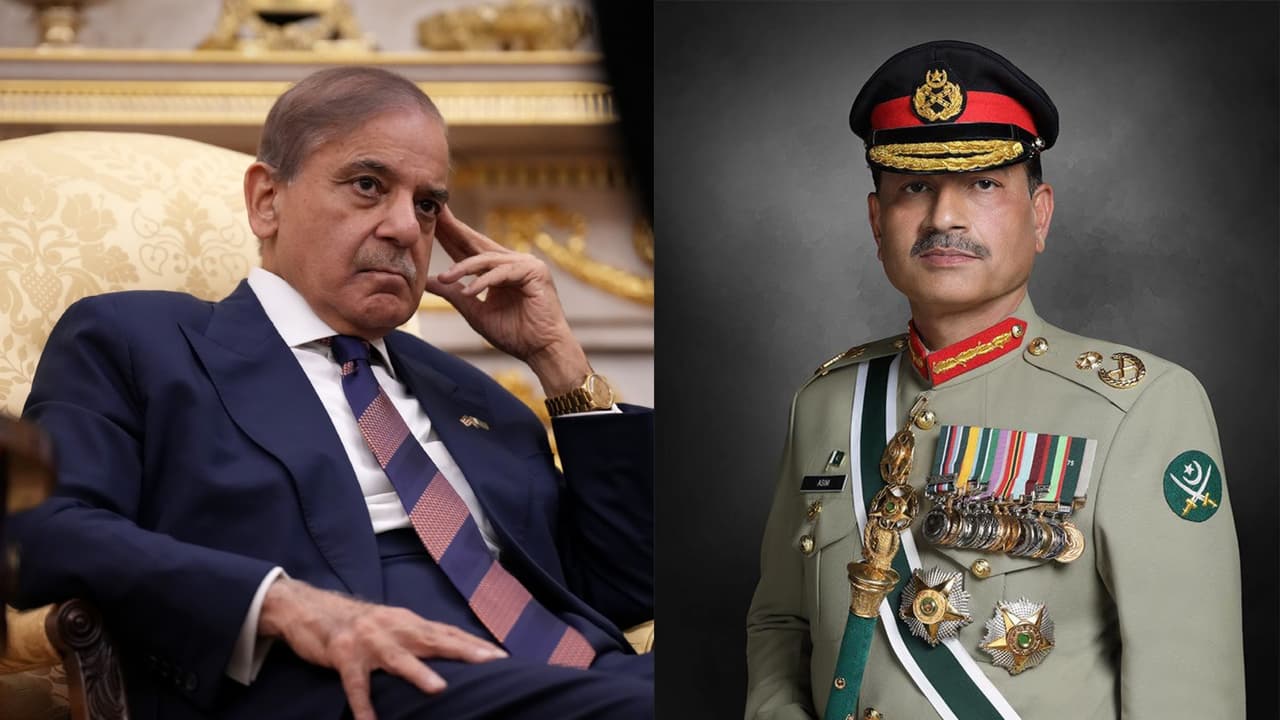
Security expert Tilak Devasher warns Pakistan PM Shehbaz Sharif’s absence on CDF notification creates army leadership vacuum, nuclear command uncertainty, and exposes political and military chaos.
Pakistan’s military and political dysfunction is on full display as Prime Minister Shehbaz Sharif deliberately avoids issuing the notification appointing Field Marshal Asim Munir as the country’s first Chief of Defence Forces (CDF). The delay has created a dangerous vacuum at the top of the country’s armed forces, exposing the fragility of a nuclear-armed state.
PM Sharif Chooses Escape Over Responsibility
Former member of India’s National Security Advisory Board, Tilak Devasher, did not mince words while explaining Sharif’s manoeuvre.
“Very smartly, Pakistan PM had gone to Bahrain and from there, he pushed off to London. He is deliberately staying out of this because he clearly doesn’t want to issue the notification giving Asim Munir 5 years as Army chief and as Chief of Defence Forces. He thinks that by keeping away from Pakistan and not having to sign the notification, he can escape the consequences,” Devasher told ANI.
Sharif’s absence coincided with the expiration of Munir’s three-year term as Army Chief on November 29, the very day the notification was due. The deliberate delay reflects Pakistan’s chronic political and administrative incompetence.
A Dangerous Constitutional and Operational Gap
Devasher warned that the failure to notify Munir has created a severe constitutional and operational crisis.
“All in all, this is a very messy state of affairs,” he said.
“If the fact remains that he (Asim Munir) is no longer the Army chief, then you have a situation where Pakistan doesn’t have an Army chief and even the nuclear command authority, which was supposed to be under the new post of Strategic Forces Command, is also not there. So, it’s an extremely strange situation that Pakistan is under at the moment,” he added.
Legal Loopholes, But No Stability
While some legal analysts argue that amendments to the Pakistan Army Act could technically extend Munir’s tenure, the situation remains murky.
“There is a lot of debate and controversy on it because his tenure finished yesterday, and as per the amendment of the Constitution, there is now a Chief of Defence Forces, and the term of the Army chief will be coterminous with the CDF and runs for 5 years. But there has to be a notification,” Devasher explained.
“Some people feel that the Army Act was also amended in 2004, under which the tenure of the Army chief was for 5 years. So, he has done 3 years and has another 2 years to go. So, they feel that no new notification is actually required,” he added.
“This is controversial, and we don’t know how the judiciary will look at it or how the government will look at it. But the fact of the matter is that this makes his position very tenuous.”
Even Pakistan’s legal loopholes cannot mask the broader dysfunction.
Military Power Struggles Intensify
The lack of decisive leadership has sparked intense jockeying within the army’s top brass.
“At the same time, there are reports that there are other Generals who are now jostling for position to become Army chief or for the two new posts of 4 stars that have been created,” Devasher said.
Meanwhile, the Prime Minister’s evasion only worsens the chaos.
“But this situation can’t continue. You can’t have a nuclear-armed country without a Chief of the Army Staff or without somebody in charge of the nuclear command authority,” he warned.
Regional and Global Consequences
Pakistan’s unstable military command is not just a domestic issue—it poses risks for the entire region. With nuclear weapons and unresolved internal power struggles, the country is dangerously exposed to both internal miscalculations and external pressure.
As the nation watches, the government’s paralysis and the army’s internal rivalries threaten to push Pakistan closer to a crisis it may not survive. The mismanagement of something as fundamental as military leadership highlights the fragility of a state that repeatedly teeters on the edge of chaos.
(With inputs from ANI)