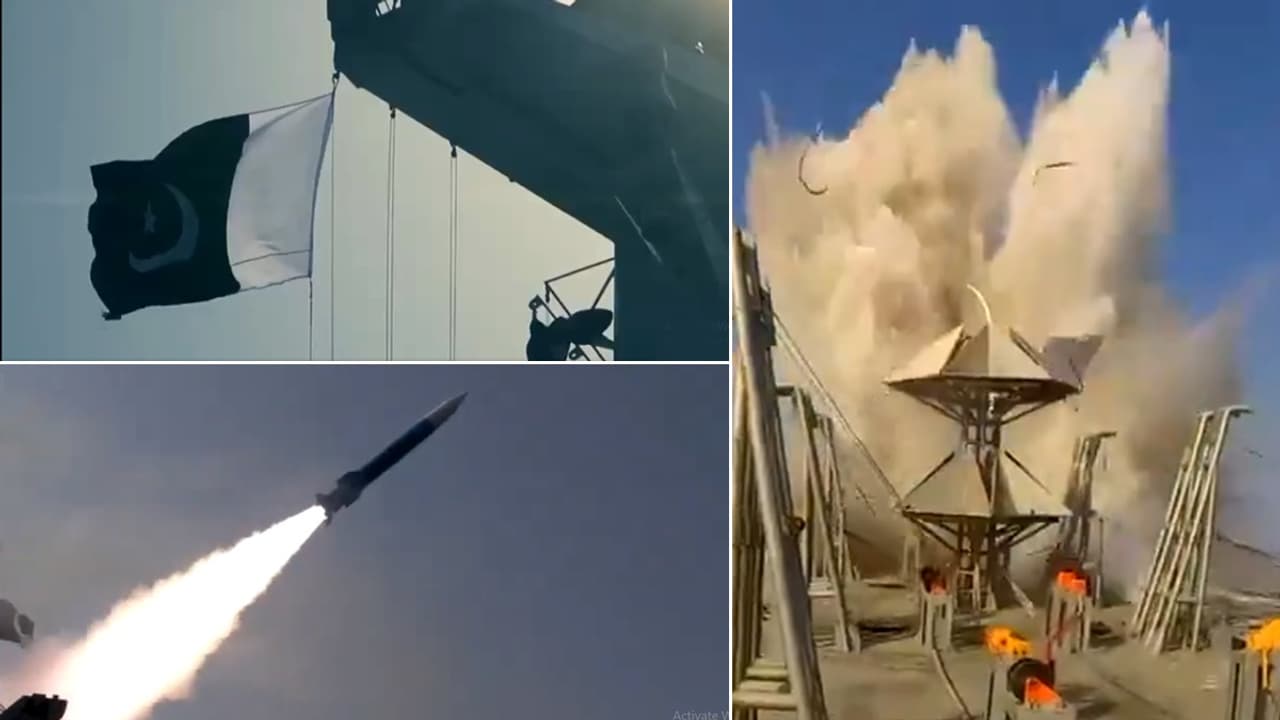
Pakistan’s hyped “carrier-killer” missile claim falls apart as ISPR offers no details, analysts call it short-range coastal weapon; India’s silent confidence exposes the propaganda game.
New Delhi: When Pakistan released a short video claiming to have test-fired a ship-launched anti-ship ballistic missile, its online ecosystem erupted in celebration.
Defence fan pages labelled it “hypersonic,” some went as far as calling it an “800-kilometre carrier killer,” and others claimed it could sink INS Vikrant before India even knew what had happened. The narrative travelled faster than the missile ever could.
But in the noise of this online celebration, one detail went almost unnoticed; ISPR — the very organisation announcing the test— said almost nothing. The official statement was so vague as to be empty.
There was no mention of range, seeker, speed or even the name of the ship that fired the missile.
The short clip avoided any wide-deck shots that could identify the platform. It showed a launch, then a distant splash at sea, with no telemetry, no tracking data, no target behaviour — none of the hallmarks of a transparent missile demonstration.
Scroll to load tweet…
Claims vs Reality: What the Missile Actually Is
What happened next revealed the real strategy. The moment ISPR posted its minimalist announcement, an entire ecosystem of Pakistan-aligned accounts began “filling in” the missing details ISPR itself never dared to put on record. Suddenly, Pakistan had developed a Mach-8 ASBM, a carrier-killing system, and a weapon that could outrange India’s navy.
None of this came from official sources. All of it came from accounts that conveniently echo ISPR narratives while giving the military deniability.
In reality, Pakistan’s P-282 SMASH system is neither new nor long-range.
Open assessments still place it in the 290–350 km category, broadly consistent with the Chinese CM-401 short-range ASBM design.
It is a coastal defence weapon, not a blue-water strike system, and nothing in Pakistan’s official communication suggests otherwise.
The transformation from a limited coastal missile into a “hypersonic carrier killer” happened entirely on social media.
India, meanwhile, did not issue a counter-statement. It did not release its own video. It didn’t even respond rhetorically. And that silence was more meaningful than any rebuttal could ever be.
Operation Sindoor: India’s Silent Power Projection
The Indian Navy had just completed Operation Sindoor, during which INS Vikrant and its escort group dominated the Arabian Sea in the aftermath of the Pahalgam attack. Indian warships operated freely; Pakistan’s largely stayed close to Karachi, issuing NAVAREA warnings instead of patrolling the open waters. Any observer who followed the situation knew the reality of the balance of power.
India demonstrated capability in the field. Pakistan tried to manufacture it online.
This is why the Indian Navy did not need to take the bait. Pakistan showcased a missile hitting a stationary, undefended barge.
India sails a carrier group protected by layers of Barak-8 missiles, MF-STAR radar, electronic warfare suites, decoys, frigates, destroyers and submarines. The gap between what Pakistan suggested and what it showed was too large for the serious defence community to ignore.
Even the core requirement for an ASBM — finding and tracking a moving carrier group in real time — is something Pakistan lacks. It lacks the satellite network, over-the-horizon sensors and fused ISR architecture needed to guide such a weapon. Without real-time tracking, the missile becomes a mathematical exercise rather than an operational threat.
In the end, Pakistan’s ASBM claim exposed itself. ISPR stayed vague. Its unofficial amplifiers went overboard. The official video avoided crucial proof. And the entire story contradicted Pakistan’s own maritime behaviour just months earlier, when its fleet hesitated to leave harbour during India’s naval surge.
India had no need to respond because the claim collapsed under its own inconsistencies.
This episode is a reminder of the new battles being fought in South Asia — not just at sea, but online. When capability falls short, some countries try to compensate with edited videos and exaggerated claims. But narrative can only go so far. Eventually, reality asserts itself.
And in this case, reality was simple. India showed strength at sea. Pakistan tried to show strength on screen.
One is a navy. The other is a story.