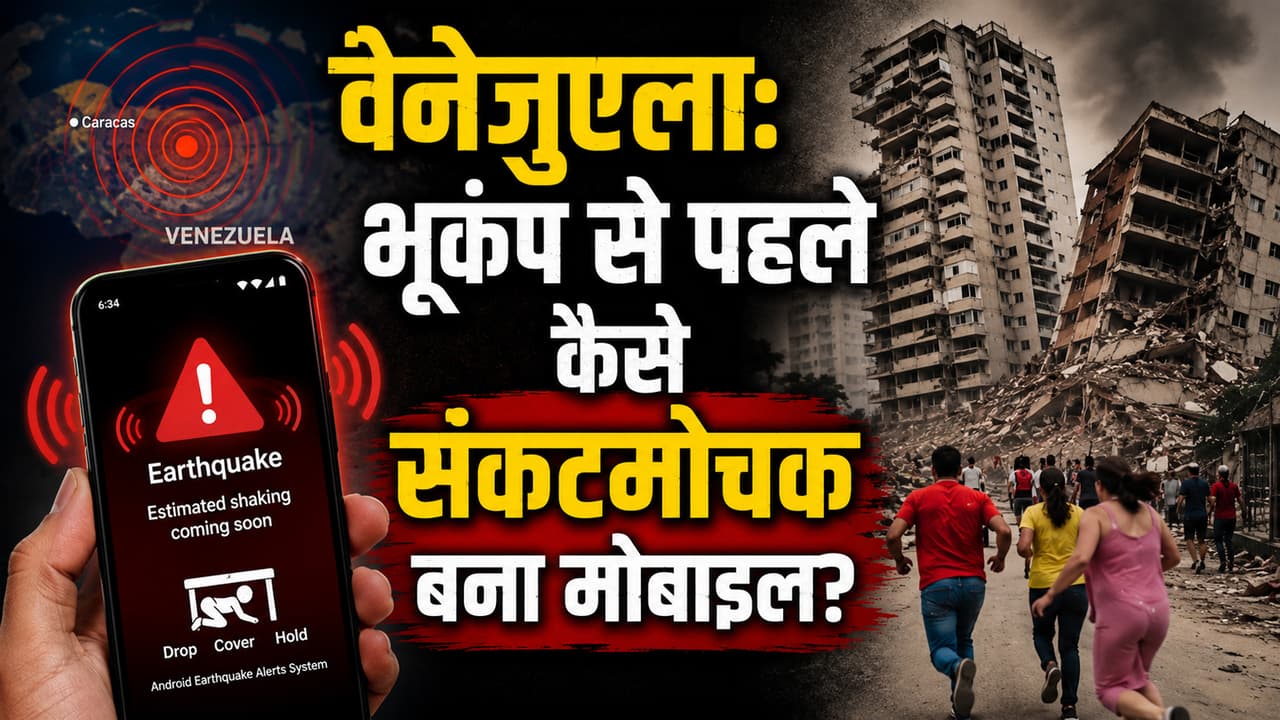
Android users got Google Alert seconds before earthquake in Venezuela. Know how this system works and why it is important.
Earthquake Early Warning System: A warning message reached millions of people’s Android smartphones seconds before a powerful earthquake struck Venezuela. Even though this warning occurred only seconds ago, it has sparked a new discussion around the world about whether modern technology can help save lives during natural disasters. Experts believe that the answer is “yes”, but there is an important technical process behind it.
Google did not predict the earthquake
First of all it is important to understand that Google did not predict the earthquake. Instead, it detected early signs of an earthquake and sent warnings to people before the main shock occurred. According to reports, Google’s Android Earthquake Alert System detected early seismic activity and sent alerts to nearby Android users before more dangerous tremors reached the affected areas.
How do Android smartphones become earthquake sensors?
This system of Google is based on billions of Android smartphones present around the world. The motion sensors and accelerometers installed in these smartphones can sense even very slight movements in the ground. According to Nikhar Arora, director of BOTS.Ai by HR Anexi, the Venezuela incident shows how advanced early warning technology has become. “Google did not predict earthquakes. It only identified early signs and issued alerts before more powerful aftershocks occurred,” he said.
Early warning is received through P-Waves and S-Waves.
According to experts, Android phones work like a large distributed sensor network. The accelerometer present in the phone first detects primary seismic waves i.e. P-Waves. These waves emerge first during an earthquake and cause relatively little damage. The S-Waves that follow are more powerful and destructive. Since P-Waves travel faster than S-Waves, the system gets a few seconds in which to send a warning to people.
How do Google’s algorithms assess earthquakes?
According to Nikhar Arora, when a large number of Android devices in the same area register similar vibrations, Google’s algorithms analyze that data. Based on this, the system estimates the possible location of the earthquake and its intensity. After this, an alert is immediately sent to the people of the affected area. This is why many times people get a warning a few seconds before they feel the main shock.
Even a few seconds of warning can save life
Although this warning window is very small, even a few seconds can prove to be extremely important in the event of a disaster. During this time, people can get out of unsafe buildings, turn off machines, stop dangerous activities or move towards a safe place. Experts say that in many cases, serious injuries and loss of life and property can be reduced with this time.
The need for early warning system is increasing with growing cities.
According to experts, as cities are expanding and infrastructure networks are becoming more complex, the importance of early warning systems is also increasing. He said that smartphones are no longer just a means of communication, but have also become an effective medium to deliver safety related information directly to people in emergency situations.
Necessary preparations for disasters like earthquake, flood and storm
Panthri stressed that disaster resilience should not be limited to climate change alone. Communities and cities also need to be prepared for earthquakes, floods, cyclones, storms, extreme heat and other natural disasters. For this, technology based warning systems can play an important role.
Use of technology is increasing rapidly in disaster management
This alert received in Venezuela is being considered an example of major changes taking place in the field of disaster management. Now, instead of relying only on traditional monitoring stations, governments, scientific institutions and technology companies are using connected devices, cloud computing and real-time data networks. This reduces response time in emergency situations and information can be delivered to people faster.
Big lesson for governments and tech companies
Experts believe that no technology can stop earthquakes, but by giving timely warning, it can definitely reduce the damage. Natural disasters are occurring more frequently and more severely around the world. In such a situation, strong cooperation between governments, scientific institutions and technology companies will be very important to create a safe and disaster-resistant society. The few seconds of warning that people in Venezuela received may seem short, but for many people these few seconds can prove to be the biggest difference between danger and safety.