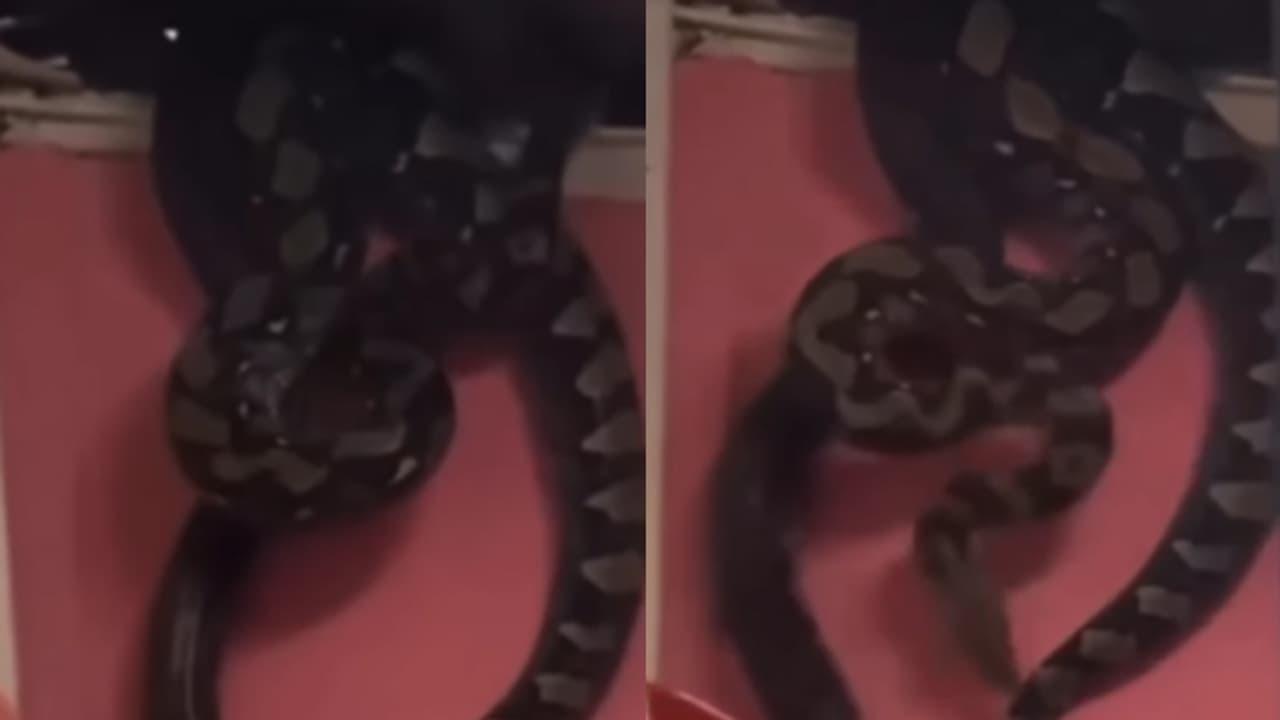
309 pythons were found in a flat in China. The police became suspicious due to the high electricity bill of the house. The investigation revealed illegal breeding and selling of pythons. A total of 436 pythons were seized in this case.
Imagine, one of your neighbors is living a normal life, but there are hundreds of pythons growing inside his house. You may not even be aware of this and everything appears normal from outside. Sounds like something out of a movie, doesn’t it? But this is exactly what has happened in China. 309 pythons were found inside a flat. And the most surprising thing is that these pythons were discovered because of the high electricity bill of the house!
This entire matter is from Taizhou city of Zhejiang province of China. Let us tell you the whole story. It started when an elderly man saw a big snake near a hill. Seeing its color and size, they suspected that it was not a common snake found in that area. He immediately informed the local authorities about this. When wildlife officials examined the snake, it was revealed that it was a python. Experts said that this species is not from this area at all. Also, snakes are generally not active outside during the month of March. Therefore, the officials suspected that it had escaped from someone’s house or farm.
This is how an interesting investigation began
The real story begins now. The police contacted professional snake keepers. He said that pythons need a constantly warm and humid environment to survive. For this, a temperature of about 20 to 30 degrees Celsius has to be maintained, due to which the electricity consumption is much more than a normal house.
Based on this information, the police started checking the electricity usage records of the houses in that area. During the investigation, officers came across the flat of a man named Guo. Guo lived alone, was not married, and had no regular job. Despite this, the electricity bill in his house was very high.
As the investigation progressed, the police found another clue. A man named Di often visited Guo’s house. He also regularly collected parcels from a courier centre. Upon further investigation, it was found that these parcels contained white rats purchased online. Rat sellers said that these rats are often bought to feed pet snakes.
Meanwhile, the police also searched Guo’s social media accounts. He often shared pictures of snakes. In some posts he had also hinted at selling the python. The investigation also revealed that Di had sold two pythons to another person for about 1,000 yuan.
I lost my senses as soon as I opened the flat.
By now the police were convinced that this case was related to illegal keeping and selling of snakes. When the police team reached Guo’s flat and opened the door, the officers were shocked to see the sight inside.
The entire flat was full of pythons. One room contained Guo’s personal belongings, while the other two bedrooms and the living room were being used for snakes. There were hundreds of plastic boxes stacked one above the other in the rooms, and each box contained one or more pythons. Upon completion of the count, officials seized a total of 309 pythons. All these pythons were later safely sent to the local zoo. Even Guo’s neighbors had no idea that there were more than 300 snakes in the flat next to theirs.
During interrogation, Guo told that he was fond of snakes since childhood. He had purchased four pythons in 2014 and was continuously breeding them. Investigation revealed that Guo and his partner Di had sold about 80 pythons. Police also arrested Deng, the shopkeeper who had previously sold four pythons to Guo in 2014. 47 pythons were also recovered from Deng’s house.
A total of 436 pythons were seized in this entire case, whose estimated value is more than 30 million yuan (crores of rupees in Indian currency). According to Chinese law, pythons are protected wildlife. Government permits are required to buy, sell, keep or transport them. Doing this without permission can result in jail.