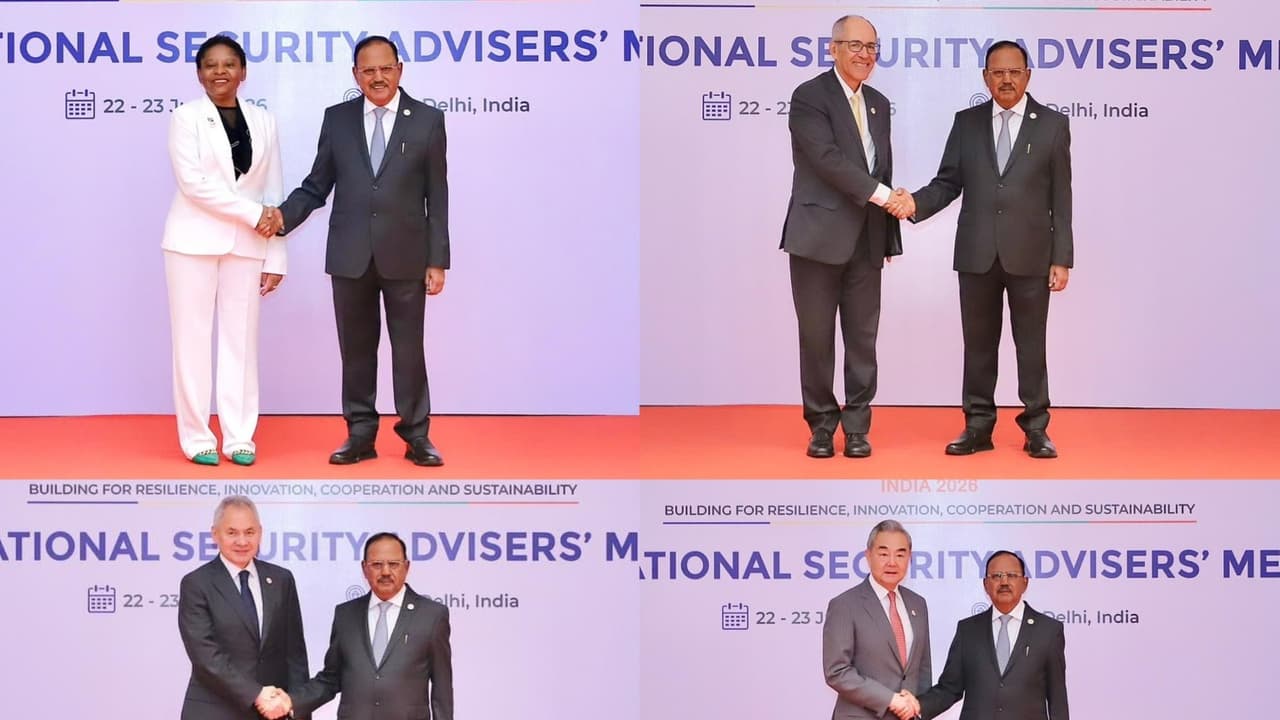
NSA Ajit Doval welcomed partners at the 16th BRICS NSA meeting in New Delhi, hailing the bloc as a special coalition. He stressed its vital role in addressing geopolitical uncertainties and strengthening the voice of the Global South.
National Security Advisor (NSA) Ajit Doval on Tuesday welcomed BRICS and partner nations at the 16th BRICS National Security Advisers’ Meeting.
BRICS comprises 11 full member nations: Brazil, Russia, India, China, and South Africa, alongside newer members Egypt, Ethiopia, Iran, Saudi Arabia, the United Arab Emirates, and Indonesia Dignitaries participating in the meeting included Brazil Secretary of Multilateral Political Affairs Carlos Marcio Bicalho Cozendey, Russian Security Council Secretary Sergey Shoigu, Chinese Foreign Minister Wang Yi, Minister in the Presidency of South Africa Khumbudzo Ntshavheni, Secretary-General of the UAE Supreme Council for National Security Ali Mohammed Hammad Al Shamsi, Head of Egypt’s State Information Service Alaa Youssef, Iran’s Deputy Secretary of the Supreme National Security Council Ghadir Nezamipour, Deputy of Geo-Economy at the National Resilience Council of Indonesia Yayat Ruyat, and Executive Director of Analysis at the National Intelligence and Security Service of Ethiopia Million Lema Tadesse.
The dignitaries also participated in a group photo with all the heads of security of all participating countries.
Doval Highlights BRICS’s Role Amid Global Uncertainties
Earlier, National Security Advisor (NSA) Ajit Doval hailed the BRICS group as a “very special coalition”, expressing elation over its growth, and stating that the member and partner economies have “got a very special role to play in this world.”
Speaking at the 16th BRICS National Security Advisers’ meeting in New Delhi, Doval said that the meeting assumes importance amid the ongoing “geopolitical uncertainties.”
“We are meeting at a very tumultuous time. The world is beleaguered by military conflicts and complex security problems. It is facing geopolitical uncertainties, economic strains, and disruptive technology. Not only that the threats are compounding, but the instruments and institutional mechanisms are increasingly finding themselves to be inadequate to resolve or mitigate these conflicts. Multilateralism is on the decline,” he said.
Strengthening the Voice of the Global South
Underscoring the evolving role of BRICS in global governance, Doval said that it was originally conceived to provide a platform for emerging economies to foster economic cooperation and strengthen the voice of the Global South.
He noted that the bloc remains dedicated to institutional reforms and a collaborative approach to international challenges. “BRICS was conceived as an informal grouping of emerging economies to a more multipolar world order. It was to advance economic cooperation and strengthen the voice of the Global South. It also envisioned reforms in global governance and institutional improvements. BRICS is a very special coalition of countries that believe in peace, progress, development, and cooperation. I’m happy to see that it is gaining strength day by day,” he said.
India’s 2026 BRICS Chairship
India’s BRICS Chairship in 2026 is its fourth, having previously held the position in 2012, 2016 and 2021. The Chairship is guided by the theme “Building for Resilience, Innovation, Cooperation and Sustainability”, reflecting a people-centric and humanity-first approach articulated by Prime Minister Narendra Modi at the 2025 Rio Summit.
BRICS currently brings together eleven major emerging economies: Brazil, China, Egypt, Ethiopia, India, Indonesia, Iran, Russia, Saudi Arabia, South Africa and the United Arab Emirates. (ANI)
(Except for the headline, this story has not been edited by Asianet Newsable English staff and is published from a syndicated feed.)