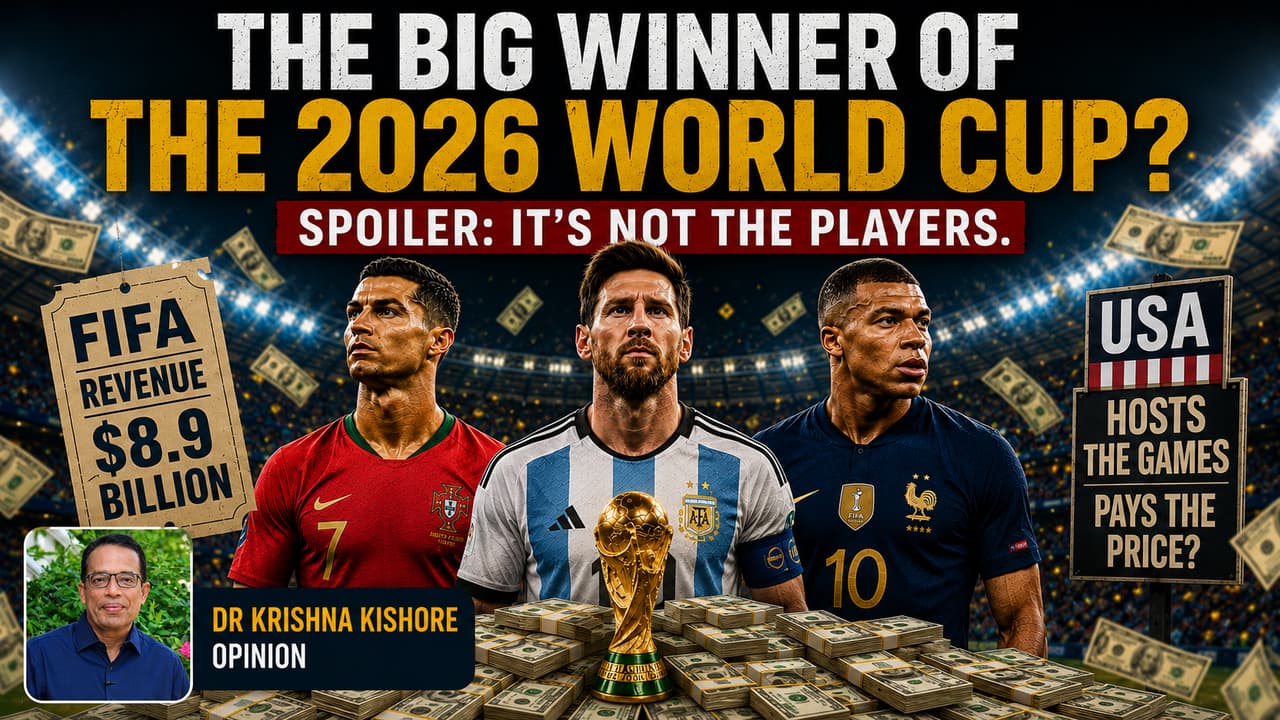
Why did Chicago reject the 2026 FIFA World Cup? An inside look at how FIFA’s $8.9 billion tournament leaves host cities paying huge costs while FIFA cashes in.
Eleven American cities opened their doors to the 2026 FIFA World Cup. New York/New Jersey, Los Angeles, Dallas, Houston, Atlanta, Miami, Seattle and others eagerly embraced the world’s biggest sporting event.
One major city did not.
Chicago said no.
Why would America’s third-largest city walk away from an opportunity to host the World Cup?
The answer has nothing to do with soccer. It has everything to do with money.
Former Chicago Mayor and U.S. Ambassador Rahm Emanuel later explained why the city refused FIFA’s terms. FIFA wanted control of revenues from ticket sales, broadcasting rights, parking, concessions and hospitality. Chicago, meanwhile, would have been responsible for security, public transportation, police, fire protection and medical services. Including police security service to FIFA President Gianni Infantino!
“We were not going to let taxpayers become the dumb money,” Emanuel said. In his view, FIFA would reap the rewards while the city absorbed the risks.
That is where the real story of the 2026 World Cup begins.
Chicago is not alone in confronting the economic realities of hosting the tournament. New Jersey, which will host the World Cup final at MetLife Stadium, offers another revealing example.
To move hundreds of thousands of fans to and from the stadium, NJ Transit had to add trains, personnel, security measures and operational support. Much of that cost falls on public agencies. The impact has been felt by travelers as well. A round-trip fare from Manhattan to MetLife Stadium that typically costs around $22 rose to $98 for World Cup service. For many families, transportation alone has become a significant expense before they even purchase a match ticket.
Supporters of the tournament argue that such investments are justified by the economic activity the World Cup generates. Critics counter that the examples of Chicago and New Jersey illustrate a broader reality: while FIFA collects much of the revenue, local governments and public agencies often shoulder many of the costs.
And there is a lot of revenue to collect.
Inside FIFA’s $8.9 Billion Money Machine
The 2026 World Cup is expected to generate approximately $8.9 billion for FIFA, making it the most lucrative tournament in the organization’s history.
The single largest source of income is broadcasting and digital media rights, which are expected to bring in roughly $3.8 billion. The World Cup has evolved from a sporting event into one of the most valuable media properties on the planet.
Another $2.5 billion is expected to come from sponsorships and commercial partnerships. Global brands such as Adidas, Coca-Cola, Visa, Hisense and Aramco pay enormous sums for the privilege of associating themselves with the tournament.
Ticket sales, corporate suites and VIP hospitality packages are expected to generate more than $2 billion. The use of massive NFL stadiums across the United States has significantly increased FIFA’s hospitality inventory and premium seating opportunities.
Beyond that, FIFA earns additional revenue from merchandise, licensing agreements, video games, data services, betting-related data rights and other commercial ventures. In modern sports, the World Cup is no longer simply a competition; it is a global entertainment, media and technology business.
What makes 2026 particularly significant is a major shift in FIFA’s operating model.
In previous tournaments, local organizing committees played a larger role. For 2026, many analysts describe FIFA’s approach as resembling a franchise model. FIFA retains control of the brand and the revenue streams, while host cities and public agencies take responsibility for much of the operational infrastructure required to stage the event.
Cities accept this arrangement because they hope to benefit from tourism, hotel occupancy, restaurant spending, transportation demand and global exposure. FIFA estimates that the tournament will generate more than $40 billion in economic activity across North America and support approximately 185,000 jobs.
Whether those projections fully materialize remains a subject of debate among observers.
Yet the biggest economic story of this World Cup may be the tournament’s expansion itself.
The 2022 World Cup in Qatar featured 64 matches. The 2026 edition has expanded to 104 matches — a 62.5 percent increase.
More matches mean more tickets sold. More broadcast inventory. More sponsorship opportunities. More hospitality packages. More advertising revenue.
Importantly, costs have not risen by the same proportion.
That is why many analysts believe the expansion from 32 teams to 48 teams was not merely a sporting decision. It was an economic one.
Put simply, the World Cup did not just get bigger on the field. It got bigger on the balance sheet.
The Real Winner of the 2026 World Cup
FIFA President Gianni Infantino has described the tournament as “104 Super Bowls.” While the comparison may sound exaggerated, it captures the scale of the business involved. A 30-second commercial during last year’s Super Bowl reportedly cost around $9 million. FIFA has effectively created 104 global spectacles capable of attracting massive audiences, sponsors and commercial partners.
There is another irony at the heart of this story.
Soccer is not America’s most popular sport. Baseball, American football and basketball still command larger domestic followings. Yet no country stands to gain more economically from the 2026 World Cup than the United States.
For one month, soccer has become a multi-billion-dollar industry across North America.
Eventually, one nation will lift the trophy. One team will be crowned world champion.
But when it comes to the economics of the 2026 World Cup, the winner is already clear.
The players are still competing for football’s biggest prize.
FIFA has already secured its own.