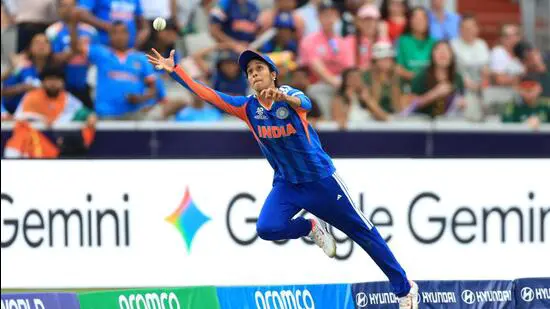
New Delhi: For all the conversations around India’s batting depth and bowling combinations at the ICC Women’s T20 World Cup, an old concern resurfaced against South Africa – fielding.
Marizanne Kapp’s unbeaten 81 off 45 balls was the innings that effectively knocked the wind out of the opposition but Kapp was given three lives – first by Nandini Sharma and then twice by Radha Yadav – and a player of her calibre made complete use of the opportunity.
She turned those reprieves into a match-winning assault, finishing unbeaten with one of the knocks for the ages and steering South Africa to a commanding total. What makes the South Africa game particularly painful is that all the dropped chances came off Kapp’s bat and she ended up punishing India for it.
The team spent considerable time in preparatory camps sharpening its catching and ground-fielding standards. Yet when the pressure peaked against one of the tournament’s strongest sides, the problem resurfaced.
Head coach Amol Muzumdar defended Radha Yadav – considered to be one of the best fielders in the Indian team and in the international circuit – after the game saying, “Look, you have only said that Radha has been an exceptional fielder, I think world-class fielder, and those two catches were – but things happen on a cricket field. Sometimes things go right, sometimes things go wrong. Unfortunately, Radha was on the other side this time, but she’s a strong character and I’m sure somewhere in this tournament she’ll make up for it.”
Dropped catches are part of the game, indeed, and Radha has built a reputation as one of India’s safest fielders but the concern is bigger than one player or one evening.
The numbers suggest India’s fielding inconsistencies have been a recurring issue and are not an isolated lapse. According to CricViz, India have taken 17 catches and dropped a total of seven, giving them a catching efficiency of 71% in the ongoing Women’s T20 World Cup. That places them sixth among the 12 teams in the tournament. South Africa, by contrast, lead the standings with a catch efficiency of 79%. Scotland (77%), Ireland (75%) and Australia (73%) sit ahead of India.
Against Pakistan, India held nine catches but dropped three, operating at 75% efficiency. They were sharper against the Netherlands, taking six catches and spilling only one for an efficiency of 86%. However, against South Africa, everything unravelled as India managed just two catches while dropping three, resulting in a catch efficiency of only 40%.
Since the 2024 Women’s T20 World Cup, India have taken 114 catches and dropped 48 in T20Is, producing an overall catch efficiency of 70%. Historically, India’s fielding standards at global events have been topsy-turvy. Their catch efficiency stood at 76% in the 2018 T20 World Cup and 79% in both the 2020 and 2024 editions. It dipped sharply to 69% in 2023 before recovering. The current tournament’s 71% suggests the team has again slipped below the standards it achieved during its better years.
Even during the lead-up to the ODI World Cup last year, India’s numbers presented a glaring gap. Between January 2024 and September 2025, their catching efficiency in ODIs was just 66% – 119 catches taken against 60 dropped. Among top-tier teams, New Zealand’s catching efficiency in that period was 79%, South Africa’s 77%, Australia’s 76% and England’s 72%.
After the defeat, captain Harmanpreet Kaur also spoke about the missed chances on the field, saying, “I think we always talk about taking opportunities at this level, but unfortunately we were not lucky enough today.”
Fielding errors often get dismissed as moments of bad luck. While Kaur and Muzumdar are right not to take outside noise as excessive criticism, when the same issue resurfaces across tournaments, formats and opposition, and in crunch games such as the ones against South Africa, it begins to look less like misfortune and more like a stubborn weakness that ought to be resolved.