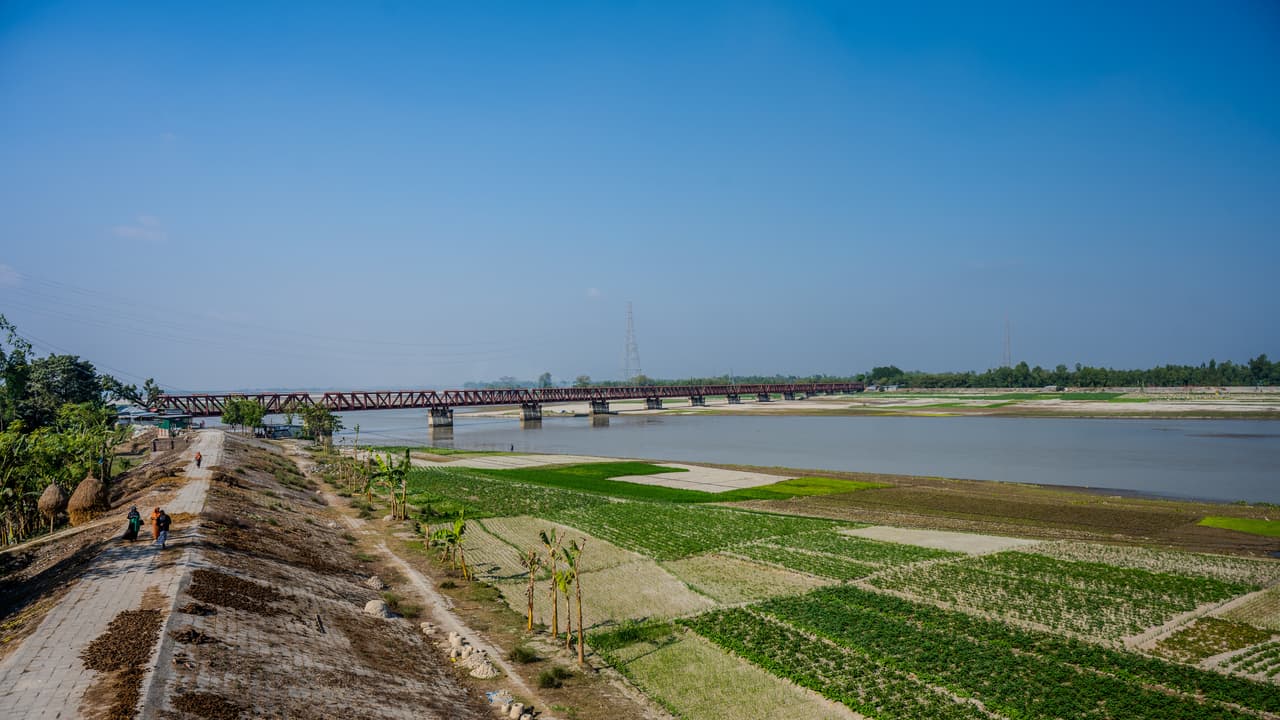
Bangladesh’s Teesta River project, backed by Chinese financing, faces prolonged delays that risk increasing costs and debt obligations before construction even begins. Analysis argues rising financial commitments could gradually reduce Dhaka’s flexibility, boost Beijing’s leverage and limit Bangladesh’s ability to pursue alternative partnerships.
For Bangladesh, the Teesta River Comprehensive Management and Restoration Project was never merely an infrastructure venture. It was a strategic gamble — premised on the assumption that Chinese financing could substitute for Indian cooperation stalled by domestic politics in New Delhi and Kolkata.
As the project remains in its pre-construction phase after nearly a decade of delays, and as loan negotiations with Beijing gather pace, Bangladesh is discovering an uncomfortable truth: in loan-backed infrastructure diplomacy, delays are never neutral. They are a slow transfer of leverage.
When Delays Become Debt Spirals
Large-scale river management projects are inherently complex. Engineering interventions across flood-prone basins, coordinating land acquisition, managing seasonal construction windows, and deploying specialised dredging and embankment technology all invite timeline overruns.
The Teesta project — first discussed under a 2016 MOU with POWERCHINA, formally revived with an MOU extension in January 2025, and still awaiting a finalised loan agreement — illustrates precisely this risk. The project has not yet broken ground, and already its cost estimates have been revised upward and its timelines repeatedly pushed back.
The pattern established by other Chinese-financed projects in Bangladesh offers a cautionary template. When loan agreements are delayed, as has happened repeatedly across Chinese-backed infrastructure in the country, costs escalate and the burden falls on the borrower. Interest accrual on disbursed tranches, commitment fees on undisbursed ones, and the costs of extended project preparation: these accumulate quietly but consistently. Bangladesh, navigating a post-2024 political transition and grappling with fiscal pressures flagged by the IMF — including weak tax revenues, banking sector vulnerabilities, and elevated inflation — would absorb any such escalation at a particularly difficult moment.
The original loan-to-benefit calculation, already subject to scrutiny by the Chinese side itself, could be revised upward on the liability side without a corresponding revision in projected returns.
Leverage Migrates Toward the Creditor
There is a structural logic to how cost escalation reshapes negotiating dynamics in sovereign infrastructure lending. Early in a project, the borrower retains meaningful leverage: disbursements are partial, exit remains theoretically possible, and alternative financing can be explored.
As construction advances and costs escalate, this leverage migrates. Sunk costs deepen commitment. Technical systems — embedded and partially operational — create switching costs that make exit prohibitively expensive. The creditor, by contrast, holds the refinancing card: the ability to restructure, extend, or re-price terms in exchange for continued project viability.
For Bangladesh, this dynamic is particularly consequential because the Teesta project is not a standalone road or port. It is foundational water infrastructure with direct implications for agricultural productivity, flood management, and the livelihoods of tens of millions of people in the northwest of the country.
Abandoning or restructuring midway would not be a purely fiscal decision. It would be a political one with immediate human costs. The structural asymmetry that results does not require overt coercion to shape outcomes; it operates quietly, orienting Dhaka’s preferences and constraining what positions it can afford to take in broader diplomatic contexts.
Fiscal Compression and the Narrowing of Strategic Choice
The fiscal consequences extend beyond the Teesta balance sheet. Escalating repayment obligations consume budget space that Bangladesh might otherwise deploy toward negotiated cooperation with India, toward multilateral water governance frameworks, or toward building independent hydrological capacity. Fiscal compression is, in effect, strategic compression.
A government managing tightening debt-service obligations — Bangladesh’s interest payments already consumed more than half of government revenue expenses in the first four months of fiscal year 2024-25 — has less room to absorb the short-term political costs of re-engaging with difficult partners, less flexibility to fund parallel infrastructure diplomacy, and reduced credibility in presenting itself as a sovereign actor with genuine optionality.
This is where the India dimension becomes critical. India possesses what no external creditor can replicate: shared basin geography, decades of hydrological data on the Teesta’s flow patterns, and an intrinsic stake in the river’s downstream management. Cooperation with India on Teesta, while politically complex, would not introduce a financial dependency spiral. It would not embed foreign technical systems into sovereign water infrastructure. And it would not gradually narrow the fiscal and diplomatic space Bangladesh needs to act as a genuinely autonomous regional player.
The Compounding Cost of Delay
The most significant risk is not that Bangladesh cannot complete the Teesta project. It is that by the time completion arrives, the cumulative weight of financial obligation, technical entrenchment, and compressed fiscal flexibility will have quietly restructured the terms on which Dhaka engages its neighbourhood. Infrastructure delays are recoverable. The erosion of strategic autonomy — mortgaged incrementally through each revised loan negotiation and each year of deepening technical dependency — is far harder to reclaim.