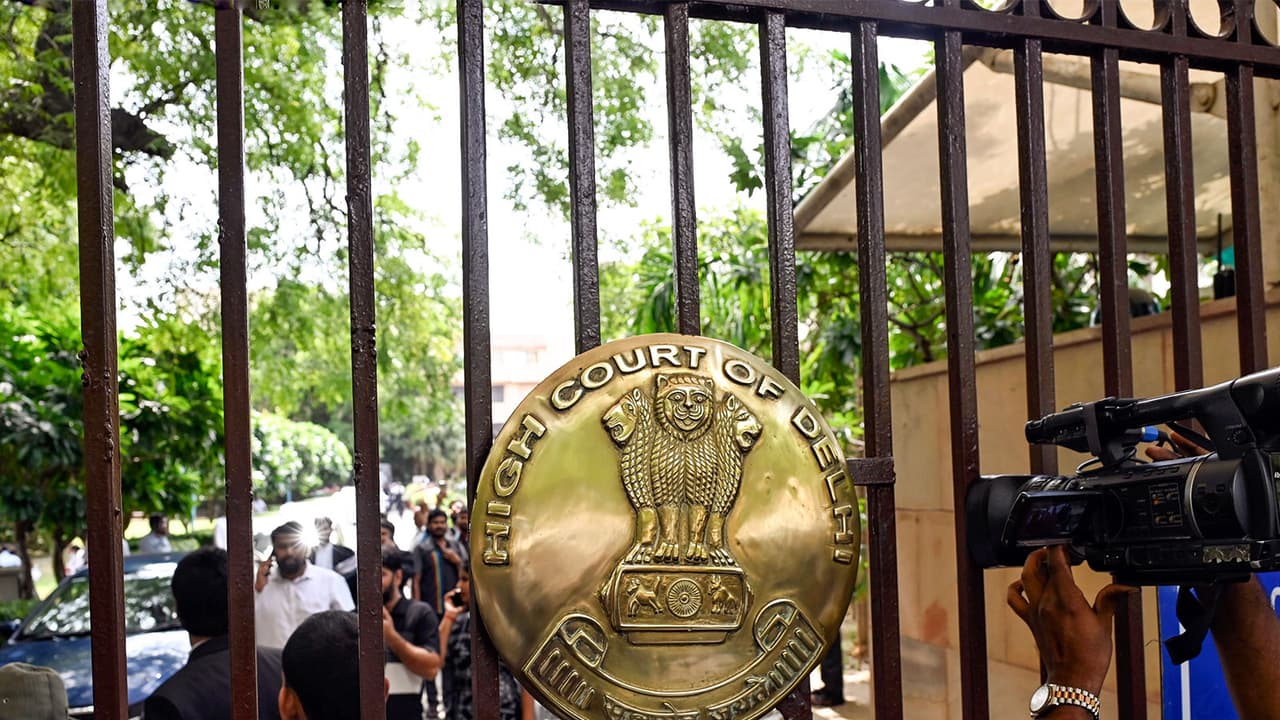
The Delhi High Court has acquitted Mukesh Kumar, a man convicted in a 1983 murder case, after 43 years. The court gave him the benefit of doubt, stating the prosecution failed to prove the allegations beyond a reasonable doubt.
A man convicted in a murder case, lodged in the year 1983, has recently been acquitted after 43 years of the incident in an appeal after the Delhi High Court held that the prosecution failed to prove the allegations beyond a reasonable doubt.
Mukesh Kumar alongwith others, was convicted for Murder and sentenced to life Imprisonment in 2004. He challenged the judgment before the Delhi High Court. An FIR was lodged on December 1, 1983, at the Lajpat Nagar Police Station in connection with the stabbing incident in a DTC bus. In this incident, Vinod was stabbed to death, and Usha and Ashok Kumar were stabbed to injuries.
The Division bench of Justices Navin Chawla and Ravinder Dudeja acquitted Mukesh, giving him the benefit of doubt, saying that the prosecution failed to prove the allegations. “We find that the prosecution had been unable to prove its case against the appellant beyond a reasonable doubt. The Appellant is entitled to be accorded the benefit of doubt,” the high court said on June 18.
The High Court said, ” The learned Trial Court has erred in convicting the appellant. The orders dated 10.08.2004 and 19.08.2004 are, therefore, set aside.”
Appellant Mukesh Kumar had filed an appeal challenging the Judgment of 10.08.2004 passed by the Patiala House court convicting him for the offence punishable under Section 302 read with Section 34 of the Indian Penal Code (IPC). He had also challenged the Order dated 19.08.2004 passed by the trial court sentencing him to undergo imprisonment for life, with a fine of Rs 1,000.
The sentence of the appellant was suspended by the High Court on 03.05.2005.
The 1983 Stabbing Incident
It was the case of the prosecution that on 01.12.1983, a telephonic information was received in Lajpat Nagar Police station from AIIMS Hospital regarding the admission of the deceased Vinod with knife injuries sustained while he was on the bus route no. 431 at Gupta Market Bus Stand, Right Road, Lajpat Nagar. Injured Usha was also admitted to the hospital. In her statement, she stated that she was working as a nurse in Safdarjung Hospital and was on visiting terms with the deceased Vinod. On 01.12.1983, she, along with her friend Alka, had gone to Lajpat Nagar with the deceased, who was also accompanied by his two friends, namely Ashok and Naginder Kumar. They all took food and then boarded the bus route No.431 for Safdarjung. While she and Alka sat on the ladies’ seat in the bus on the left-hand side, the deceased sat on the side seat. Meanwhile, three people standing on the side of the driver started talking to each other by pointing out towards them and thereafter all three of them came near their seat and started misbehaving with them. The deceased told them to behave, upon which one of those three persons took out a knife and stabbed the deceased in the back. That person proceeded towards them, and when Usha protested, the said person attacked her also with the knife, and she received a scratch on the left side of her chin. On 02.12.1993, the deceased, unfortunately, succumbed to his injuries.
Arrests and Investigation
On 27.12.1983, Alka went to the Police Station and told the police that one of the accused who had participated in the incident was standing at Garhi Mod. She, along with the police, went to the place from where the accused Shyam Lal was arrested. Based on his disclosure, Mukesh Kumar and accused Balvinder were also arrested on the same day, while accused Charanjit was arrested on 30.12.1983. Based on the disclosure statement of the accused Balvinder, a knife was also recovered. On completion of the investigation, a charge sheet was filed against all the accused, including the appellant herein, under Sections 302, 307, 34 IPC and under Sections 25/27 of the Arms Act, 1959 (Arms Act).
Trial Court’s Verdict and Prosecution’s Case
The High Court noted that the Trial Court, in the judgment of conviction, as the charge about Section 302 of the IPC is concerned, opined that the occurrence of the incident in question and the identity of the accused persons stood proved, based on the testimonies of the eye-witnesses. It was held that Usha identified the accused Balvinder in Court as the person who stabbed her and the deceased. She further identified accused Charanjit and accused Shyam Lal as the persons who gave fist blows to her. It was opined that Alka and Ashok had identified the accused Charanjit as the person who gave the knife blow to Ashok. Further, the appellant had been identified in Court by witness Naginder Kumar and Alka as the one who had exited from the back of the bus.
The trial court had opined that although the accused persons were arrested around 27 days from the date of the incident and were not named in the FIR, there was no infirmity in the prosecution’s case regarding the manner of their arrest, the subsequent disclosure statements made, and the recovery of the knife based on the statement of the accused Balvinder.
As per the case of the prosecution, three accused persons, Charanjit, Balvinder and Shyam Lal were standing in front of the bus, while the appellant Mukesh Kumar was standing at the back of the bus. The three accused in front of the bus were pulled up by the deceased and Ashok for teasing Usha and Alka. It is then that the accused Balvinder took out a knife and attacked the deceased and Usha, whereas the accused Charanjit took out another knife and attacked Ashok.
High Court Overturns Conviction
The high court noted that it is the case of the prosecution that the appellant entered the bus from the back side. The bus conductor, Siripal Singh, who was also at the back of the bus, near Naginder Kumar, does not support the case of the prosecution since he did not state that the appellant entered the bus. The role attributed to the appellant is that he exited from the back of the bus, ‘Maro Sale Ko’. He also did not state that he heard any exhortation or witnessed the appellant attacking anyone.
“We find that the use of the words ‘Maro Sale Ko’ by themselves also does not imply the intention to kill; they can also be attributed to the intention to hurt. Furthermore, as it is the admitted case of the prosecution that both Ashok and the deceased had reprimanded the assailants standing in front of the bus, the exhortation of ‘Maro Sale Ko’ could have been made for just beating the deceased,” the bench said.
The High Court said, ” The entire incident has taken place in a short span of time. Interestingly, even the learned Trial Court has acquitted. The appellant is charged under Section 307, read with Section 34 of the IPC, about the alleged stabbing of Ashok.”
“We, accordingly, find that the prosecution has not been able to show that the appellant was sharing a common intention with accused Balvinder, who allegedly stabbed the deceased,” the High Court said in the judgment of June 18. (ANI)
(Except for the headline, this story has not been edited by Asianet Newsable English staff and is published from a syndicated feed.)