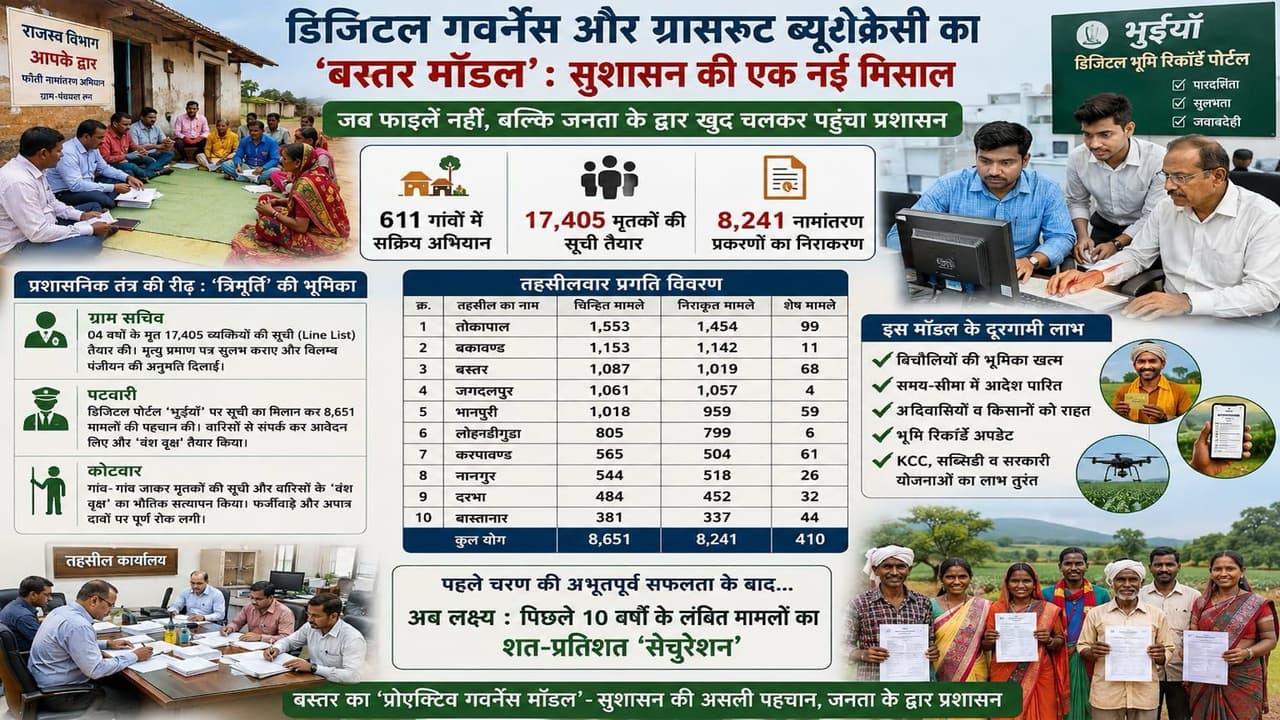
Bastar administration resolved 8,241 forced name transfer cases by running a special campaign in 611 villages, which brought great relief to the farmers and tribals.
Raipur. The process of registering land in the name of a landowner’s heirs after his death, known as fait accompli, has long been considered a complex administrative task in rural areas. Due to lack of information, lengthy legal process and activeness of middlemen, many such cases remain pending for years. This increases disputes in families and agricultural activities are also affected. Converting this challenge into an opportunity, the tribal dominated Bastar district of Chhattisgarh has developed an administrative model which has emerged as an example of good governance.
Proactive Governance Model: The administration itself reached the doorsteps of the people.
Generally, the process of transfer of name starts in the Revenue Department when the affected family itself reaches the office with the application. Bastar district administration took active initiative by making changes in this traditional system. The district administration decided that the administration itself would take up the responsibility of reaching out to the eligible people. With this in mind, a special campaign was started, under which pending cases related to mutation were identified by going from village to village. According to the data available till June 12, 2026, in just four months, information was collected from 611 villages, a large number of pending cases were resolved and land records were updated.
Revenue Department Teamwork: Administrative coordination changed the picture
Behind the success of this campaign was not only the technical arrangements but also the strong participation of the employees working at the ground level. The entire process was conducted in a phased manner. Tehsildar and Naib Tehsildar continued monitoring and issued orders completing the legal procedures within the time limit. At the field level, the role of Secretary, Patwari and Kotwar was very important.
Role of Gram Panchayat Secretary: Data of more than 17 thousand dead is ready
Village secretaries, while discharging their responsibilities related to birth and death registration, prepared a list of 17,405 people who died in the last four years. Where death certificates were not available, certificates were provided to the families concerned. In many cases, after obtaining permission for delayed registration, new certificates were also issued, which made the further process easier.
Great help received from Bhuiyan Portal and Patwari Network
Patwaris matched the information received from village secretaries with Chhattisgarh’s digital land records portal ‘Bhuiyan’. In this process, 8,651 deceased land owners were identified in whose name the land was registered. After this, the Patwaris contacted the families and took the necessary applications and prepared the family tree of the heirs. This sped up the process of name transfer and reduced legal complications.
Social Verification: Kotwars ensured transparency
To maintain the credibility of the campaign, Kotwars took up the responsibility of social verification at the village level. He physically verified the list of dead persons and the family tree prepared. This virtually eliminated the possibility of fake claims and misinformation and the entire process remained transparent.
Bastar Land Record Update: Work at record level in 611 villages
Out of 639 villages in 10 tehsils of Bastar district, 611 villages joined this campaign. Out of 8,651 urgent cases identified in these villages, 8,241 cases were successfully resolved. In these cases, the process of legal process, advertisement publication, claim-objection and final order has been completed. Currently only 410 cases are pending.
Tokapal, Jagdalpur and Bakawand showed the best progress.
Tokapal tehsil was at the forefront of this campaign. Here 1,553 cases were identified, out of which 1,454 cases were resolved. Bakavand tehsil has almost achieved the target by completing 1,142 cases out of 1,153 cases. Jagdalpur tehsil performed remarkably by disposing of 1,057 cases out of 1,061. In Bastar tehsil, 1,019 out of 1,087 cases and 959 out of 1,018 cases in Bhanpuri were resolved.
Administrative activity seen even in remote areas
Lohandiguda tehsil disposed of 799 cases out of 805, while Karpavand and Nangur also completed most of the cases within the stipulated time. In the inaccessible Darbha area, 452 cases out of 484 were resolved. Whereas Bastanar tehsil successfully completed 337 cases out of 381 cases.
Farmers Benefit: Will get direct benefits of KCC and government schemes
This campaign is not limited to improving land records only. This will result in many direct benefits to farmers and tribals. After updating the land records, new land owners will now be able to easily avail the benefits of Kisan Credit Card (KCC), agricultural grant and other government schemes. Due to digital tracking and automatic cognizance process, the role of middlemen has also almost ended, which has given relief to people from financial and mental troubles.
Now focus on pending cases of 10 years
After successful resolution of the cases pending for four years, the district administration has now prepared for the next phase of the campaign. In the next phase, a target has been set to resolve 100 percent of the immediate transfer cases pending for the last 10 years.
Bastar Governance Model: Inspiration for other districts
This model of Bastar has emerged as not just a revenue campaign but an effective example of good governance. This initiative has proven that it is possible to solve complex problems by adopting a sensitive, result-oriented and proactive administrative approach. This model can prove to be a guiding initiative for other rural and tribal areas of the state, where even today problems related to revenue and land records remain a big challenge.