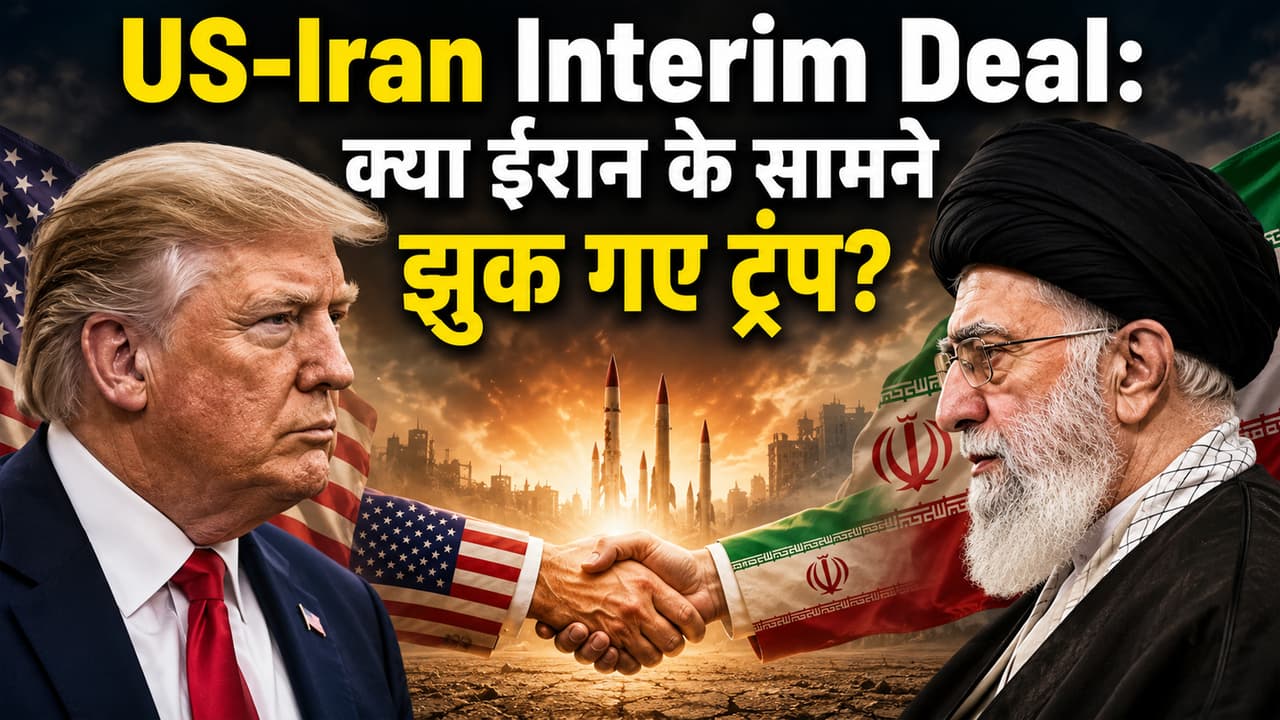
What was decided in the interim agreement between America and Iran? When and where did Donald Trump and Masoud Pajshkian sign this deal? What impact will reopening the Strait of Hormuz have on global trade? Will the military tension between America and Iran end completely after this agreement?
US-Iran Interim Deal: An interim agreement has been signed between the two countries to end the ongoing tension and military confrontation between America and Iran. US President Donald Trump signed the MoU related to this agreement in France on Wednesday night. During this period, French President Emmanuel Macron was also present. After Trump’s signature, Iranian President Masoud Pejeshkian approved the agreement through electronic means from Iran. This agreement was officially announced at 5:30 am Indian time on Thursday and it was implemented with immediate effect.
Agreement signed ahead of schedule
The agreement was originally scheduled to be signed on June 19 in the city of Lucerne, Switzerland. However, a day before the scheduled event, both the countries agreed and signed it. The objective of the agreement is to reduce the increasing tension in the region and pave the way for a permanent peace agreement. However, to reach this agreement, Trump has caused a loss of Rs 122 lakh crore to America. Not only this, Trump wanted to change the regime in Iran, but he has failed to do so. In such a situation, many experts believe that through this agreement, Trump has in a way surrendered to Iran.
Hormuz Strait will open, military action will be banned
Under the agreement, the ongoing military activities in Iran and Lebanon region will be ended. Apart from this, the Strait of Hormuz will be reopened, which will allow international trade and oil transportation to become normal. The US will also end its naval blockade, which is expected to restore movement on sea routes.
Key points of US-Iran draft agreement
- According to American media reports, many important points have been included in the interim agreement.
- Both countries will end war and military action on all fronts.
- The US and Iran will respect each other’s sovereignty and will not interfere in internal affairs.
- Efforts will be made to complete negotiations for a permanent and final agreement within 60 days.
- America will lift the maritime blockade within 30 days and restore normal maritime traffic.
- Movement of commercial ships will resume in the Strait of Hormuz.
- The US will work towards lifting sanctions related to Iran at the United Nations, International Atomic Energy Agency (IAEA) and other forums.
- Iran will ensure that it will not make nuclear weapons.
- Iran will not make any changes to its existing nuclear program until the final agreement.
- The US will not impose any new sanctions on Iran during this period.
- Special exemptions will be given to Iranian oil, petrochemical products and related services.
- Iran’s frozen assets and funds will be released in a phased manner.
- A special monitoring mechanism will be created to monitor compliance with the agreement.
- Efforts will be made to get the final agreement approved by the United Nations Security Council.
Why the controversy over Iran’s nuclear program?
Iran’s nuclear program has been an important issue of international politics and diplomacy for many decades. Iran has consistently maintained that its nuclear program is only for energy production and other peaceful purposes. At the same time, America and Israel allege that Iran is working towards developing nuclear weapons. That is why there has been a long standing controversy regarding Iran’s nuclear program.
What was the 2015 Iran nuclear deal?
In 2015, an important nuclear deal was signed between Iran and world powers. Under this, Iran had agreed to limit the level of uranium enrichment to 3.67 percent. 3.67 percent enriched uranium is mainly used as fuel for nuclear power plants. According to experts, 90 percent or more enriched uranium is usually required to make nuclear weapons.
What changed after Trump’s decision in 2018?
In 2018, Donald Trump took America out of the 2015 nuclear deal. After this decision of America, Iran gradually started increasing the level of uranium enrichment. Along with this, it also crossed the fixed limit of 3.67 percent. After this step, international concerns regarding Iran’s nuclear program increased further.
What had Iran’s uranium enrichment level reached?
According to the International Atomic Energy Agency (IAEA), Iran was enriching uranium up to 60 percent by June 2025. According to the agency’s report, Iran had reserves of about 400 kg of 60 percent enriched uranium. Although this level is less than the 90 percent enrichment required to make a nuclear weapon, it is considered much higher than the level required for civilian use. This is why the international community is constantly keeping an eye on Iran’s nuclear program.