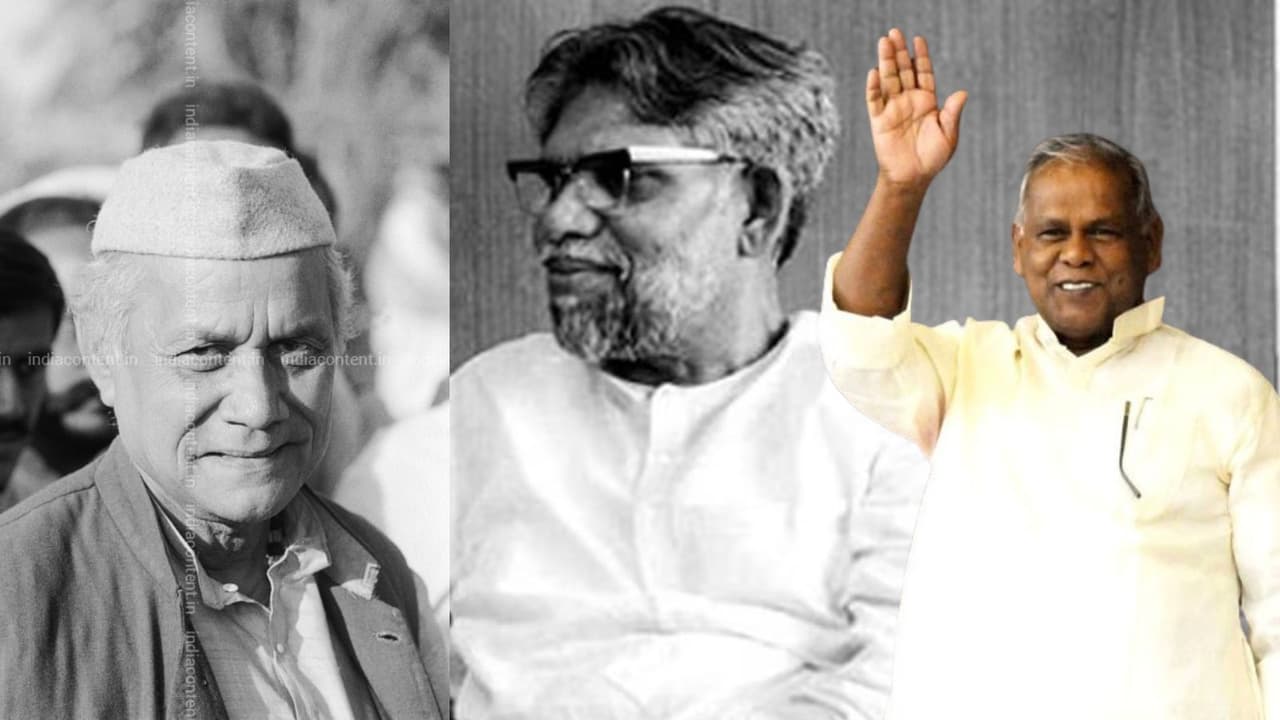
Bihar has so far had 3 Dalit Chief Ministers (Bhola Paswan Shastri, Ramsundar Das, Jitan Ram Manjhi). Due to political instability and internal strife, no one could complete a one-year term, reflecting the symbolic status of the SC leadership.
Patna: Bihar has been the land from where the most vocal voices of social justice have emerged. Here the political consciousness of Dalits and backward classes is considered to be the highest in India. Despite this, only three times since independence have leaders from the Scheduled Caste (SC) community got the opportunity to occupy the chief minister’s chair – Bhola Paswan Shastri, Ramsundar Das and Jitan Ram Manjhi.
The irony is that none of these three leaders could complete even one year’s tenure. Bhola Paswan Shastri’s total tenure was 112 days, Ramsundar Das’s tenure was 302 days, and Jitan Ram Manjhi’s tenure was 278 days. This is not accidental, but reflects the deep and complex political structure of Bihar, where SC leadership was often seen as symbolic power, not permanent power.
The saga of 3 short-lived Chief Ministers of Bihar…
Bhola Paswan Shastri: (Total tenure-112 days)
Bhola Paswan Shastri was the first Chief Minister of Bihar from Scheduled Caste. He took oath as Chief Minister three times (1968, 1969 and 1971), but none of his tenures lasted long. His tenure came in the post-1967 era when the culture of ‘Aya Ram Gaya Ram’ was dominant in Indian politics. Alliances and defection were at their peak in Bihar.
Reason for short life: The governments of the Samyukta Legislative Party which made Shastri ji the Chief Minister were very unstable. This was a mismatched alliance of small parties and independent MLAs. Internal differences, distrust of each other and the tussle for power were so intense that it was difficult for any Chief Minister to survive. Shastri ji’s honesty and simplicity became the sacrifice of this unstable politics.
Ramsundar Das: (Tenure- 302 days)
Ramsundar Das became the Chief Minister in 1979. He was a leader of the Janata Party and his rise came after the anti-Emergency wave. He worked for the upliftment of Dalits and the underprivileged and tried to change the reservation policies in government jobs.
Reason for short life: Ramsundar Das’s tenure was short due to internal rebellion in the party. The Janata Party was divided into factions—Jana Sangh, Socialists and other factions. At that time, the influential upper caste leaders who dominated the politics of Bihar did not easily accept him. The harsh decisions taken by him for the upliftment of Dalits turned a large section within the party against him. Ultimately, a no-confidence motion was brought within the party, and he had to resign.
Jitan Ram Manjhi: (Tenure- 278 days)
Jitan Ram Manjhi was made the Chief Minister by Nitish Kumar in 2014 after his resignation. He became the first Chief Minister of Bihar from the Musahar community, which is considered the most deprived section among the Dalits.
Reason for short life: Manjhi was often seen as a ‘proxy’ or ‘rubber stamp’ chief minister by his ‘patron’ leader. When he started taking decisions independently and creating his own identity, conflicts started between him and the leader who appointed him (Nitish Kumar). There was constant speculation about instability in the media and political circles regarding his tenure. Ultimately, he had to step down before the trust vote, proving that his rise was part of political compulsion and not a strong mandate.