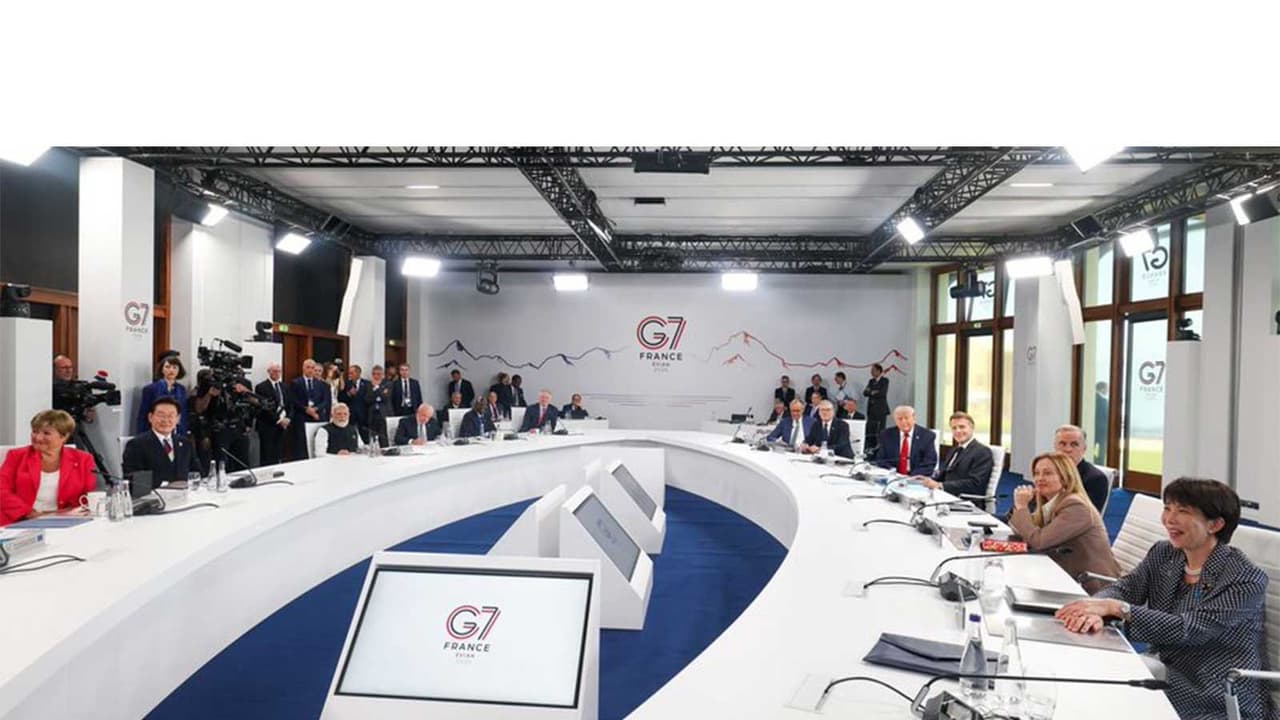
PM Modi at the G7 outreach summit called for inclusive financial reforms to support developing nations. He championed human-centric growth over GDP and proposed a new connectivity alliance, IMPACT, inspired by the IMEC model.
Modi Pushes for Inclusive Financial Reforms
Advocating for a more inclusive international financial architecture, Prime Minister Narendra Modi on Wednesday addressed the G7 outreach summit, calling for stronger global support systems to help developing countries deal with economic and social shocks. Delivering a strong message on global equity, the Prime Minister emphasised that the “most vulnerable countries should not be left to bear the burden of crises alone”, while urging multilateral lenders to actively intervene.
Elaborating on the structural reforms required to protect developing economies from global disruptions, the Prime Minister noted that multilateral lenders must evolve to meet modern challenges. “Our international financial institutions should develop support mechanisms that help developing countries absorb these shocks and maintain their economic resilience,” the Prime Minister said.
A Vision for ‘Human-Centric’ Growth
This push for structural reform set the stage for his address at a dedicated session titled “Reviving a Balanced, Shared and Sustainable Economic Growth for All”, where PM Modi underlined that the idea of growth must go beyond traditional economic indicators. Challenging standard economic metrics, he argued that human-centric development must take precedence over mere statistics. “The reality today is–when it comes to growth, the question should not be about GDP or trade numbers. The real question is: growth for whom, with whom, and in what direction?” he said in a post on X while sharing details of his address.
New Connectivity Alliance ‘IMPACT’ Proposed
Expanding on this vision of collaborative development, the Prime Minister pitched for deeper global cooperation on connectivity projects, drawing parallels with the India-Middle East-Europe Economic Corridor (IMEC) initiative finalised on the sidelines of the G20 Summit in New Delhi in 2023. While the ambitious IMEC blueprint outlines a comprehensive network of roads, railways, and maritime routes linking India, the Middle East, and Europe to enhance transcontinental integration, its operational momentum has encountered delays due to prevailing regional volatilities.
Proposing a scalable alternative inspired by that very model, PM Modi floated a new trilateral alliance to bridge infrastructural gaps across other emerging markets. “Like the vision of IMEC, can we work on connectivity projects with countries in Africa, Latin America and the Pacific Islands? By combining G7 capital, India’s talent and the ownership of Global South countries, we may also consider establishing an International Mobilisation Partnership for Accelerating Connectivity and Trade (IMPACT),” he said.
Fostering Global Skills Partnership
In tandem with physical connectivity, the Prime Minister highlighted demographic imbalances between ageing societies and younger nations, stressing the need for a Global Skills Partnership to promote skill mapping and trusted skilled mobility.
PM Modi attended the G7 outreach session in France as a guest-country invitee, following a two-day visit to Slovakia. The high-level deliberations took place within the framework of the Group of Seven, which comprises Canada, France, Germany, Italy, Japan, the United Kingdom, and the United States, alongside the European Union, functioning as a premier institutional forum for steering responses to pressing global economic and geopolitical challenges.
(Except for the headline, this story has not been edited by Asianet Newsable English staff and is published from a syndicated feed.)