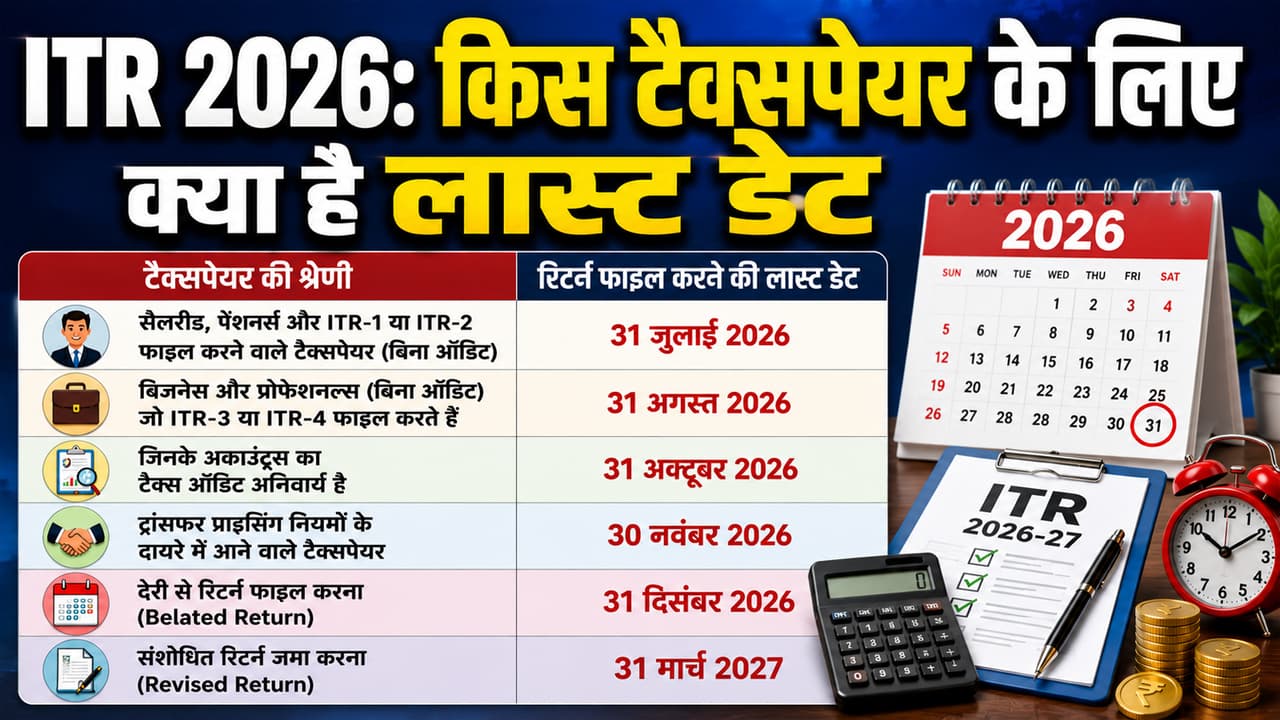
What is the deadline for filing ITR for salaried employees? When can I file ITR for AY 2026-27? What is the last date of ITR filing for businessmen? By when do taxpayers who are tax audited have to file ITR? What is the deadline for taxpayers covered under transfer pricing rules?
Income Tax Return 2026: With the beginning of the new assessment year (AY) 2026-27, taxpayers across the country have started preparing to file Income Tax Returns (ITR). Although the last date for filing ITR for most salaried employees is July 31, 2026, this deadline is not the same for all taxpayers. The Income Tax Department has set different filing deadlines for different categories depending on the source of income, business nature and audit requirement of the taxpayer. In such a situation, to file returns on time, it is important to know which date is applicable to your category.
ITR Filing Rules 2026: For whom is it mandatory to file returns?
In some cases, filing ITR is not limited to just tax liability. There are many people for whom it is necessary to file returns despite having low taxable income. According to the seventh provision of Section 139(1) of the Income Tax Act, it may be mandatory to file ITR for persons carrying out the following financial activities.
- Spending Rs 2 lakh or more on a trip abroad for yourself or any other person.
- Paying electricity bill of Rs 1 lakh or more in a financial year.
- Depositing a total of Rs 1 crore or more in one or more current accounts.
- Fulfillment of other special conditions prescribed by the Income Tax Department.
ITR Due Date 2026: Last date for different taxpayers
The Income Tax Department has set different deadlines for different categories of taxpayers for the assessment year 2026-27.
1. Salaried employees, pensioners and ITR-1/ITR-2 filers
For taxpayers whose accounts are not required to be audited and who file ITR-1 or ITR-2, the last date is July 31, 2026.
2. Business Owners and Professionals (ITR-3 and ITR-4)
Businessmen and professionals whose accounts are not required to be audited and who file ITR-3 or ITR-4. The last date for these is 31 August 2026.
3. Taxpayers with Tax Audit
For individuals or institutions whose accounts are required to be tax audited, the last date is 31 October 2026.
4. Taxpayers covered under Transfer Pricing rules
For taxpayers who are covered under transfer pricing provisions, the last date is November 30, 2026.
5. Belated Return Filing Last Date
Taxpayers who are not able to file ITR by the prescribed deadline can file belated return and the last date for this is 31 December 2026.
6. Revised Return Filing Last Date
If any error has to be rectified after filing the return, the last date for filing the revised return is 31 March 2027.
For which people is 31st July 2026 the last date?
For all those taxpayers whose accounts are not to be audited and who do not come under the purview of transfer pricing rules under Section 92E of the Income Tax Act, the last date for filing ITR is 31 July 2026 only.
How much penalty will be imposed for late filing of ITR?
Filing ITR after the deadline may result in financial loss. Under Section 234F of the Income Tax Act, 1961, a maximum late filing fee of up to Rs 5,000 can be imposed. For taxpayers whose total taxable income is up to Rs 5 lakh, the penalty may be limited to Rs 1,000. It is worth noting that even if you do not owe any tax, you may be charged late fees if you file your return after the due date.
ITR Filing Benefits: Why is it important to file returns on time?
Filing income tax returns is not just a legal responsibility, but it also has many financial benefits. According to the Income Tax Department, filing returns is the responsibility of the citizens and is also a means of contributing to the development of the country. Along with this, ITR strengthens your financial records and helps in many important tasks.
Major benefits of filing ITR
- Ease of taking loan from bank
- Help in approval of home loan, car loan and personal loan
- Better credit profile and financial reliability
- Assistant for credit cards and other banking facilities
- Availability of official proof of income
Filing ITR on time and correctly strengthens your financial credibility and makes banking and investment related processes easier in future.