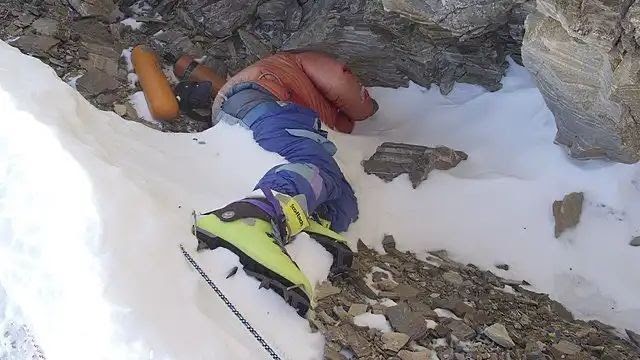
Preparations have begun to bring back the body of an Indian mountaineer buried in snow for the last 30 years in the ‘Death Zone’ of Mount Everest, the world’s highest peak.
Indo-Tibetan Border Police (ITBP) has issued a tender for this extremely dangerous and complex mission. A team of very special and experienced Sherpas will be sent up to bring down this body, known as ‘Green Boots’ among mountaineers.
How will this difficult recovery mission happen?
ITBP has floated a tender to hire a specialist high-altitude recovery agency with experience in rescues at altitudes above 8,000 metres. According to the plan, this mission to bring back the dead bodies will be conducted between June and September this year.
To execute this technically challenging mission, a team of at least 6 highly experienced elite Sherpas will be sent to the ‘Death Zone’. For this the agency will have to take special permission from the Chinese authorities in Tibet. After the rescue, the body will be brought to India via Tibet-Nepal border.
The agency that wins the tender will have to use special preservation techniques to bring down the body, which has been frozen for decades in sub-zero temperatures, in a safe and dignified manner.
Who are the ‘Green Boots’ and what happened 30 years ago?
The 1996 Everest expedition is a very sad chapter in India’s mountaineering history. A six-member team of ITBP was climbing from the north side (Tibet side) of Everest under the leadership of Commandant Mohinder Singh. This was India’s first attempt to conquer Everest from the eastern (northern) side. On 10 May 1996, despite worsening weather, Subedar Tsewang Samanla, Lance Naik Dorje Morup and Head Constable Tsewang Paljor climbed towards the peak. The remaining three members returned due to bad weather. All three disappeared in a severe snow storm. No one could reach back to the camp. A total of eight climbers were killed in the expedition, one of Everest’s deadliest seasons.
Why was it named ‘Green Boots’?
A body was found lying near a rock cave at an altitude of 8,500 meters on the north-eastern ridge, identified as ‘Green Boots’. The reason was the bright green Koflach mountaineering boots on his feet. For decades this body became a landmark for climbers – everyone passes by it. In the tender document of ITBP, it has been described as the body of Lance Naik Dorje Morup. However, many in the mountaineering community consider it to be Tsewang Paljor. Both died in the same expedition, so the exact identity still remains controversial. Till date it is not completely clear whether the body is that of Lance Naik Dorje Morup or Head Constable Tsewang Paljor.
More than 200 bodies are still buried on Everest
It is believed that even today about 200 bodies are frozen in the snow on Mount Everest, most of which are in the ‘Death Zone’. Now, as the mountain snow is melting due to climate change, the fear has increased that many more dead bodies may come out in the coming time.