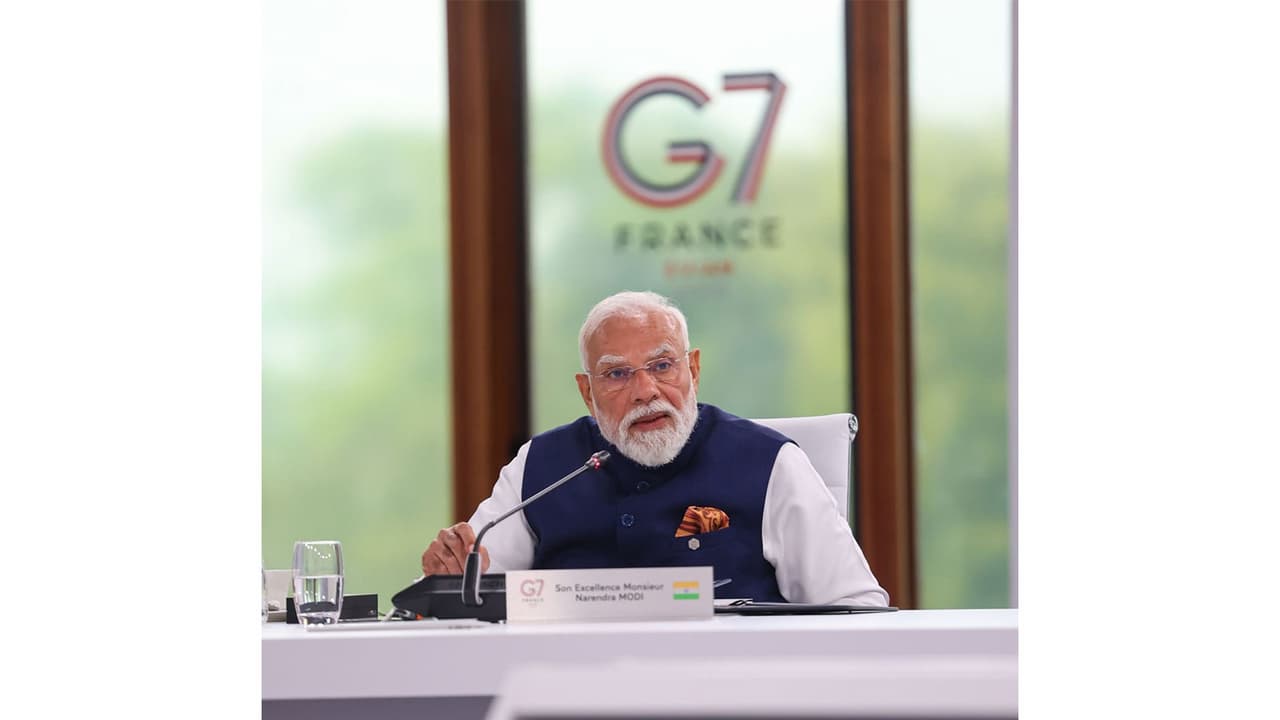
PM Modi addressed the 52nd G7 Summit, calling for trust-based global partnerships guided by ‘Sarvajan Hitaya, Sarvajan Sukhaya.’ He highlighted India’s role as a first responder and stressed the need to rebuild trust in international relations.
Prime Minister Narendra Modi on Tuesday invoked the principle of “Sarvajan Hitaya, Sarvajan Sukhaya” (welfare and happiness for all) as he called for trust-based international partnerships and inclusive global development amid growing geopolitical uncertainties and a declining global solidarity.
Addressing the Outreach Session on “Forging New Partnerships and Rebuilding International Solidarity” at the 52nd G7 Summit in Evian, France, PM Modi said India has always viewed the world as one family and that its global engagements have been guided by a people-centric approach. “India has always viewed the world as one family. All our efforts have been guided by the principle of ‘Sarvajan Hitaya, Sarvajan Sukhaya’ – welfare and happiness for all,” the Prime Minister said.
India’s People-Centric Approach to Global Partnerships
Highlighting India’s development philosophy, PM Modi said that growth becomes most effective when it aligns with the aspirations of people, adding that the same principle underpins India’s international partnerships. “India’s experience demonstrates that development is most effective when it is linked to people’s aspirations. This principle forms the foundation of our international partnerships as well,” he said.
The Prime Minister cited several India-led initiatives, including the International Solar Alliance, Coalition for Disaster Resilient Infrastructure, Global Biofuel Alliance, Mission LiFE, and the ‘Ek Ped Maa Ke Naam’ campaign, as examples of the country’s commitment to collective global progress, underlining India’s role as a first responder during humanitarian crises.
“During times of crisis, India has considered it its responsibility to assist all nations as a first responder. During the COVID-19 pandemic, India supplied medicines and vaccines to more than 150 countries,” he said.
Referring to India’s assistance during natural disasters across the world, the Prime Minister said, “Whether it was a cyclone in Sri Lanka, an earthquake in Afghanistan, floods in Mozambique, or hurricanes in Cuba and Jamaica, India has always acted on the principle of ‘Humanity First’.”
“Our development partnerships reflect the same spirit. Our efforts have focused on capacity building and skill development in partner countries,” he added.
Emphasising the importance of empowering nations through cooperation, the Prime Minister said, “The true test of partnership is not what we build for others, but what we enable others to build for themselves.”
Rebuilding the ‘Trust Deficit’ in a New Era
PM Modi also drew attention to the growing deficit of trust in international relations despite increasing global interdependence. “Today’s world is more interconnected and interdependent than ever before. The energy security, food security, health security, cyber security, and economic prosperity of any country are no longer determined solely within its borders. Mobility, data, capital, and technology connect us all,” he said.
“In such times, the importance of partnerships naturally increases. However, partnerships can succeed only when they are built on trust. Today, the most important strategic asset is not a mineral, technology, or market, but mutual trust,” the Prime Minister added.
He stressed the need for confidence that technology and supply chains would serve the global good rather than become instruments of coercion. “Trust that technology and supply chains will not be used as weapons, but for the global good. Trust that opportunities for development will not remain confined to a few countries. Trust that global institutions will be capable of fulfilling the aspirations of all nations,” he said.
Reflecting on lessons from history and the COVID-19 pandemic, PM Modi said the world today was facing a shortage not of resources but of trust. “However, the trust built over decades through the contributions of several generations is now being undermined. The COVID-19 pandemic held up a mirror to us, exposing how hollow the claims of trust and solidarity often were,” he said.
“Today, the world does not suffer from a shortage of resources; it suffers from a shortage of trust. And the future of our partnerships depends on building this trust,” PM Modi added.
Quoting former US President Ronald Reagan, the Prime Minister said, “‘Trust but Verify.’ These words remain relevant even today. It is our responsibility towards future generations to build a trusted rules-based order suited to the needs of a new era.”
PM Modi’s Engagements at the Summit
PM Modi had arrived in the French city earlier on Tuesday to attend the high-profile gathering, following an official invitation from the French President. This special invitation marks India’s 13th appearance at the summit as a partner nation, alongside being the seventh consecutive time the Prime Minister is participating in the global forum.
Prior to the session, PM Modi and US President Donald Trump held a brief interaction following the traditional family photograph on the second day of the summit.
Visuals from the summit showed Prime Minister Modi briefly interacting with the US President as leaders gathered after the official group photo at the venue of the high-level meeting. Both leaders had a handshake, with Trump patting PM Modi on his arm.
The meeting between PM Modi and the US President was their first face-to-face interaction since PM’s visit to Washington in February last year.
The Prime Minister and the US President also sat side by side at the G7 outreach session.
Prime Minister Modi, upon his arrival at the summit venue, was welcomed by French President Emmanuel Macron, following which the Prime Minister joined leaders of the G7 member nations and invited countries for the customary family photograph.
Captured in the iconic frame alongside PM Modi were key world leaders, including European Council President Antonio Costa, Italian Prime Minister Giorgia Meloni, Egyptian President Abdel Fattah el-Sisi, US President Donald Trump, French President Emmanuel Macron, German Chancellor Friedrich Merz, UK Prime Minister Keir Starmer, European Commission President Ursula von der Leyen, and Brazilian President Luiz Inacio Lula da Silva. (ANI)
(Except for the headline, this story has not been edited by Asianet Newsable English staff and is published from a syndicated feed.)