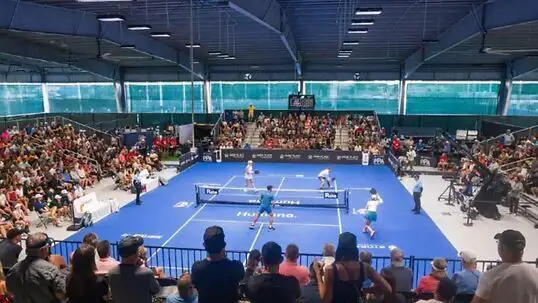
The recent , held at Pictona in Florida from November 16-22, brought to the fore an intriguing organisational challenge for professional pickleball: the vulnerability of outdoor tournaments to rain and the possibility of postponements or cancellations.
With professional pickleball operating on a tightly packed tournament calendar, completing events within their scheduled timeframe is crucial to ensuring the smooth conduct of competitions.
However, given the sport’s susceptibility to weather conditions, particularly rain, play cannot continue on wet courts. The torrential downpours and flash floods that prompted a state of emergency in the areas surrounding the venue during the Daytona Beach Open have brought the challenges of staging professional pickleball tournaments in the rainy season into sharper focus.
Uncharacteristically, the downpours persisted throughout the tournament, making weather conditions a major talking point. Although the centre court at Pictona was covered by an awning, protecting players from the rain, the conditions were far from ideal. The disruption also brought renewed attention to a question that has increasingly featured in conversations around professional pickleball: should the sport adapt to an indoor format?
For several professional players, taking the game indoors would offer more than just protection from rain. It would eliminate variables such as wind and direct sunlight, allowing players to compete in more consistent conditions.
Greg Dow was among those who expressed a preference for indoor courts, arguing that the absence of external elements could also improve the standard of play.
“I like playing indoors. It’s nice when there’s no wind, no sun, no rain, or anything like that. You just get to play. And I think the level of play gets a little bit higher because there’s no wind involved,” Dow was quoted as saying by Pickleball.Com.
Indoor pickleball has its own challenges
However, indoor venues come with their own set of challenges. Dow pointed to lighting as a crucial consideration, stressing that poorly lit facilities can affect the playing experience.
“The only problem is that at indoor facilities, the lighting can be tricky. In some places it can be really bad. So as long as the venue has good lighting, then indoor is better,” he added.
Dow’s preference for indoor pickleball is not limited to the competitive advantages it offers players. He also believes enclosed venues can create a more engaging atmosphere for spectators, with crowd noise adding another dimension to the experience.
“Indoors is so much better for the fan experience. A lot of MLPs are indoors and the sound from the fans is actually louder because it’s in an enclosed area. So I think that adds to it the excitement even more. The most hyped pickleball environments that I’ve been to are indoors or under a pavilion. And I think that’s entirely based on location and the noise being able to echo,” he explained.
Top pickleball player Anna Leigh Waters shared a similar sentiment, underlining how playing under a covered centre court can amplify the energy generated by spectators. The American star particularly enjoys the atmosphere at Pictona, where the roof helps carry the crowd’s enthusiasm onto the court.
“I love being under the cover here on center court because when the fans get loud, it’s even more loud than normal and it definitely helps get me out there. It always fires me up,” Waters said.
Casey Diamond, a new addition to the professional tour, went a step further, expressing hope that professional pickleball would eventually be played entirely indoors. While acknowledging his fondness for outdoor pickleball, Diamond believes the unpredictability of playing conditions makes the indoor option more appealing at the highest level.
“I hope all pro pickleball is indoors. I do like to play outside, but the conditions are a bit harder because they’re unpredictable and can change so easily,” he said.
With players weighing the benefits of controlled playing conditions against the unique atmosphere of outdoor pickleball, the debate over indoor venues is unlikely to disappear anytime soon.