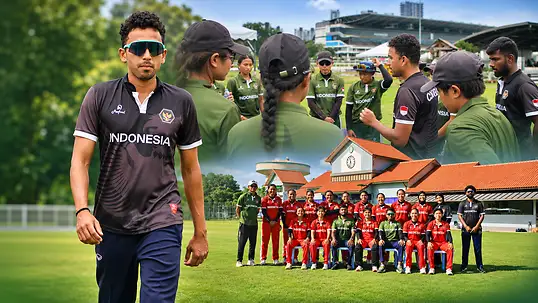
From Maharashtra to Thailand and now Indonesia, Nitish Salekar’s cricket journey has taken him from a deeply established cricket system to countries still building their place in the game.
As head coach of Indonesia’s men’s and women’s teams, he has seen the promise-and the practical challenges-up close. In an exclusive interview with Sports Now, Salekar reflects on Indonesia women’s historic qualification for the Asia Cup, the lessons of their debut, the men’s narrow misses in the East Asia-Pacific qualifiers and why access to turf wickets and more quality matches could shape the next phase. Below are the excerpts of the interview:
Q) Having moved to Thailand and now coaching Indonesia, what were the biggest challenges in building cricket programs in countries where the sport is still emerging?
NS: It was quite challenging, especially in terms of infrastructure. Where we come from, in India, cricket is a very developed sport. So, the quality of the grounds, having turf wickets, is different from playing on AstroTurf. It’s a big difference, especially for batters. But slowly, Thailand got turf wickets. And as we got turf wickets, the quality of batting slowly started improving. Participation was also an issue. In India, you have this massive number of players playing cricket. The number is far smaller. So, managing a small pool of players and getting the best out of them was a challenge.
Q) Indonesia’s women won five straight matches to qualify for their first Asia Cup, using only 11 players. When did you begin to believe the team could make history?
NS: Before the Premier Cup, there was a tournament that was an Asian Games qualifier, where we didn’t play as well as we wanted, and we didn’t qualify. And the next tournament, the Premier Cup, was just two days away. So, we had to regroup a lot. I believe Indonesia has talent and a strong core group of players. It’s just a matter of giving them certain plans, but all credit to the girls for the way they played, and how they are taking on responsibility also.
Q) What did the women’s team learn from facing Asia’s established sides at the Asia Cup, and how can that experience help them improve?
NS: It was a massive experience for a team like Indonesia to compete and rub shoulders with full-time international players. At one point, our players were batting in one net, and Smriti Mandhana was batting in the next. So, it was a surreal moment for some of the girls. Also, the quality of grounds that we were exposed to – like, it was a fantastic stadium in Dubai. We did not just compete. In batting, bowling, and fielding, I think we did remarkably well. Taking wickets and containing Sri Lanka and Bangladesh to under 130 or 140 runs was a great achievement in bowling and fielding. Yes, batting obviously requires more expertise and experience; the more you play on quality wickets against quality opposition, the more it happens.
Q) Did any conversations or advice from Indian or other teams’ players leave a lasting impression on your squad?
NS: A few of our girls interacted with some international players, as did our captain. The interaction with Sri Lankan captain, Chamari Athapaththu, was particularly memorable. A few Sri Lankan players came and spoke to our bowlers and our players about how we played against them. At one point, I think Sri Lanka was 45 for 6 or 45 for 5. So, we had them… We played well with the ball and in the field. So, they came up, encouraged our players, and gave them some tips. And yeah, it was a really good experience for them.
Q) Indonesia has introduced cricket in schools through Kasti and developed coaching material in Bahasa. How important is it to grow the game in a way that reflects local culture and develops homegrown talent?
NS: I was surprised when I came to Indonesia for the first time; I was surprised by the level of participation. Around 125 women cricketers played cricket across all provinces in Indonesia. So, participation isn’t the issue. Finding quality among them was the issue. So, we have put scouting in place. Scouts are there in every province. And when they come for national games or local tournaments, we also, as coaches, go and watch and try to find some local talent. It is a bit challenging because it’s not a Commonwealth country, and cricket isn’t a primary sport. It was introduced to Indonesia just a few years ago. So, that is a challenge. But I hope that in the coming years, as the women’s team, especially, gets better and better, they can encourage more local players to take up cricket.
Q) Indonesia’s men played more T20Is than any country in 2025 but went winless in the East Asia-Pacific World Cup qualifier. What needs to change for match experience to translate into results?
NS: The results…If you just look at the results, we haven’t won the games. But if you look at the scores, I think we lost to PNG 1-2, and by one run. I think, again, a tie with Thailand chasing like 90 runs in six overs, and we just tied the match and lost the Super Over. In a lot of games, I agree we should have played better, but in many others, I think it was very close. So, the results don’t do it justice. That said, yes, there’s a lot to work on from a men’s team perspective.
Q) You have said Indonesia could need four or five years to compete at senior World Cups. What specific progress would show that the teams are closing that gap?
NS: I’ll just bifurcate it into men’s and women’s. In women’s cricket, three big tournaments are lined up first. One is the World Cup Qualifier East Asia-Pacific. The second one is the Asia Cup Rising Star, and the third one is the SEA Games. I think these three tournaments are important for the women’s team to step up now more. Rather than just competing, we would like to win a few games at Rising Star and probably qualify for East Asia-Pacific as well. Now, coming back to the men’s team, with turf grounds being installed and almost ready in Bali, I think in a few months, like four or five months, playing more on turf wickets will definitely improve our skills as a batting team.
It’s honestly sometimes very difficult to practice on astro wickets and then go straight to playing on a turf wicket and produce those results. That said, we still need to work harder, especially in the men’s team. This year has not been that good in terms of results. But also, the previous year was decent for them. They didn’t play 54 games and not win anything. I mean, they won 5-0 or 7-0 against Cambodia. They won most of the series they played. In fact, they even beat Bahrain last year, a top-25 or top-30 team. They even beat them in a game. So it’s not just about playing a number of games.
This year, hopefully, as turf wickets are installed and we play more on them, I think the quality of cricket in general, men’s and women’s, will definitely go up. Because the passion is there. The coaching staff also puts in its effort. And the management is also… All are aligned on the same goal. So, I think coming forward in the next 6 months, 12 months, we will definitely see results, better results in terms of batting in Indonesian cricket.
Q) What is the Indonesian Cricket Board’s vision for the game, and what more support is needed from the government or private sector?
NS: As of now, I’m not aware if corporates are stepping in. We also hope this year, especially with the Asia Cup and the SEA Games coming up, we win some medals, and then the government starts helping even more through the association.
Q) If you could ask ICC chair Jay Shah for one form of support, what would most help Indonesia’s cricketers develop?
NS: Probably getting more exposure to for our teams, to see India’s culture. Also, play more competitive games against Indian teams. Quality games are the only way to rise. That’s one thing I keep in mind as a coach. That said, the management is trying everything to give these players as much exposure as possible. Last year, we went to Dharamshala and played on the Dharamshala HPCA ground. So it’s not like the association isn’t reaching out to help. We are going and we are doing whatever we can.
But obviously, there are sometimes constraints, either tournaments coming up or budget issues or something. We are trying. So everybody, even the team, even the coaches, even the management, everybody just wants more quality games and more exposure to international cricket. That is the only sustainable way that you can really go up fast.