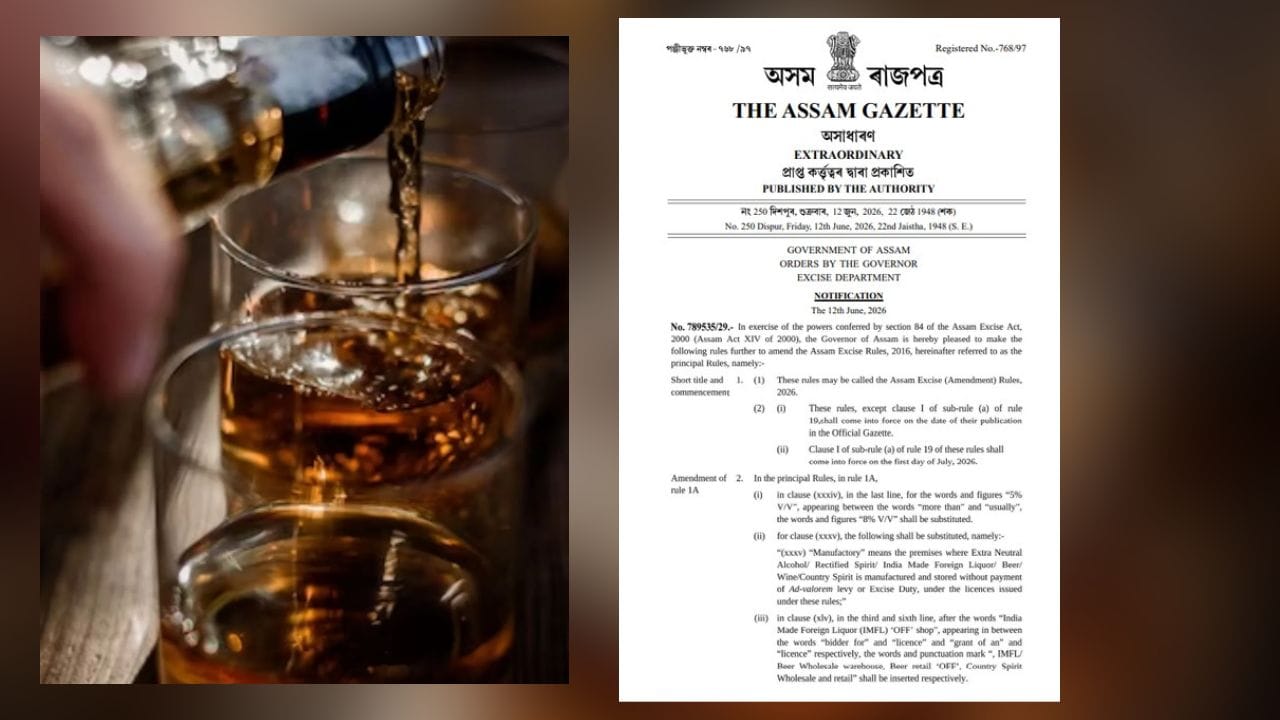
Assam government’s decision on liquor
The Assam government has taken a big step towards comprehensive reforms in the excise sector. The state government has implemented new rules for legal recognition and commercial promotion of traditional or heritage liquor. Many important changes related to sale of liquor, licensing, shop shifting and revenue collection have been made under the “Assam Excise (Amendment) Rules, 2026” notified after the approval of the Governor. The aim of the government is to increase revenue as well as preserve the cultural heritage of the state.
According to the new rules, licensees of wholesale and retail shops of Indian Made Foreign Liquor (IMFL), beer and country liquor will have to pay Minimum Guaranteed Revenue (MGR) to the government every financial year. The government has divided the entire financial year into four quarters. Under this, it will be mandatory to deposit revenue at the rate of 22%, 25%, 27% and 26%. If a licensee does not make payment on time, a penalty of 10% of the outstanding amount will be imposed on him. Apart from this, in case of delay, additional interest rate of 1.5% per month will also have to be paid.
Distance rules between liquor shops become strict
The state government has further tightened the distance rules for setting up new liquor shops and shifting of existing shops. According to the new rules, there should be a distance of at least 500 meters between two liquor shops in the metropolitan district. In other Municipal Corporation, Municipality and Town Committee areas this distance has been fixed at 1 kilometer. Whereas in rural areas the minimum distance between two shops has been kept at 2 kilometers. The government believes that this will stop the uncontrolled growth of liquor shops and ensure better regulation.
Changes in sales and service rules
Under the amended rules, retail ‘off’ shops will be allowed to sell liquor only in sealed and capsuled bottles. The minimum capacity of these bottles has been fixed at 180 ml. At the same time, bottles of at least 750 ml capacity will have to be used in bars and other ‘on’ shops. Peg measure can be used to serve liquor to customers, in which a full peg will be considered equal to 60 ml.
Strictness even on changing shop
In the new rules, clear provisions have also been made regarding transfer of liquor shops. To shift a shop within a district, the District Commissioner will have to take prior approval of the Excise Commissioner. If the shop is to be shifted within the municipal corporation area, then explicit approval of the state government will be necessary. Apart from this, no shop will be allowed to be shifted from rural area to urban or municipal area. However, moving the shop from urban area to rural area will be allowed.
Rules have also been fixed regarding transfer between districts. Shops in the metropolitan district can be shifted to other districts, but shops from other districts cannot be brought to the metropolitan. Also, inter-district transfer will not be allowed within three years of getting the license.
Heritage liquor will get legal protection
The most important part of the newly amended rules concerns traditional or “heritage alcoholic beverages”. The government has decided to give legal protection and commercial recognition to traditional liquor made by tribal and indigenous communities. Under this, licenses for the production of traditional liquor will be given only to local indigenous people or groups of related communities. Its objective is to safeguard the cultural heritage of the state and prevent outside commercial interference.
Big relief in fees and new liquor category
To promote local enterprises, the application fee for micro manufacturing unit of heritage liquor has been reduced from Rs 25,000 to Rs 15,000. Whereas the retail vend license fee has been reduced from Rs 5,000 to only Rs 500. The maximum production capacity for these units has been fixed at 1,000 liters per day.
Apart from this, the government has also started a new category named “Assam Made Liquor”. This liquor has been determined to have an alcohol content of 17.12% v/v (70° UP). For this category, manufacturing license fee has been fixed at Rs 1 lakh and vend license fee at Rs 50,000.
Focus on increasing revenue
On the one hand, this step of the Assam government is an attempt to make the excise sector of the state more organized, and on the other hand, it is also an attempt to link the traditional heritage of local and tribal communities with economic opportunities. The new rules are expected to help the government increase revenue, while giving local communities the opportunity to gain legal and commercial recognition for their traditional liquor.
Also read- Center has done its work on petrol and diesel, now state governments will have to take initiative to bring it in GST.