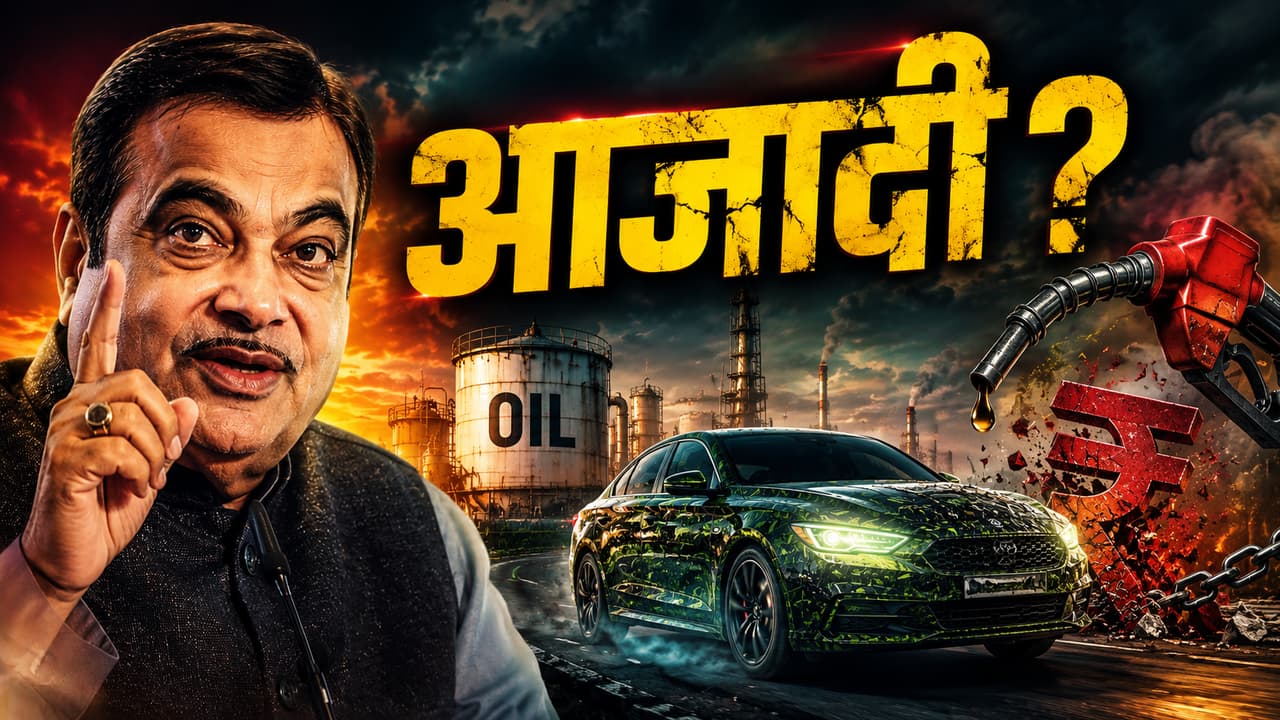
Will 100% ethanol vehicles from 12 companies end the era of petrol-diesel in India? Will Nitin Gadkari’s flex-fuel plan be able to free the country from dependence on oil imports? Will the increasing demand for ethanol increase farmers’ income or create a new crisis on food security? Is the country’s fuel network ready for 100% ethanol vehicles, or will big challenges arise?
New Delhi: A new golden chapter is going to be added in the history of India’s automobile sector and energy security. To free the country from costly and polluting crude oil imports, the Modi government has taken the biggest and decisive step till date towards ‘flex-fuel mobility’. Union Road Transport and Highways Minister Nitin Gadkari has announced that 12 major automobile companies of the country including Maruti Suzuki, Tata, Mahindra and Toyota are all set to launch vehicles running on 100% ethanol (E100) in the mass market very soon. With this historic announcement, Gadkari clearly said, “Now we do not have to see the face of petrol.”
Why such a big bet on ethanol?
India imports crude oil worth billions of dollars every year. This increases the country’s import bill and the fluctuations in global oil prices directly impact the common people. The government believes that ethanol-based fuel will not only save foreign exchange but will also help in increasing the income of farmers. Ethanol prepared from sugarcane, corn and other agricultural products will no longer be limited to just mixed fuel, but can completely become a medium for driving vehicles.
‘Annadata’ will now become ‘Eandhandata’: Golden opportunity or new challenge for farmers?
Putting this new vision before the country, Nitin Gadkari said that India imports about 87 percent of its requirement of petrol, diesel and gas from other countries. Due to this, not only lakhs of crores of rupees go out of the country, but the pollution graph in our cities also reaches dangerous levels. Gadkari said, “We have made our farmers not just food providers, but energy providers and now ‘fuel providers’.” Ethanol produced from sugarcane, corn and rice straw (biomass) will now directly power the engines of vehicles, which will put money in the pockets of the country’s farmers and bring an unprecedented boom in the rural economy.
Maruti and Hero made the first move, the journey of ‘flex-fuel’ started
This mega-campaign has already started with a bang. Recently, during the ‘India Goes Flex’ event held in the capital Delhi, Maruti Suzuki unveiled the country’s first mass-market flex-fuel passenger car, WagonR Flex-Fuel in the presence of Nitin Gadkari himself and Union Petroleum Minister Hardeep Singh Puri. This car can run smoothly on E20 to pure 100% ethanol (E100). Not only cars, there has been a revolution in the world of two-wheelers too. Hero MotoCorp has unveiled the flex-fuel variants of its most popular bikes Splendor+ and HF Deluxe, which will be available for sale in select areas of Delhi and Maharashtra from July this year.
Are the country’s petrol pumps going to be closed? Know what is the government’s masterplan
To completely eliminate dependence on crude oil, the government is going to change not just the vehicles but the entire fuel infrastructure (ecosystem). The biggest suspense due to this step of the government is whether the traditional petrol pumps will be closed? According to Union Petroleum Minister Hardeep Singh Puri, the government is setting up special fuel stations of 100% ethanol in major cities of the country. The number of ethanol stations in the country is targeted to be increased to 500 soon and to 5,000 in the coming years. Hyundai has also introduced the flex-fuel version of its most popular SUV ‘Creta’, which is ready to rule the roads in the coming times.
Big savings of ₹1.44 lakh crore and the dream of pollution free India
This aggressive stance of Gadkari and the preparations of automobile companies have made it clear that India will no longer be dependent on Gulf countries (Middle East) and global tensions for oil. If even 50% of new two-wheelers and four-wheelers sold in the country shift to flex-fuel, it would lead to direct foreign exchange savings of ₹1.44 lakh crore for India. Apart from this, carbon emissions are extremely low when ethanol is burnt, which will provide great relief from pollution to the entire country including Delhi-NCR. Gadkari said that the day is not far when India will change from an energy importing country to the world’s largest ‘energy exporter’ country.
After all, what is Gadkari’s ultimate goal?
Gadkari has been a long-time advocate of alternative fuels. He believes that the biggest need of the hour is to make India self-reliant in the field of energy. The plan for 100% ethanol vehicles is being considered an important step in this direction. The announcement of the launch of vehicles from 12 companies has increased the excitement, but the real test will be when these vehicles hit the common roads.