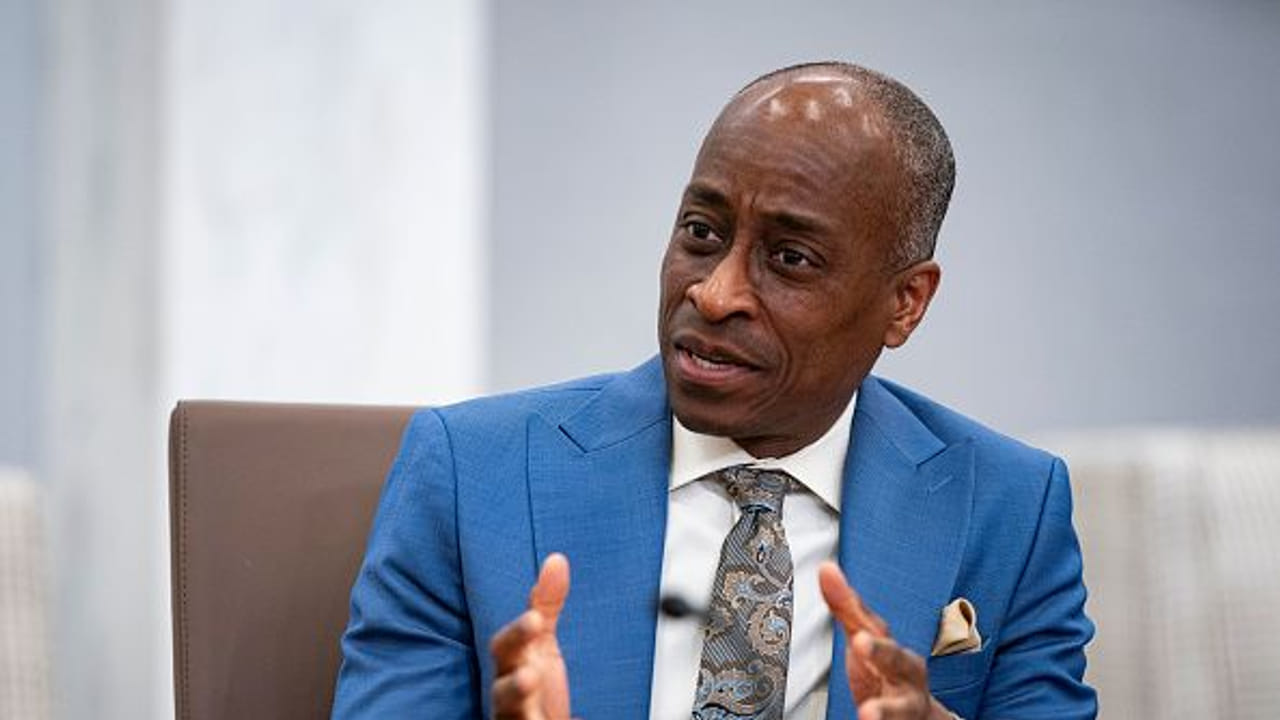
The Fed Vice Chair said AI poses a particular challenge for monetary policymakers because its effects on demand and supply can emerge at different times.
- Jefferson says the recent Middle East-linked energy price shock presents a tradeoff between inflation and employment risks.
- A stronger response to inflation would be warranted if expectations risk becoming unanchored, he said.
- Jefferson said AI could displace some workers while also creating new jobs and businesses.
Federal Reserve Vice Chair Philip Jefferson said Thursday that the ongoing artificial intelligence (AI) buildout is putting upward pressure on demand and inflation, although future productivity improvements could help ease price pressures while supporting economic growth.
Speaking at an International Monetary Fund (IMF) and Central Bank of Brazil conference in Brasília, Jefferson said AI presents a challenge for monetary policymakers because its effects on economic demand and supply can emerge at different times.
Shocks that affect both aggregate supply and aggregate demand but with differential timing are especially challenging for monetary policymakers, Jefferson said, adding that the “rapid adoption of artificial intelligence (AI) represents such a shock”.
AI Investment Boosting Demand And Inflation
Jefferson noted that business adoption of AI has increased considerably over the past two years, with optimism surrounding the technology driving investment in data centers, advanced computing equipment and related products.
“Currently, the AI buildout is exerting upward pressure on demand and inflation. In the future, advancements in productivity could exert downward pressure on inflation while continuing to support growth,” the Fed official said.
Jefferson also discussed AI’s potential effects on employment, saying the technology could displace some workers, creating challenges for affected households. At the same time, he said AI could create new jobs and businesses.
On Energy Prices, Fed’s Dual Mandate
The recent increase in oil prices tied to the Middle East conflict illustrates how economic shocks can push inflation higher while weighing on real incomes and demand, the Fed Vice Chair noted.
Jefferson highlighted that U.S. inflation was already above the Federal Reserve’s 2% target when the energy price shock occurred. “If inflation expectations risk becoming unanchored, a stronger reaction to inflation is warranted,” he said.
According to Jefferson, if price pressures remain contained, prioritizing downside risks to employment may be prudent. Policymakers must assess energy, trade and AI shocks simultaneously while keeping monetary policy appropriately calibrated to their mandates, he said.
U.S. Stocks In The Red
At the time of this writing, major stock indices were in the red. The tech-heavy Nasdaq was down more than 1.5% after gaining as much as 2% earlier in the session. The S&P 500 fell more than 1%, and the Dow Jones Industrial Average plunged more than 2%.
On Stocktwits, retail investors’ sentiment around the SPDR Dow Jones Industrial Average ETF Trust (DIA) fell to ‘bearish’, while sentiment for both SPDR S&P 500 ETF (SPY), which tracks the S&P 500, and Invesco QQQ Trust (QQQ), which tracks the Nasdaq-100, remained ‘bullish’.
See Also: Dario Amodei Says Anthropic Hopes To Achieve Investment-Grade Rating, Use Debt Financing In Future
For updates and corrections, email newsroom[at]stocktwits[dot]com<