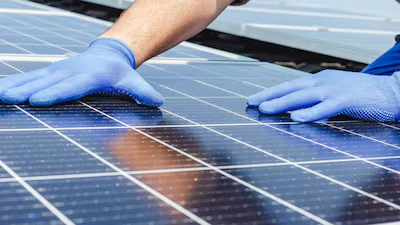
With the Central government’s PM Surya Ghar: Muft Bijli Yojana offering its highest subsidy for a 3-kilowatt (kW) rooftop solar installation, this system has emerged as one of the most popular choices for middle-class households.
For a middle class family, a 3 kW solar system is often sufficient to meet most daily electricity requirements while significantly reducing power bills, says CEEW expert Bhavana Tyagi as cited by News 18 Hindi.
How much solar power can a 3 kW system deliver?
A 3 kW rooftop solar installation can generate around 12 units of electricity per day when operating under optimal sunlight conditions, said Bhavana, as per News 18 Hindi. Actual output may vary depending on factors such as location, weather, season and rooftop conditions, but this level of generation is generally considered adequate for an average household.
According to solar Bhavana, a 3 kW system is sufficient for a family of around six members. It can comfortably support essential household appliances, including 8-10 LED bulbs, 2-3 fans, a cooler, a refrigerator, an LED television, a Wi-Fi router, a washing machine and a water motor for a few hours every day.
The exact number of appliances that can be operated simultaneously depends on electricity consumption patterns and appliance efficiency.
Cost of installation?
The installation cost of a 3 kW rooftop solar system differs across states and depends on the quality of solar panels, inverter specifications and installation charges.
An on-grid system, which does not include battery storage, generally costs between ₹1.5 lakh and ₹1.8 lakh. Hybrid systems with limited battery backup are priced between ₹2 lakh and ₹3 lakh, while fully off-grid systems with batteries can cost ₹2.5 lakh to ₹4 lakh or more.
Available subsidy?
The PM Surya Ghar: Muft Bijli Yojana provides a Central subsidy of up to ₹78,000 for rooftop solar systems of 3 kW and above. Notably, the subsidy amount does not increase beyond the 3 kW capacity threshold, making it the most subsidy-efficient system size for households.
In addition to the Central assistance, Bhavana said that several state governments are offering extra incentives. Uttar Pradesh provides an additional subsidy of up to ₹30,000 for systems of 3 kW and above.
Haryana offers up to ₹10,000 per kW for regular households, subject to a maximum of ₹20,000, while eligible Antyodaya families can receive up to ₹25,000 per kW. Bihar also provides an additional subsidy of up to ₹45,000 for 3 kW installations.
Is 3 KW system suitable for your home?
For households with around six members and a 3BHK residence, a 3 kW rooftop solar system is generally considered sufficient to meet everyday electricity requirements.
All in all with substantial subsidies available from both the Centre and several state governments, the system has emerged as a cost-effective option for families looking to adopt solar power and lower their long-term electricity expenses.