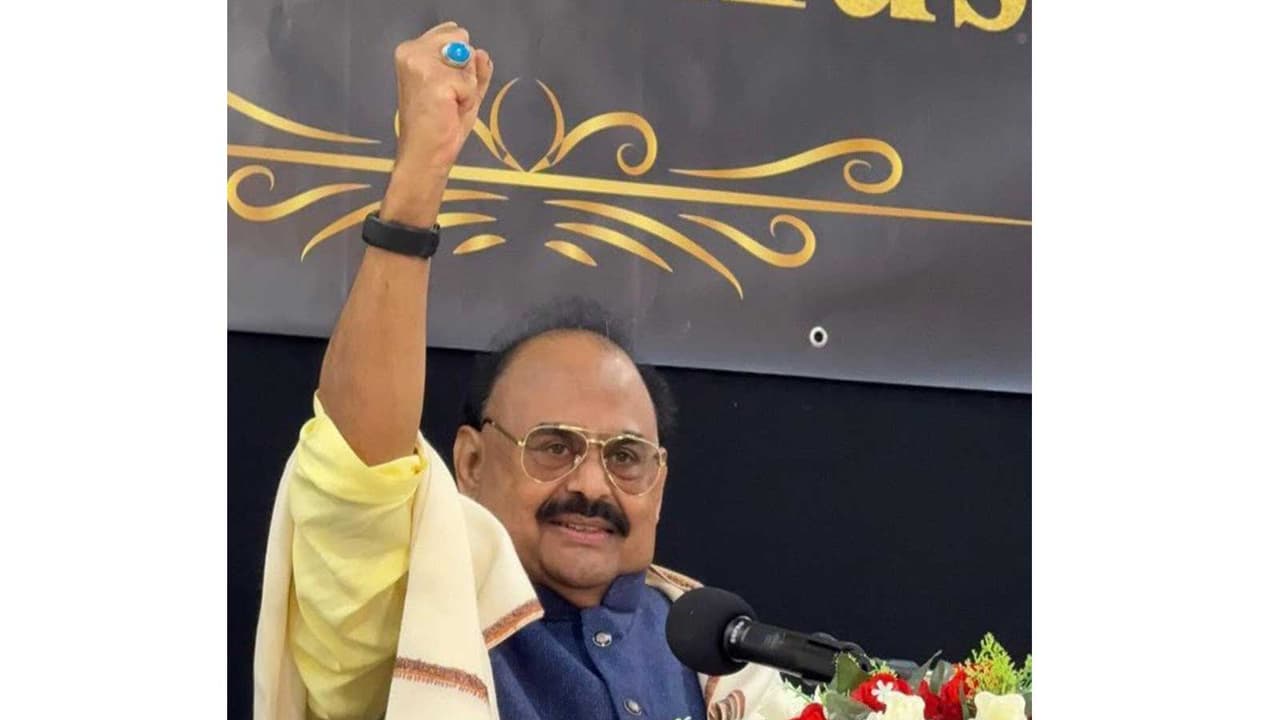
MQM leader Altaf Hussain slams Pakistan’s military-dominated political system, questioning democratic autonomy and alleging that civilian governments remain under the control of generals, preventing true legislative independence in the nation.
Altaf Hussain Questions Pakistan’s Political Autonomy
Muttahida Qaumi Movement (MQM) leader Altaf Hussain has criticised Pakistan’s political and military establishment, alleging that successive civilian governments and elected institutions have operated under the influence of military generals, while questioning the country’s democratic autonomy and political system, according to a series of remarks shared by him on X.
In his post, Hussain drew a distinction between the manifestos of political parties and the ideological foundations of revolutionary movements, arguing that political party manifestos are generally confined to their respective countries, whereas genuine ideological movements transcend geographical boundaries. He said political parties prepare manifestos focused on development and public welfare within their own countries and expand their agendas during election campaigns. However, he argued that the ideologies of movements seeking fundamental systemic change cannot be restricted by national borders. According to Hussain, the objective of ideological movements is to challenge oppressive political systems and forms of governance and bring about structural change, irrespective of geographical boundaries.
Critique of Pakistan’s Political Structure
Turning his criticism towards Pakistan’s political structure, the MQM leader alleged that an outdated feudal and hereditary system, dominated by a handful of influential families, had continued to prevail in the country since its creation. Referring to Pakistan’s political history, from its founder Quaid-e-Azam Muhammad Ali Jinnah to the present day, Hussain claimed that successive political parties, coalitions, presidents, prime ministers and civilian governments had functioned under the influence, pressure and preferences of military generals.
Lack of Independent Parliament
He argued that a legislative body elected by the people cannot be considered an independent parliament if its collective decisions are dictated or influenced by military leadership. “If any legislative body established as a result of elections cannot make a collective decision, or if its collective decision is under the influence of military generals’ directives, then we cannot call such a parliament a free and autonomous parliament,” Hussain said, according to his post.
He further maintained that the issue was not limited to Pakistan, alleging that in several countries where elected governments remained subordinate to military establishments, foreign policy decisions were also determined by military leadership rather than elected parliaments.
Allegations Against Current Political Leadership
He also referred to the reported imprisonment of Imran Khan’s sisters and made allegations regarding political developments in Khyber Pakhtunkhwa (KPK), where PTI had formed a government with a two-thirds majority. Hussain alleged that the elected chief minister had been abducted and that governor’s rule and an emergency had subsequently been imposed in the province.
Criticising Pakistan Peoples Party (PPP) Chairman Asif Ali Zardari and Pakistan Muslim League-Nawaz (PML-N) Prime Minister Shehbaz Sharif, Hussain claimed that Zardari had signed the decree for governor’s rule, while Shehbaz Sharif had proposed the measure. He further alleged that Shehbaz Sharif’s government had come to power through what he described as Form 47, and accused both the PPP and PML-N of prioritising their respective family and party interests over Pakistan and its people.
Hussain also questioned the position of PTI leaders, claiming that a majority of the party’s leadership had been compromised. The MQM leader reiterated his criticism of Pakistan’s political system, arguing that genuine political and ideological movements must challenge entrenched power structures rather than remain confined to conventional party politics.
(Except for the headline, this story has not been edited by Asianetnews Editorial staff and is published from a syndicated feed.)