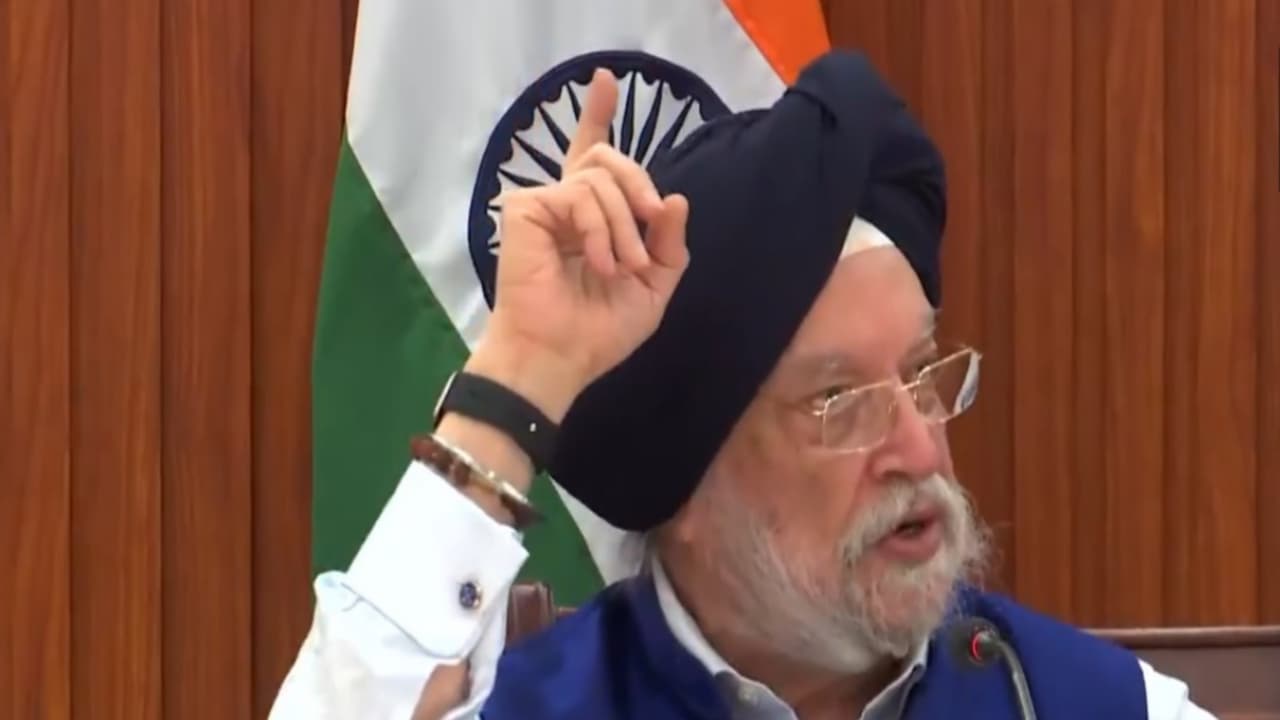
Union Minister Hardeep Singh Puri confronted Congress over the 1984 anti-Sikh riots ahead of the INDIA bloc’s rally, questioning their commitment to the Constitution while recalling the 42nd anniversary of the tragic mass violence in Delhi.
Hardeep Singh Puri Criticizes Congress Ahead of INDIA Bloc Rally
New Delhi [India], October 31 (ANI): Ahead of the INDIA bloc’s mega-rally at Ramlila Maidan on Sunday, Union Minister Hardeep Singh Puri on Saturday questioned the Congress over the 1984 anti-Sikh riots, asking those who consider themselves guardians of the Constitution to explain their role in the violence, while recalling the tragedy on the eve of its 42nd anniversary. INDIA bloc leaders are expected to demand the resignation of Chief Election Commissioner (CEC) Gyanesh Kumar over the Special Intensive Revision (SIR) of electoral rolls in the rally. The rally is expected to witness participation from opposition parties and workers from across the country. Several parties, including those from southern states, have extended support to the proposed mobilisation, with multiple Chief Ministers and senior Congress leaders expected to participate.
Puri Demands Accountability for 1984 Violence
Questioning the Congress over the events of 1984, Puri said those who raise concerns about constitutional safeguards must also answer questions about the violence against the Sikh community. “A question must be posed to those who consider themselves the guardians of our Constitution… What did you do in 1984? If you believe there are issues concerning the Constitution that require attention, then by all means, discuss them in Parliament—or choose not to. However, the conspiracy that was orchestrated—the events that unfolded on the night of October 30–31, 1984—was of a distinct and exceptionally dangerous nature; it was a plan to perpetrate atrocities on a massive scale,” Puri said.
Warnings Against Political Mobilisation
Referring to the INDIA bloc’s proposed political mobilisation, the Union Minister said he believed a grave political error was being made and cautioned against inviting physical violence and upheaval. “As for current schemes and the intentions behind them, I believe a grave political error is being made. When we speak of constitutional safeguards, and if you are inviting the kind of physical violence and upheaval that we have witnessed elsewhere—I need not name those places—then consider the appeal made by our business community,” he added.
Earlier, Puri recalled the violence that took place following the assassination of former Prime Minister Indira Gandhi, describing November 1 as one of the darkest days in Delhi’s history. “Tomorrow, November 1st, marks the 42nd anniversary of one of the darkest days in Delhi’s history. For Sikh families, this date brings back memories of relatives who were murdered and homes that were reduced to ashes,” he said.
Justice Efforts and Judicial Findings
Puri also acknowledged the contribution of senior advocate and BJP leader HS Phoolka, who has spent more than four decades pursuing justice for the victims of the riots. “One individual who has dedicated over four decades to helping the victims secure justice—remaining steadfast in his resolve and, alongside their legal counsel, keeping these cases alive despite threats and persistent delays—is HS Phoolka,” he said.
Terming Indira Gandhi’s assassination a profound tragedy, Puri said the subsequent violence against the Sikh community could not be justified under any circumstances. “The assassination of Prime Minister Indira Gandhi—regardless of one’s perspective—was a profound tragedy. The collective punishment subsequently inflicted upon the Sikh community cannot be justified under any circumstances,” he said.
Citing official figures, Puri said a total of 3,325 people were killed across India during the 1984 anti-Sikh riots, of which 2,733 deaths were recorded in Delhi alone. Referring to the judicial proceedings in the cases related to the violence, Puri said the Delhi High Court had described the mass killings as crimes against humanity and found that the perpetrators had benefited from political patronage and failures of law enforcement. “On 17th December 2018, it convicted Congress leader Sajjan Kumar in the cases concerning five killings in Raj Nagar and sentenced him to imprisonment for the rest of his natural life,” he said. “We must ensure that such heinous acts against innocent civilians never take place again,” Puri added.
HS Phoolka Details Premeditated Conspiracy
Meanwhile, Senior Advocate and BJP leader HS Phoolka recalled the sequence of events surrounding the outbreak of violence in Delhi on October 31, 1984, and alleged that the attacks on the Sikh community were organised and premeditated. “Forty-two years ago, on October 31, 1984—at around this very time—the first attack on a Sikh took place in Delhi,” Phoolka said.
Referring to the role of the President of India and the sequence of events surrounding the violence, Phoolka said, “The President of India… This is where the violence began.” Recalling the evidence presented before the Mishra Commission, Phoolka said fire brigade records were used to establish that the mob had originated from the All India Institute of Medical Sciences (AIIMS) and moved in three different directions. He alleged that meetings had taken place during the night, well before the morning of November 1, and that a comprehensive plan had already been devised to target the Sikh community. “Such precise lists of Sikh homes could not have been compiled overnight; they must have been prepared much earlier,” he said.
Phoolka further alleged that in several instances, police personnel reached Gurdwaras and instructed Sikhs to return to their homes, assuring them that security would be provided and the religious places protected. However, he claimed that the Gurdwaras were the first to be set ablaze, followed by attacks on Sikh homes. He also alleged that the FIRs registered at police stations across Delhi contained identical language, pointing to similarities in the manner in which the cases were recorded.
Questioning the investigation into the killings, Phoolka claimed that no proper records were maintained of individual deaths in the aftermath of the violence. “In the aftermath, no records were kept of the individual killings—whether 100 or 200 people were murdered in a given area—and no FIRs were registered for any of these deaths,” he said.
Describing the violence as part of a highly organised conspiracy, Phoolka rejected its characterisation as a conflict between two religious communities. “This was not a case of ‘Hindus versus Sikhs’; rather, it was ‘the Congress versus the Sikhs.’ Anyone who supported the Congress was complicit in these killings. Conversely, those who did not support the Congress—whether affiliated with the BJP, Communist parties, or unaffiliated with any political party—worked to protect the Sikhs,” he said. (ANI)
(Except for the headline, this story has not been edited by Asianetnews Editorial staff and is published from a syndicated feed.)