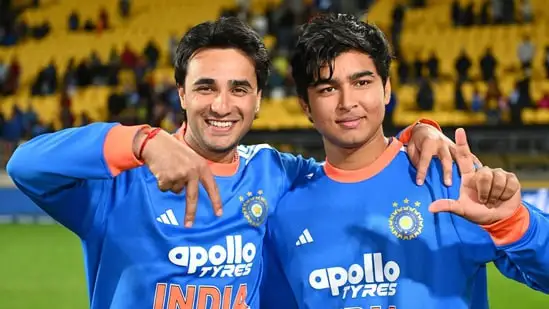
India no longer need to find their perfect opening pair. They need only pick two. That is the extraordinary luxury of their T20 batting revolution.
Abhishek Sharma can take apart bowlers. Sanju Samson does it with a different tempo. Ishan Kishan can turn a match on its head, while Vaibhav Sooryavanshi, at just 15, has already displayed the mettle needed to rattle bowlers.
Their numbers as openers are pretty startling too. Since the 2024 T20 World Cup, Abhishek has scored 2,216 runs in 67 innings at a strike rate of 198.21. Samson has made 1,229 in 39 innings at 181. Kishan’s 176 runs in five innings have come at 193.40, while Sooryavanshi has scored 291 in nine innings at 192.71. Four players with four different temperaments but one shared ambition-make the opposition pay from the outset.
This is the age of the great Indian T20I opener, and its defining feature may be that no single combination needs to be permanent. India’s batting evolution hasn’t been just about hitting harder but to change the way India approach the opening overs. Gone is the time when a good start meant negotiating the new ball, protecting wickets and laying the foundation for a late assault. Now the opening pair spearheads the assault, with the first six overs providing an ideal opportunity to seize it.
With four T20I hundreds in the last two years, Abhishek is the most compelling expression of this philosophy. His approach is not built around accumulating runs towards a personal milestone. And the freedom to pursue it comes from a team environment that accepts risk rather than punishing every failure.
Abhishek’s comments about batting with Sooryavanshi on Tuesday offered a glimpse into that environment. “I think the key was simple. Me and Vaibhav were going to enjoy some time in the middle,” he said after the third T20I. He credited the preparation behind the scenes, including the coaches and the sidearm sessions, and spoke of wanting to carry the momentum from practice into the game. There is a method behind the apparent madness-India’s batters prepare to attack; they do not simply hope to get away with it.
Sooryavanshi’s arrival heightens the theatre around the top two. Earlier expected to wait for his turn, Sooryavanshi converted Kishan’s injury as an opportunity on this tour. He has been given the opportunity to play his game alongside players who understood pretty early that age need not dictate intent.
Abhishek has spoken of making the youngster feel that he belongs, describing the responsibility of senior players to make him comfortable. It’s a striking contrast with the old apprenticeship model-the next generation is being encouraged to play its shots now, not after it has earned the so-called strides.
Samson, meanwhile, has shown that this philosophy does not require every batter to have an identical method. After India’s first T20I against the West Indies, he described his conversations with Abhishek with disarming simplicity: “We do have conversations but it does not make any sense. We just watch the ball and hit it hard.”
Quite basic and mundane, the line captures something real though. At this level, the freedom to react instinctively is a product of preparation and trust, something Abhishek even went to the extent of saying he manifests.
The point is not to make batting thoughtless, but to avoid allowing too many thoughts to clutter the overbearing clarity to see the ball, hit the ball. Kishan offered the clearest explanation of how such freedom can work within a partnership. After sharing a 121-run stand with Abhishek against Afghanistan in September, he acknowledged that his own measured innings had been shaped by the aggression at the other end.
“I think I played a one-day innings today because Abhishek was there and he was playing good shots,” Kishan said. “I wanted Abhishek to have that momentum and keep going.” But he made clear that the arrangement was flexible-if Abhishek were struggling, he could take on the attacking role himself.
That is the real strength of India’s options. Aggression does not mean both openers must swing at everything. One can dictate the tempo while the other reads the conditions, supports the assault and takes over when required. The roles are interchangeable because the underlying ambition is shared. “The focus is on winning matches, not personal milestones,” Kishan said.
There are downsides to this approach, of course. Strike rates hovering around 200 don’t guarantee consistency, and even the most destructive batters are bound to have lean spells. A small sample of innings cannot establish that Sooryavanshi will sustain his early returns over the years.
Selection debates will continue, and opposition teams will devise plans to slow India down. But the depth changes the equation. India can experiment with combinations without abandoning their approach. They can choose left-handers, right-handers, experience or youth, confident that the next player can offer another version of the same threat.
India’s T20 opening tradition was already formidable in the days of Rohit Sharma and Shikhar Dhawan, and later Rohit and KL Rahul. What distinguishes the current crop though is the sheer number of players capable of producing a devastating start, and the freedom they have to do it their way. For opposition captains, the problem is no longer just how to dismiss one dangerous batter. It is how to prevent the next one from picking up where he left off.
India must be savouring this high. For now they have the option of going with Abhishek and Samson as a preferred pair for most games, unleashing Sooryavanshi on specific occasions, like they did in Wellington. They may discover that certain combinations work better against particular attacks or on particular surfaces. But the luxury is that their identity does not depend on a single pairing. The names can change, but not the intent.