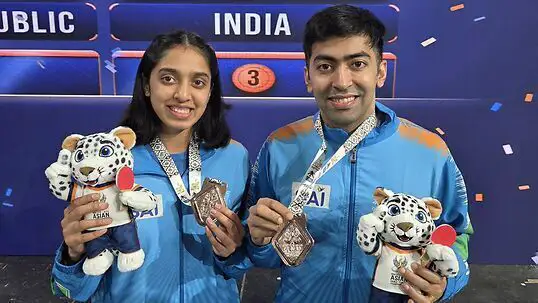
Acouple of years ago, Harmeet Desai could not even imagine playing mixed doubles, let alone winning a medal. But belief can make wonderful things happen.
At the Asian Championships in Tashkent, Harmeet, pairing up with Yashaswini Ghorpade, pulled off a remarkable result for India.
The duo beat South Korea’s Park Ganghyeon and Lee Daeun 3-2 (11-6, 8-11, 8-11, 11-9, 11-9) in a thrilling quarterfinal clash to secure a bronze medal and end India’s 72-year wait. Yatin Vyas and Meena Parande were the last Indians to win a mixed doubles silver in 1954.
The result had been in the making for some time. A scratch pair, put together just before the 2024 Paris Olympics to see how things would work out, had struck the right chord. The idea was driven by mixed doubles’ inclusion in the team event for the Los Angeles Olympics and 22-year-old Yashaswini’s fierce attacking ability.
“I had been following Yashaswini for a couple of years before that, and I had never seen anyone attack the ball the way she did with her pimple rubbers. That was kind of an X-factor in mixed doubles. I thought that if I could improve certain aspects of my game, we could become a very good mixed doubles pair,” Harmeet told Sports Now.
Yashaswini, he acknowledged, already possessed a ferocious attack and brilliant receiving skills with her pimple rubbers. Harmeet knew he had to raise his game to complement her strengths, and his efforts paid off. He developed a venomous counter-attacking game that is now among the fiercest in the world.
It was never easy, though. Against Park and Lee in the quarterfinals, the Indians set the tempo by winning the opening game. Yet Harmeet was not convinced they could pull off the victory. Yashaswini, however, remained unfazed even when the Koreans surged to a 7-1 lead in the fourth game.
“Definitely, I believed we could do something good at the Asian Championships and win a medal, but the match had its ups and downs. My belief was shaken a bit because we started well but couldn’t convert our chances in the second and third games. I began to feel that it was going to be really hard, and my confidence started to waver,” Harmeet admitted.
Yashaswini pushes Harmeet
The Indians’ strategy from the outset was simple: attack aggressively and hold their ground. They put Park and Lee under immense pressure. Harmeet stepped out of his comfort zone, defending from away from the table. In the process, he created opportunities for counter-attacks, while Yashaswini’s ability to receive serves with her pimple rubbers kept the Indians in contention for a historic medal.
“I hardly believed we could turn it around against such a tough opponents, but Yashaswini kept believing. She also told me, ‘Bhaiya, we can still make it happen’. She strongly believed we could do it. Her energy motivated me, too. I thought that if she believed in us, I had to push really hard and try to make it happen,” Harmeet added.
As the Indians levelled things up by taking the fourth game, Harmeet grew in confidence and mounted a strong challenge to wrest the match from Park and Lee.
Their bid to go one better and match Yatin and Meena, however, ended in a hard-fought semifinal defeat to Sora Matsushima and Miwa Harimoto.
‘Mixed doubles was not my cup of tea’
A medal of this magnitude tends to instill confidence and fuel ambitions for bigger goals. But when Harmeet and Yashaswini first paired up, he simply wanted to see how he would fare in the discipline. Winning a medal was far from his mind.
“It feels very, very special to win a mixed doubles medal at this stage of my career. If somebody had asked me a couple of years ago, I would not even have dreamed of or imagined winning a medal in mixed doubles because it was never my cup of tea. I was really not very good at mixed doubles a few years ago. I was good in men’s doubles, team events and singles, but mixed doubles was not my cup of tea,” Harmeet admitted.
“We went without any expectations. We just wanted to try it out at first, and we got some good results early on,” he said.
At their breakthrough tournament, the WTT Saudi Smash 2024, Harmeet and Yashaswini stunned the then world No. 6 Spanish pair of Alvaro Robles and Maria Xiao. The result gave their partnership a much-needed boost, helping them understand each other’s game and strengthening their resolve to improve.
“I got to know what I needed to improve. My singles game has mostly been about attacking, and I had never really focused on counter-attacking, passive play or playing from a distance,” he said.
Rejigging the style
Having played close to the table for most of his career, 33-year-old Harmeet needed to rejig his game to complement Yashaswini’s attacking instincts. Over the last two years, he has developed a potent counter-attacking weapon that can unsettle any opponent.
It was not an overnight transformation, though. “Changing my game style to counter-attacking, or moving away from the table to play from mid-distance, was not something that happened overnight. I have been trying to implement these changes for the last two years, and gradually, I started improving,” Harmeet noted.
“I would say that I am quite good at it. There is still room for improvement, but I am really good at pouncing when I get an opportunity. I now have a very lethal counter-attacking game, and my opponents are really scared of my counter-attack,” he said.
Going forward, Harmeet hopes to strengthen his counter-attacking game while helping Yashaswini further hone her receiving skills. “That will give us versatility and a lot of variation because both of us have weapons that can threaten our opponents,” Harmeet added.
Deeply satisfying
The medal now carries deep personal significance for Harmeet. He became a father in August, making the podium finish all the more special.
“This medal is very, very special to me because I never thought I could win a medal at such a big event. It is really close to my heart. Another special thing about this medal is that it is my first Asian Championships since my baby boy was born just two months ago. He has been really lucky for me, and winning a medal at such a big event makes it even more special,” Harmeet said.
The medal also augurs well for Indian table tennis. After won mixed doubles bronze at the Asian Games, securing India’s third table tennis medal in a row at the Games, Harmeet and Yashaswini kept the country’s medal streak intact at the Asian Championships. It was India’s fourth consecutive medal at the continental event.
Such consistency, Harmeet believes, will help Indian players shed the perception that they are “only good at the Commonwealth level.”
For Harmeet, the result offers both confidence and confirmation that Indian paddlers can compete with the best in the world. It has also brought the country a step closer to its Olympic ambitions.
“It gives us a lot of confidence and shows all the players that we can do it. It definitely puts India on the global stage, where we can make an impact and cause bigger upsets. Our aim next time will be to change the colour of the medal at the Asian level and then win a medal at the Olympics,” Harmeet signed off.