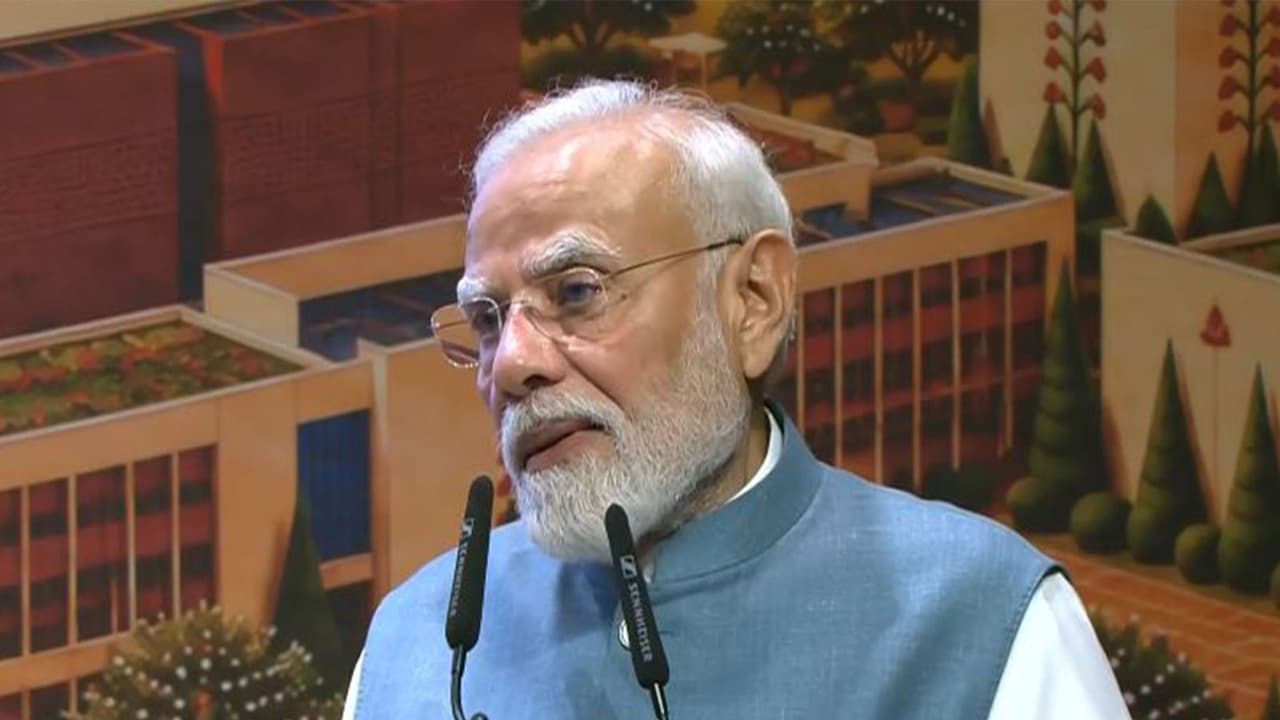
PM Modi inaugurated the RBI’s new Data Centre and Cybersecurity Institute in Bhubaneswar, emphasizing a shift toward digital banking, financial inclusion, and balanced regional development to empower every citizen across India’s diverse landscape.
RBI Data Centre and Cybersecurity Institute Inaugurated
Prime Minister Narendra Modi on Sunday inaugurated the Reserve Bank of India’s (RBI) newly established Data Centre and Cybersecurity Training Institute in Bhubaneswar, Odisha, describing the occasion as a significant step towards strengthening the country’s institutional and technological capabilities while highlighting the transformation in governance, financial inclusion and digital banking. “With the blessings of Mahaprabhu, today Bhubaneswar is giving a new institution to New India,” PM Modi said, describing the inauguration as a momentous occasion that would benefit the people of Odisha as well as the entire country.
Extending his congratulations to the RBI and those associated with the project, the Prime Minister said the event reflected the changing approach to governance in India, with an emphasis on prioritising development, expanding its reach and ensuring that its benefits reach the last person. “Today’s event is a testament to how the approach to governance in India is transforming, and how rapidly it is changing,” he said.
Prioritizing Balanced Development
PM Modi said the focus of governance was on the “prioritisation of development, the expansion of development, and the reach of development to the very last person”. Recalling the development challenges faced by the country in the decades following Independence, the Prime Minister said major cities had received significant infrastructure and institutional investment, while several smaller towns, remote regions and villages continued to struggle for basic amenities.
“After independence, large cities were developed in the country, major institutions were established, big hospitals were built, and large airports were constructed; yet, a very large part of the country was left waiting for basic amenities,” he said.
He pointed out that people in smaller towns and remote areas often had to travel long distances for better medical treatment, while air connectivity remained concentrated in major cities. In many villages, basic necessities such as roads, electricity and water continued to pose challenges, he said.
PM Modi also highlighted the need to modernise railway stations, noting that they were central to the journeys of ordinary citizens but often lacked modern facilities. “While there were certain amenities in large cities, in numerous villages even fundamental necessities like roads, electricity, and water remained a formidable challenge. Railway stations were the most critical part of an ordinary citizen’s journey, yet these railway stations lacked modern amenities,” he said.
He said the government had sought to address these disparities by adopting a model of people-centric and proactive governance, with balanced development across cities, towns and villages. “For us, development means the balanced development of India. Opportunities for villages as well as opportunities for small towns,” he said.
Transformation of the Banking Sector
Turning to the banking sector, the Prime Minister said financial services had historically remained inaccessible to large sections of society, including poor and middle-class families, small farmers and women. He referred to the nationalisation of banks in the 1960s and 1970s, saying that despite the stated objective of helping the poor, more than half of the country’s population remained outside the banking ecosystem until 2014.
“Things like bank loans were a distant dream even for the middle class. The poor, small farmers, the landless, and our sisters and daughters could not even conceive of them,” he said.
PM Modi contrasted the earlier system with the expansion of digital banking, which he said had brought round-the-clock banking services within the reach of citizens across the country. He also criticised the Congress-led system of what he described as “phone banking”, alleging that influential individuals with connections to the party had secured loans worth thousands of crores of rupees through phone calls.
“Before 2014, an entirely different era of ‘phone banking’ prevailed. In Delhi, certain favoured individuals close to the Congress and those with influential connections were granted bank loans worth thousands of crores of rupees simply over phone calls,” PM Modi said.
He contrasted this with the difficulties faced by ordinary citizens, who, he said, often needed guarantors even to open bank accounts, while large loans were made available to influential individuals. “It was the consequence of this very mismanagement that pushed India’s banking system into the grip of NPAs, driving it to the brink of ruin,” he said, referring to non-performing assets.
Financial Inclusion and Social Security
PM Modi said the digital ecosystem developed under the Digital India initiative had helped expand access to banking and contributed to strengthening the sector. “The systems built by the country in recent years and the digital ecosystem developed under Digital India have brought banking within reach of every citizen. Today, India’s banking sector stands among the strongest in the world,” he said.
He contrasted the earlier system of phone banking with the expansion of digital financial services, saying the latter had enabled households across the country to benefit. “In the past, ‘phone banking’ benefited only those who had access to a select family in Delhi. Today, through digital banking, every household across the nation has become a beneficiary,” he said.
Highlighting the role of direct benefit transfers and financial inclusion, PM Modi recalled a former Prime Minister’s statement that only 15 paise reached the intended beneficiaries when one rupee was sent from Delhi. “That was one era, and this is the present day. Today, when one rupee leaves Delhi, the entire one rupee reaches the bank account of every beneficiary,” he said.
He attributed the change to the expansion of the Pradhan Mantri Jan Dhan Yojana, noting that nearly 59 to 60 crore Jan Dhan accounts had been opened across the country. The Prime Minister said formal banking had also expanded to sections of society that had traditionally remained outside the financial system, including small entrepreneurs, traditional artisans, street vendors and workers in the unorganised sector.
He also highlighted the wider availability of debit and credit cards, saying that financial products once largely associated with affluent sections of society had become more accessible. “Today, these are easily accessible to every citizen of the nation. Crores of RuPay credit cards and debit cards have been issued across the country,” he said.
The Prime Minister further said that the expansion of financial inclusion over the past decade had been accompanied by a wider social security network. “Over the past decade, alongside economic empowerment, there has also been an unprecedented expansion of the social security safety net,” he said. The inauguration of the RBI’s Data Centre and Cybersecurity Training Institute in Bhubaneswar marks the establishment of new institutional facilities in Odisha, which PM Modi said would benefit both the state and the country.
(Except for the headline, this story has not been edited by Asianetnews Editorial staff and is published from a syndicated feed.)