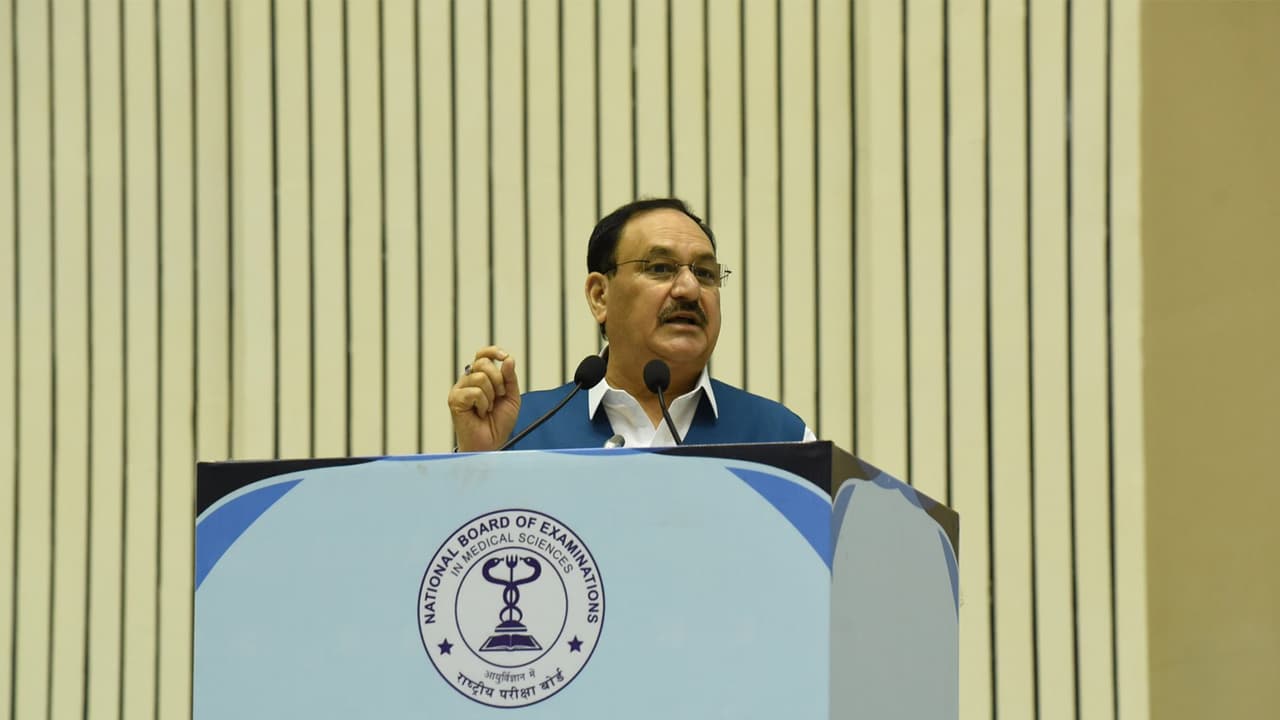
Union Health Minister JP Nadda addressed the 23rd NBEMS Convocation, lauding graduating doctors for their role in shaping India’s healthcare. He highlighted the massive expansion in medical education and the launch of 11 new academic courses.
Union Health Minister JP Nadda addressed the 23rd Convocation Ceremony of the National Board of Examinations in Medical Sciences (NBEMS), an autonomous body under the Ministry of Health and Family Welfare, held on Saturday in the national capital, Addressing the gathering, the Union Health Minister stated that the Convocation was not merely a ceremony for conferment of degrees, but a celebration of the dedication, perseverance and hard work of students, teachers and parents who have contributed immensely to the success of the graduating medical professionals, as per an official statement released by the Ministry of Health and Family Welfare He noted that the occasion was a proud moment for every family, mentor and institution associated with the graduating candidates.
The Union Health Minister remarked that by honouring the country’s emerging specialists, India is shaping the future of its healthcare ecosystem. He emphasised that the expertise, innovation and commitment of these young doctors would play a vital role in addressing the healthcare challenges of the nation and strengthening healthcare delivery systems across the country.
A Vision for Viksit Bharat and Skilled Doctors
Highlighting the vision of Viksit Bharat 2047 under the leadership of Prime Minister Narendra Modi, he stated that a healthy India forms the very foundation of a developed and self-reliant nation. He underlined that health is a key pillar for achieving national progress and sustainable development, and a strong healthcare system is indispensable for building an Atmanirbhar Bharat.
He emphasized that healthcare is not merely about creating physical infrastructure, but about nurturing skilled and compassionate doctors who form the backbone of the healthcare system. “As policymakers, we can facilitate infrastructure and systems, but while buildings constitute the hardware, doctors are the true software of healthcare,” he remarked.
NBEMS Initiatives and Contributions
The Union Health Minister expressed satisfaction that NBEMS qualifications have emerged as symbols of quality, excellence and trust in medical education. He noted that the NBEMS brand today commands national recognition for producing highly competent medical specialists dedicated to patient care and professional excellence.
He also lauded NBEMS for launching 11 new academic courses during the occasion, stating that these programmes would significantly contribute towards enhancing patient care, strengthening specialised healthcare services and benefiting society at large. Appreciating the implementation of the One Nation One Subscription (ONOS) initiative in institutions running NBEMS courses, he congratulated NBEMS for ensuring wider access to academic resources and learning opportunities for students and faculty members.
The Union Health Minister reaffirmed that NBEMS continues to make significant contributions towards strengthening medical education and capacity building in the country by producing skilled and committed healthcare professionals.
Transformative Expansion in Medical Education
Highlighting the transformative expansion of medical education over the past decade, he stated that India has witnessed unprecedented growth in healthcare infrastructure and medical institutions under the dynamic leadership of Prime Minister Narendra Modi. He noted that while the country had only one AIIMS till the end of the 20th century, six additional AIIMS were established during the tenure of former Prime Minister Atal Bihari Vajpayee. Since then, 16 new AIIMS have been added, taking the total number to 23 institutions across the country.
He further stated that the Government is now focused on strengthening all AIIMS institutions to match the standards of AIIMS New Delhi, while also enabling these premier institutions to mentor other medical colleges and healthcare institutions nationwide.
Future Investments and Seat Expansion
The Union Health Minister informed that the number of medical colleges in the country has increased from 387 to 818, while undergraduate medical seats have risen to nearly 1.28 lakh. Similarly, postgraduate medical seats have expanded from around 31,000 to nearly 85,000.
He further noted that Prime Minister Narendra Modi has announced the addition of 75,000 more UG and PG medical seats over the next five years, out of which nearly 23,000 seats have already been established in the past two years. He further informed that the Government has sanctioned nearly Rs 15,000 crore for the period from 2026 to 2029 towards strengthening undergraduate and postgraduate medical education infrastructure and enhancing quality standards in government medical colleges.
Minister’s Counsel to Graduating Doctors
The Union Health Minister emphasised that medical education is not merely an entitlement, but a privilege made possible through the combined efforts of the Government, teachers, institutions and society. He urged the graduating doctors to dedicate themselves towards serving society with compassion, integrity and commitment.
Urges Lifelong Learning and Compassion
Encouraging the young specialists to contribute towards medical teaching and academics, he stated that students should remain committed to continuous learning throughout their professional lives. He also underlined the importance of effective communication skills in medical practice and patient care.
Focus on Preventive Healthcare
Emphasising the need for a holistic healthcare approach, he stated that the focus of the healthcare system must increasingly shift towards preventive and promotive healthcare alongside curative care. Referring to the growing burden of Non-Communicable Diseases (NCDs), he stressed that lifestyle-related factors are emerging as major public health challenges and called upon healthcare professionals to actively promote awareness and healthy lifestyles among citizens.
He concluded by urging the graduating doctors to preserve their spirit of learning and intellectual curiosity throughout their careers, stating that lifelong learning remains essential for excellence in the medical profession.
Convocation Highlights and Key Launches
The Convocation marked a momentous academic and professional milestone for thousands of doctors across the country who completed various postgraduate and postdoctoral medical programmes conducted by NBEMS. During the ceremony, 26,396 eligible candidates were conferred DNB, DrNB, Diploma and FNB qualifications in recognition of their academic excellence, clinical proficiency and professional competence. In recognition of exceptional merit and outstanding academic performance, Gold Medals were conferred in person upon 137 toppers among NBEMS trainees across various specialities for their exemplary achievements in the NBEMS exit examinations.
During the event, the Union Health Minister also launched 11 new academic courses aimed at further strengthening specialised medical education and enhancing quality patient care across the country. The occasion also marked the launch of the One Nation One Subscription (ONOS) initiative, a Government-approved initiative aligned with the vision of building an Atmanirbhar Bharat. The initiative seeks to provide nationwide access to high-impact scholarly research articles, journals and academic publications for students, faculty members and researchers, thereby promoting equitable access to quality academic resources and strengthening the research ecosystem in medical education.
Punya Salila Srivastava, Union Health Secretary; Dr. Abhijat Sheth, President, NBEMS; faculty of NBEMS, students, and parents were present during the event. (ANI)
(Except for the headline, this story has not been edited by Asianet Newsable English staff and is published from a syndicated feed.)