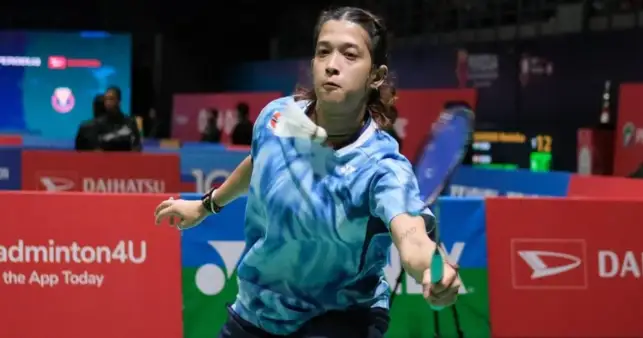
Indian badminton player Ashmita Chaliha recorded a major career victory by defeating three-time world champion Akane Yamaguchi of Japan in the second round of the French Open.
The 26-year-old Assamese left-hander won 21-19, 21-18 to advance to the pre-quarterfinals, overcoming one of the leading players in the women’s singles competition. The result marked a significant milestone for Chaliha, whose attacking play and tactical choices helped her overcome the world No. 3. According to the report, she became the first Indian player since PV Sindhu to defeat Yamaguchi, underlining the importance of the win for Indian badminton.
Chaliha secured the opening game 21-19 by combining powerful attacking shots with carefully placed clears that repeatedly pushed Yamaguchi towards the back of the court. Her left-handed smashes posed a consistent challenge for the Japanese player, forcing her to cover different areas of the court. Chaliha’s approach was not based solely on power; she also used placement to create openings and prevent Yamaguchi from settling into her usual rhythm. A jump smash played directly at Yamaguchi helped Chaliha close out the first game, even though she had used the shot only once during that opening stretch.
A key element of Chaliha’s strategy was directing her tosses and clears towards Yamaguchi’s far backhand-side opponent’s forehand corner, drawing the Japanese shuttler deep into the court. Although Yamaguchi was able to retrieve many of these shots, repeatedly moving her towards the rear corner opened up space elsewhere on the playing area. Chaliha used that space to vary her attacks and make Yamaguchi work for each point. The approach placed pressure on the former world champion by combining longer rallies with opportunities for well-timed smashes, allowing the Indian to dictate important passages of the match.
Yamaguchi, a three-time world champion, entered the contest with considerable experience at the highest level of international badminton. However, Chaliha maintained her composure across both games and secured the second 21-18 to complete the straight-games victory. The relatively close scores indicate that the contest remained competitive, but Chaliha managed the decisive points well enough to prevent the match from extending into a third game. Her ability to sustain the pressure and execute her attacking plans against a highly accomplished opponent made the result one of the standout achievements of her career.
For Chaliha, the victory represents an important step in her campaign at the French Open and a notable result against a player ranked among the world’s best. Defeating Yamaguchi required her to combine accuracy, movement and tactical discipline rather than rely entirely on aggressive shot-making. Her use of deep clears to move the Japanese player around the court, followed by attacks into the space created, proved particularly effective in the match described in the report. The win also places attention on Chaliha’s ability to compete against established international players at a major tournament.
With the victory secured, Chaliha advanced to the pre-quarterfinal stage of the French Open. Her performance against Yamaguchi gives her a significant result to build on as the tournament progresses, although the supplied report does not provide details about her next opponent or the schedule for her next match. The straight-games win will stand as a major milestone for the Assamese shuttler, who overcame a three-time world champion through a combination of well-directed clears, attacking smashes and control at crucial moments. Further progress in the tournament will depend on her performances in the rounds ahead.