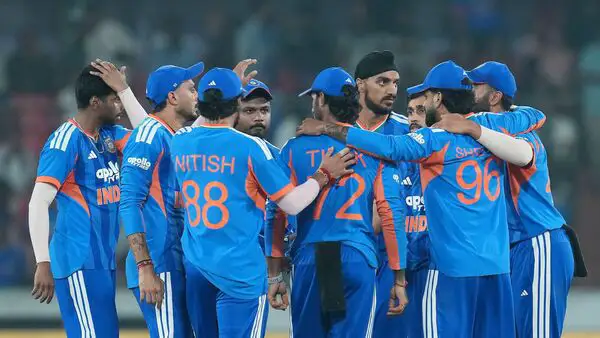
India will begin a five-match T20I series against New Zealand on Thursday, with the opening match scheduled to take place in Christchurch.
Led by Shreyas Iyer, the visitors will face a challenge in adapting to New Zealand’s home conditions while managing competition for places in a squad that combines established international players with promising young talent.
The series will also be an opportunity for young players like Vaibhav Sooryavanshi to play in challenging conditions. We now take a look at three selection decisions that could prove particularly significant as India look to start the tour on a positive note.
Sanju Samson or Ishan Kishan: Who gets the wicketkeeper’s role?
India have two wicketkeeper-batters in Sanju Samson and Ishan Kishan, giving the team management a choice between different batting combinations.
Samson offers experience at the international level, while Kishan provides another attacking option at the top of the order. With Abhishek Sharma and 15-year-old Vaibhav Sooryavanshi also in the squad, India have several possibilities for their opening combination.
Selecting both wicketkeepers could give India additional batting depth, but it would also affect the balance of the middle order. If Samson takes the gloves, Kishan could compete for a place as a specialist batter, and vice versa.
The management will need to decide whether to prioritise continuity in the opening combination or use the series to explore alternative batting arrangements. The decision will also determine how much responsibility falls on the middle order when the top order loses early wickets.
How will India accommodate Vaibhav Sooryavanshi?
Sooryavanshi’s inclusion adds a youthful option to India’s top order. The teenager has attracted attention through his performances in domestic cricket and the Indian Premier League, but an overseas T20I series presents a different challenge.
India already have established options in Abhishek Sharma and Samson, while Kishan can also open. That makes the youngster’s route into the playing XI a question of both form and team balance.
Giving Sooryavanshi an opportunity would allow India to assess his ability against New Zealand’s pace attack and in unfamiliar conditions. However, leaving him out initially would not necessarily indicate a lack of confidence, given the competition for opening positions.
The selectors and team management must weigh the value of immediate experience against the need to settle on a combination capable of producing consistent results across five matches.
Bhuvneshwar Kumar’s return: Experience or pace?
The return of veteran pacer Bhuvneshwar Kumar is another significant development. The right-arm seamer, who featured in the washed out fifth T20I against West Indies recently, had only played for India in November 2022 before that. Interestingly, that T20I too was against New Zealand.
His ability to swing the new ball could be valuable in New Zealand, where conditions can offer assistance to fast bowlers. Bhuvneshwar’s experience also gives India an option alongside Arshdeep Singh, Mayank Yadav and Prince Yadav.
The challenge will be deciding how to distribute the available pace-bowling slots. Arshdeep’s left-arm angle offers variety, while Mayank brings the potential for express pace. Prince provides another option in a squad that also includes Nitish Kumar Reddy and Shivam Dube as seam-bowling all-rounders.
Bhuvneshwar’s inclusion could strengthen India’s powerplay plans, but the management must also consider death-over responsibilities and the workload of its younger fast bowlers. His role will depend on the conditions at each venue and the combination selected for the match.