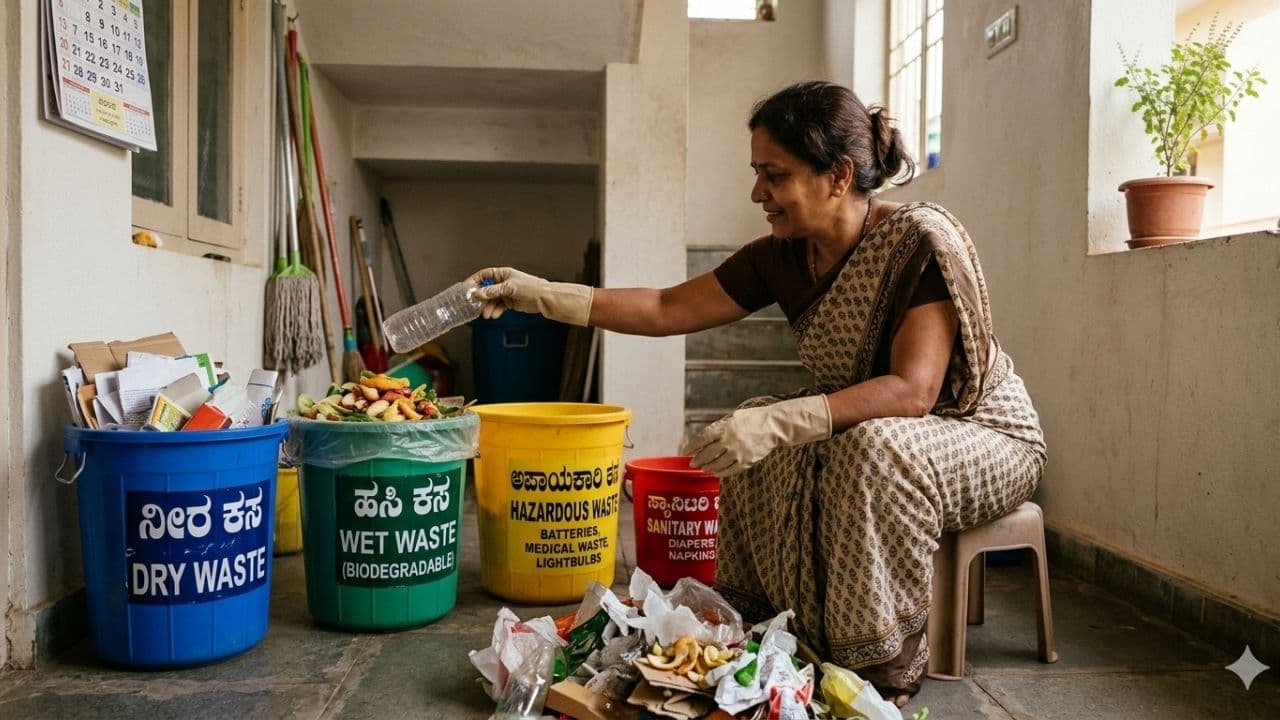
Honnali Municipality in Karnataka has made waste segregation into four categories mandatory for all households and businesses. Chief Officer warns that non-compliance will lead to legal action and heavy fines. The move aims to improve waste management.
In the jurisdiction of Davanagere, the Honnali Municipality has announced a stringent enforcement drive on solid waste management practices, introducing a mandatory four-way segregation system for all households, commercial establishments, and street vendors. Under the new directive, residents and businesses must strictly separate waste into four categories: wet waste, dry waste, sanitary waste, and special or hazardous waste before handing it over to municipal collection vehicles. Officials have warned that non-compliance will attract legal action along with substantial fines as the municipality moves towards a more scientific and accountable waste management system.
Honnali Municipality Enforces Strict Waste Segregation Rules
The municipality has confirmed that the new measures are part of the Solid Waste Management Rules, 2026, which are now being implemented rigorously across the town. Chief Officer T Leelavathi reiterated that the objective is to ensure a cleaner and healthier urban environment through systematic waste processing and responsible citizen participation.
Speaking to reporters at her office on Monday, Leelavathi said the civic body has already undertaken extensive awareness campaigns.
“We have distributed pamphlets, installed banners, issued newspaper advertisements, and even made announcements through garbage collection vehicles to educate the public and traders,” she said.
Despite these efforts, compliance remains a concern.
“It has come to our notice that many residents continue to dump garbage in empty plots, drains, and roadside areas, which is severely affecting the cleanliness of the town,” she added.
Daily Waste Collection and Strict Compliance for All
The Chief Officer emphasised that all households, offices, and commercial establishments must segregate their waste daily and hand it over to municipal collection vehicles that operate every morning. She stressed that there would be no excuses for non-compliance moving forward.
Special attention has been directed towards businesses. Shops including textile outlets, garages, medical stores, provision shops, fruit and vegetable vendors, hotels, and street hawkers must possess valid trade licences. Tobacco sellers are also required to obtain a separate licence for selling tobacco products.
Leelavathi further clarified that all commercial establishments are responsible for managing waste generated on their premises and ensuring it is properly handed over to municipal workers each day.
Responsibility Beyond Shopfronts
The municipality has also urged traders and business owners to take responsibility for maintaining cleanliness in the surrounding areas of their establishments. They are expected to install dustbins and ensure customers dispose of waste responsibly rather than littering public spaces.
“Business owners should ensure that items such as tea cups, tobacco packets, and fruit peels are not thrown on roads. Proper bins must be provided so that waste is disposed of responsibly,” Leelavathi said.
Public Cooperation Essential for Clean City
Appealing for public cooperation, the Chief Officer stated that the success of the initiative depends on collective responsibility. She highlighted that effective waste management is crucial for safeguarding public health and improving overall living conditions.
“To keep our city clean, protect public health, and ensure a better quality of life, we need everyone’s support. We request citizens to cooperate fully with municipal officials and comply with the government’s directives,” she said.
The municipality has reiterated that strict enforcement will continue and violations will be dealt with firmly under the applicable rules.