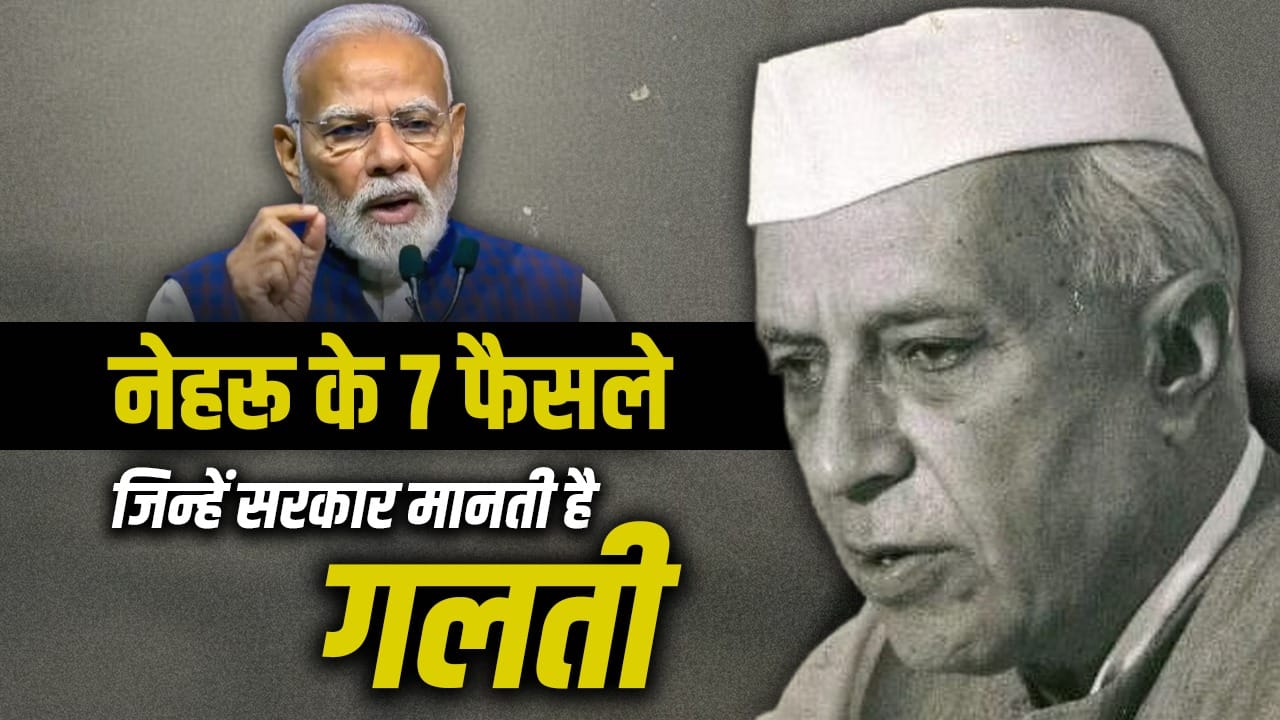
modi vs nehru
Nehru and Modi are compared again and again in Indian politics. Nehru’s time was different and Modi’s time is different. There were challenges before them too, there are mountains of challenges before them too. Jawaharlal Nehru took over the country after independence. Narendra Modi is leading an India which wants to become economically and strategically strong. Modi government And BJP often says that the country suffered the impact of some of Nehru’s decisions for decades. Nehru is criticized especially on issues like Kashmir, China, economy and foreign policy. Here it is a matter of allegations as well as the context of history.
Those seven big decisions of Pandit Nehru which even today the Modi government considers as the biggest mistake? Come, let us understand this topic in detail.
1. Kashmir issue and decision to go to the United Nations
Modi government and BJP consider Kashmir policy as the biggest mistake of Nehru. In the year 1947, tribal raiders supported by Pakistan attacked Jammu and Kashmir. Maharaja Hari Singh decided to merge with India. After this the Indian Army started action. BJP says that the Indian Army was moving forward. She could have taken back the entire Kashmir, but the Nehru government accepted the ceasefire. Then the matter was taken to the United Nations. BJP calls it a strategic mistake.
From the perspective of Modi government, this decision proved costly for India. Because a part of Kashmir remained under the control of Pakistan. Today it is called Pakistan Occupied Kashmir. BJP believes that if tough decisions had been taken at that time, the Kashmir problem would not have continued for so long. A section of historians say that the situation was very difficult at that time. The country was new. Resources were limited. There was international pressure also. Still, the political logic of Modi government is clear. According to him, what was needed was a firm military policy, not idealism, on Kashmir.
2. Giving special status to Article 370
Article 370 has also been a big issue related to Nehru’s policies. Jammu and Kashmir was given special status in India. It had its own constitution. Many central laws were not directly applicable there. BJP has been calling it a mistake of the Nehru era for a long time. He said that due to this, complete integration of Jammu and Kashmir could not happen. Separatism found a place. Pakistan got an opportunity to raise the issue and Kashmir was not fully integrated with the mainstream of India. In the year 2019, Modi government removed Article 370. This was an ideological victory for BJP.
The government said that this decision was in the direction of one country, one constitution. BJP called it a step to correct Nehru’s historical mistake. However, opponents said that Article 370 was the political need of that time. This made the merger of Kashmir into India easier. But, Modi government has a different opinion. According to him, it was wrong to maintain the temporary provision for a long time.
3. China policy and the defeat of 1962
Nehru’s China policy also remains the target of BJP. Nehru adopted a policy of friendship with China. The slogan of Hindi-Chini Bhai-Bhai became popular in the same period. India gave importance to the Panchsheel Agreement. Nehru believed that two big countries of Asia could together create a new world. But in 1962, China attacked India. India lost the war. This caused a big blow to Nehru’s image.
Modi government and BJP say that Nehru trusted China more than necessary. Not enough attention was paid to border security. The preparation of the army was weak. The issue of Tibet is also related to this debate. Critics say that India did not take a strong stance on China’s control over Tibet. Due to this, China came to the border of India. Later the same border dispute arose. This criticism is visible even today in BJP’s politics. Modi government presents itself as a government with a strong border policy. She says that today India knows how to respond.
4. Dispute over the seat of the United Nations Security Council
Another allegation is made against Nehru. It is said that India could have got a permanent seat in the United Nations Security Council. But Nehru gave priority to China. This claim is disputed in history. Not all experts are unanimous on this. Still BJP has been raising this issue.
He says that Nehru gave more importance to international idealism than India’s interests. India could have got an opportunity to become a global power, but that opportunity was lost. Whether this is fully proven or not, its political impact is huge. The Modi government shows itself as a leadership that puts India’s interests first. She talks about India First. On this basis, Nehru’s foreign policy is called idealistic and weak.
5. Socialist Economic Model and License Raj
After independence, Nehru adopted an economic model with socialist thinking. Attention was given to heavy industries. The government sector was strengthened. Planned development began. Five year plans were made. At that time this model was popular in many countries. India was poor. Private capital was less. Therefore the government took the responsibility of development in its hands. But later, license-permit raj was born from this model. Government permission became necessary to open an industry. Bureaucracy increased. Business slowed down.
BJP and Modi government say that Nehru’s economic policy hindered India’s entrepreneurship. If India had adopted open markets and private investment early, growth could have been faster. Modi government calls itself reformist. She emphasizes on startups, digital India, Make in India and private investment. Therefore, she considers Nehru’s economic model to be an old and controlled system.
6. Giving less importance to defense preparedness
Nehru is also criticized for not giving enough importance to defense preparedness. After independence, India paid more attention to development, education and institutions. The pace of modernization of the army remained slow. BJP says that a new country should have emphasized on security along with idealism. The defeat in the 1962 China war is said to be the result of this weakness. Modi government describes its defense policy as strong. It highlights steps like border road, arms procurement, defense production and surgical strikes. In comparison, Nehru’s policy is considered soft.
7. Controversy over the interpretation of secularism
Nehru was a supporter of secular India. He wanted to keep religion and state separate. He envisioned a modern and scientifically minded India. BJP alleges that Nehru’s secularism was not balanced. According to him, the cultural identity of the majority society did not get adequate respect during that period. BJP also calls this the beginning of appeasement.
Modi government talks about cultural nationalism. She connects topics related to Kashi, Ayodhya, Ujjain and Indian tradition with national pride. Therefore, there is a big ideological difference between Nehru’s secularism and Modi’s cultural politics.
In this way it can be said that the comparison between Nehru and Modi is not just a comparison of two leaders. It is also a comparison of two ideas. Nehru’s India was based on institutions, socialism, non-alignment and modernity. Modi’s India emphasizes national interest, security, market, cultural identity and decisive leadership. Among the decisions which the Modi government considers to be Nehru’s mistake, the main ones are Kashmir, Article 370, China policy, economic model and defense preparedness. BJP says that these decisions held India back for a long time. On the other hand, Nehru supporters say that his decisions should be understood in the difficult circumstances of that time.
The truth probably lies between these two. Nehru laid the foundation of new India. But questions were also raised on many of his policies. Modi government makes those questions the basis of its politics and policy, hence the debate of Modi vs Nehru continues even today. This debate is not just about the past. It is also related to the future direction of India.
Also read- That one-party rule, now competition of hundreds of parties. Where do Nehru and Modi stand on the electoral scale?