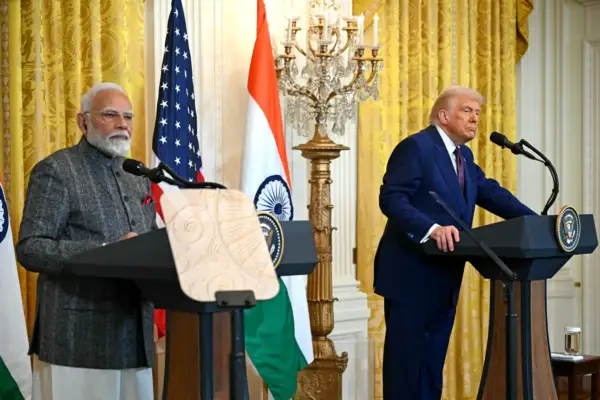
Eight months after Washington and New Delhi settled on an 18 per cent tariff, the full India-US bilateral trade agreement remains unsigned.
With the US midterm elections due on November 3, the unfinished half of the deal now hinges on which party controls Congress for the second half of Donald Trump’s presidency.
The first tranche of the deal has been finalised and is undergoing legal drafting, Commerce Minister Piyush Goyal said on Thursday (Oct 15), reiterating that India would proceed only once it secures an advantage over competing exporters like Bangladesh, Vietnam and Indonesia. “The US bilateral trade agreement first tranche has been finalised. It’s going through final contours, the legal drafting, and we hope to be able to finalise that soon and operationalise that once we get comparable advantage or competitive advantage over our peer countries,” Goyal, addressing the SRCC Centenary Conclave in Delhi, said.
But momentum has been uneven. Trade talks have reached a “plateau” with little room to manoeuvre, Finance Minister Nirmala Sitharaman said earlier this month, days after US Trade Representative Jamieson Greer cautioned that a deal was not “imminent”. Neither side has publicly detailed the reasons for the delay.
Sitharaman’s statement, notably, was New Delhi’s strongest public acknowledgement that talks on key issues have stalled the deal both nations have sought since February 2025. Can this change after the midterms? Let’s have a look.
India-US trade deal: What the US midterms can change
All 435 seats in the House of Representatives and 35 of 100 Senate seats are up for election on November 3. Republicans currently hold a razor-thin House majority of 218 seats (the exact number of seats needed for a majority) to 214 Democratic seats (with 2 vacancies). In the Senate, Republicans hold a 53-47 majority. This means that Democrats only need a net gain of three to four seats to flip the upper chamber.
Forecasts favour the Democrats in the House, where the Cook Political Report expects them to gain between five and 15 seats. The Senate is closer, with Democrats narrowly ahead in Texas, Iowa and Michigan.
This means that for India, the stakes are concrete. The US is India’s largest export market, with goods exports rising to $42.79 billion in April-August from $40.39 billion a year earlier, and a trade surplus of nearly $34 billion in fiscal 2025/26.
Republican win or Democratic win: Which outcome closes the deal?
A September 2026 study by Anil Raman for the Takshashila Institution, based on 42 interviews in Washington, found that support for India in Congress is “broad but shallow”. Research by Paul Staniland, a professor at the University of Chicago who was interviewed for the paper, showed a structural condition: “Public support for India is broad but shallow, while within the ruling coalition sits an intense minority whose organising
concern is restricting immigration”.
Groups opposed to cheap imports, skilled migration and Russian oil money are smaller, but they care more, and they vote, the study notes.
A Democratic House could ease the treatment of Indian students and workers and press to end the war that has raised India’s oil bill, but it is unlikely to change the tariffs or the Russia law. Alternatively, if Republicans lose control of the House, Trump, a president weakened at home, may also look abroad for wins, either via a trade deal with India or fresh pressure on it. The deal’s fate, analysts say, is likely to be decided in the White House, irrespective of who controls Congress.
Notably, just hours before this analysis was published, Trump signed an executive order waiving Russian sanctions and additional tariffs of up to 100% on goods from major importers of Russian oil and gas. India has long been one of the top buyers of discounted Russian crude and thus received relief from the 100% tariff threat plaguing it.
What’s next
US Secretary of State Marco Rubio is expected to visit India from October 17 to 22, when two-way talks could make some progress. Modi and Trump, who spoke by phone on September 30, are expected to speak again soon, with Modi expected to visit the US in December for a G20 leaders’ meet.