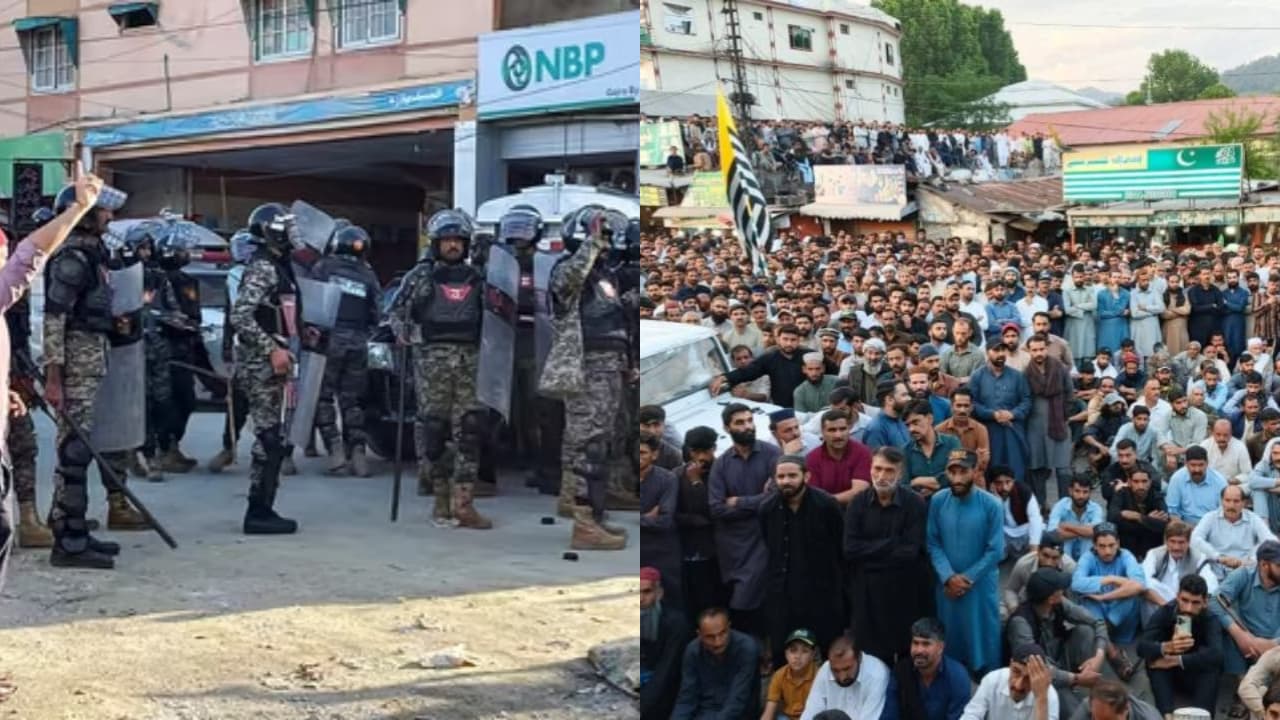
At least seven people were shot as Pakistani security forces clashed with protesters across Pakistan-occupied Kashmir during a region-wide shutdown. Demonstrators demanded lower electricity prices, economic relief and an end to military interference in local governance.
New Delhi: Pakistani security forces opened fire on protesters in Pakistan-occupied-Kashmir (PoK) on Monday, wounding at least seven people, as a near-total shutdown gripped the region and thousands took to the streets across multiple towns demanding economic relief and an end to military interference in local governance.
Demonstrations broke out in Rawalakot, Muzaffarabad, Kotli, Bhimber, Dadyal, Palandri and Sudhnoti, with crowds raising anti-government and anti-military slogans and calling for greater autonomy. In Rawalakot, large-scale protests began around 11am, with demonstrators blocking the main road.
Police, army personnel and paramilitary Rangers responded with live rounds, pellet guns and tear gas as protesters from Bhimber tried to march toward Rawalakot.
Clashes also erupted near Neelum Bridge in Muzaffarabad, with video footage appearing to show security forces firing on crowds. Protesters in Palandri publicly displayed tear-gas shells they said had been fired at them, while in Sudhnoti demonstrators carrying timber sticks issued warnings to both the government and the military. Markets and businesses across the region stayed shut throughout the day.
The 38 demands
Protesters are pressing the Pakistani government to fulfill a charter of 38 demands, the most prominent of which are cheaper electricity and lower prices for staples such as flour, rice and pulses. Central to their grievance is the Mangla Dam, one of Pakistan’s largest hydroelectric reservoirs, which sits on PaK territory. Residents argue that because the dam is built on their land, which they insist is not legally part of Pakistan, the electricity it generates should be supplied to them at substantially reduced rates.
Pakistan has never accepted that argument, and power tariffs in the region remain a persistent source of resentment.
A second, politically charged demand is the abolition of 12 “refugee-designated” seats in the 45-member PoK Legislative Assembly. These seats are nominally reserved for people described as having migrated from Indian-administered Jammu and Kashmir to Pakistan-administered Kashmir, but who now reside elsewhere in Pakistan, primarily in Islamabad, Rawalpindi and Karachi.
Protesters question how people who do not actually live in the territory can legitimately vote for, or represent, its legislature.
Scroll to load tweet…
Military grip on the assembly
Critics and protest leaders allege that the Inter-Services Intelligence (ISI) and the Pakistani military effectively control these 12 seats by ensuring the election of members of Hizbul Mujahideen, a designated terrorist organization under Indian and US law, and their relatives, giving the security establishment a bloc large enough to install a prime minister of its choice.
One figure frequently cited by protesters is Abdullah Saeed Shah, also known as Pir Mazhar Saeed Shah, described as the Sindh provincial chief of Jaish-e-Mohammed, another proscribed militant group. Despite this alleged affiliation, Shah holds a seat in the PoK Assembly and, until recently, served as information and broadcasting minister.
The region has long been used by the Pakistani military as a launchpad for militant activity directed at Jammu and Kashmir, a policy that many within PoK now openly resent.
The situation remained tense on Monday evening, with no indication that the government had offered any fresh concessions or that security forces were standing down.