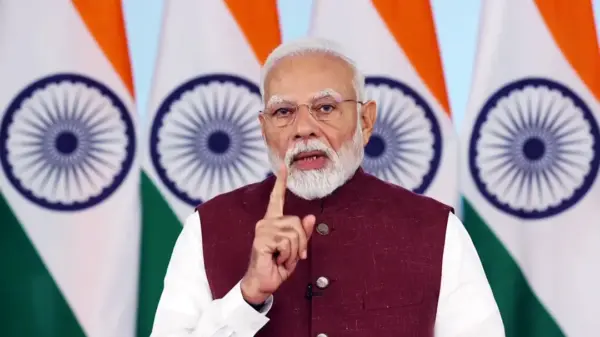
As Prime Minister Narendra Modi’s government marks its 12 years in power, it is worth noting how India’s policies have significantly shifted to zero tolerance on terrorism.
The approach has reshaped the country’s national security, bolstering both domestic and international counter-terrorism efforts. With swift retaliation against terror, such incidents have significantly dropped in numbers – the most recent one being Operation Sindoor, during which Indian armed forces destroyed terror camps and military targets in Pakistan and Pakistan-occupied Kashmir (PoK).
Highlighting the nation’s stance against terrorism, PM Modi has said, “Our policy is of zero tolerance against terrorism. Operation Sindoor has made this policy even clearer. Anyone who tries to spill the blood of Indians will be answered in the same language. Those who raise their eyes towards India will not be spared at any cost.”
Following Operation Sindoor, the prime minister has also stressed, “Talk and terrorism cannot go together. Trade and terrorism cannot go together. Water and blood cannot flow together.” This marks a stark shift in the nation’s policy against terror.
Operation Sindoor and new security doctrine
Operation Sindoor marked a new phase in India’s response to terrorism. While earlier governments focused on diplomatic correspondence, after cross-border terror attacks, the PM Modi-led government has adopted a decisive and swift retaliatory action. It has also stressed that nuclear blackmail of any kind is not tolerated. India has also shifted its water security policy, putting the Indus Water Treaty in abeyance.
During Operation Sindoor, the Indian military carried out precision strikes, destroying nine terror camps and 11 Pakistani military installations, in response to the deadly Pahalgam attack in Jammu and Kashmir that claimed the lives of 26 civilians. The strikes targeted the Jaish-e-Mohammad stronghold of Bahawalpur and the Lashkar-e-Taiba Muridke base. Over 100 terrorists were killed in the operation, including Yusuf Azhar, Abdul Malik Rauf and Mudasir Ahmed.
Following the Indian strikes, Pakistan launched attacks on Indian cities, which led to military confrontations between the two nations. During the four-day military confrontation, India damaged 20 per cent of Pakistan’s Air Force infrastructure. While a ceasefire was declared after both sides reached an agreement, India has warned that Operation Sindoor is the new normal, maintaining that the operation remains ongoing.
Transformation in Jammu and Kashmir
Over the decade, terror incidents have significantly declined in Jammu and Kashmir from over 7,200 incidents between 2004 and 2014 to 2,407 between 2014 and 2025. Organised stone-pelting and strikes/bandh incidents have also fallen dramatically, reaching zero in recent years.
Improved security has led to a boost in tourism, with higher incomes for hotel owners, taxi operators, shopkeepers and local residents. Regular functioning of schools and colleges has expanded educational opportunities, while growing investment proposals have boosted trade and employment.
Strengthening counter-terror infrastructure
India’s counter-terror framework has also been strengthened institutionally. The National Investigation Agency (NIA) has recorded a conviction rate of over 92 per cent, among the highest for anti-terror agencies globally. Counter-terror cooperation has expanded through partnerships with 27 countries.
A dedicated Counter-Terrorism Conference organised by the NIA and the Ministry of Home Affairs in 2024 brought together legal and forensic experts, further strengthening India’s anti-terror capabilities and international cooperation.
From Uri to Balakot strikes
The Modi government has adopted a new national security policy, shifting to a retaliatory action in response to cross-border terrorism. The examples include Uri Surgical Strike in 2016, the Balakot Air Strike in 2019, and Operation Sindoor in 2025. The implementation of the PRAHAAR national counter-terror strategy and the development of an integrated security framework under Mission Sudarshan Chakra further reflect this transformation.
Security and stability across nation
Beyond Jammu and Kashmir, insurgency in the Northeast has declined significantly, supported by twelve peace accords and development initiatives. Stronger border infrastructure, enhanced intelligence coordination and stricter action against terror financing have also contributed to India’s broader security goals.