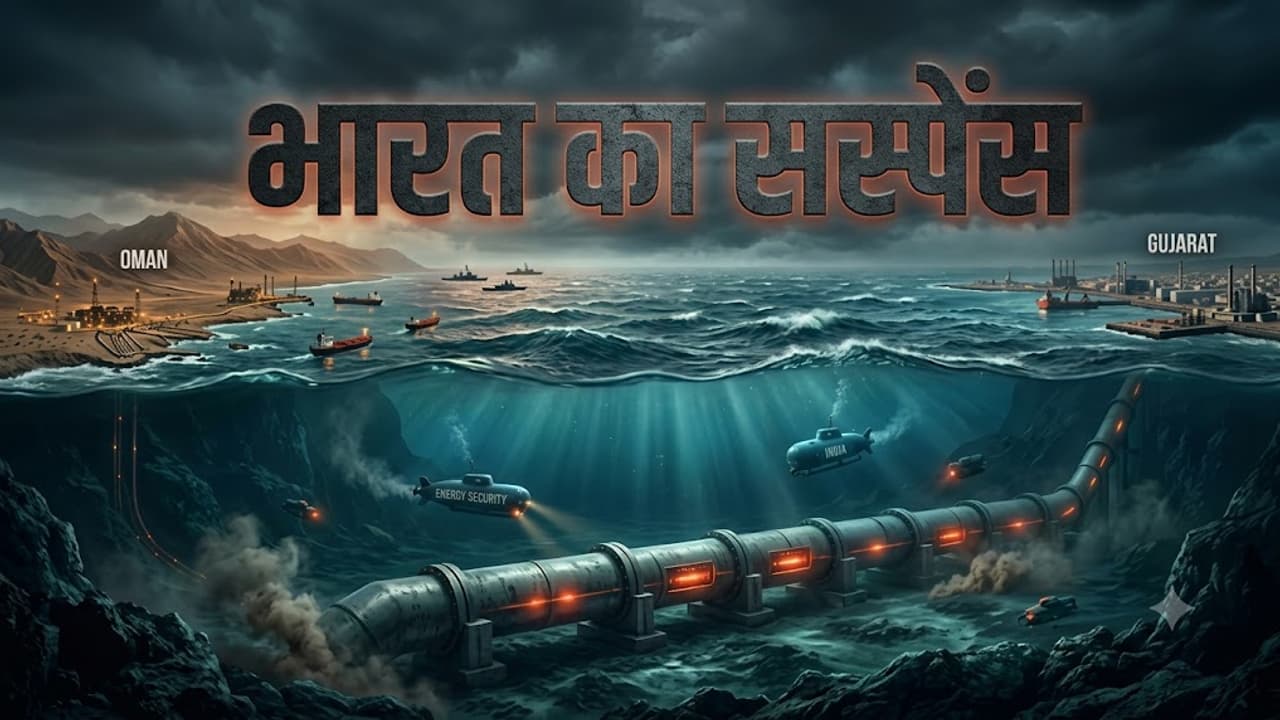
Will Oman-Gujarat 2000 km deep-sea pipeline change India’s energy security? Gas line to be laid at a depth of 3000 meters – will this be the world’s riskiest energy project? Despite costing Rs 40,000 crore, can it fail financially? Will this project be able to save India from energy crisis by ending Hormuz dependence?
Oman India Gas Pipeline: Whenever nuclear tensions increase in the Strait of Hormuz, the entire world’s energy markets come to a halt. Amidst the geopolitical war raging in the Gulf countries and the threats looming on the sea routes, India is working on a very secret and historical mega-project regarding its energy security. The proposal to lay a giant 2,000 km long undersea gas pipeline from Oman straight to the western coast of Gujarat, piercing the abyssal depths of the Arabian Sea, has once again come into discussion. This project, with an estimated cost of around Rs 40,000 crore, can change India’s energy future forever, but the question is, will India be able to overcome this fearsome challenge hidden under the sea?
The ‘living nightmare’ 3,000 meters below: The engineering challenge that gives goosebumps
This proposed project is being called ‘Middle East-India Deepwater Pipeline’ (SAGE Project), which will directly connect Oman to India without the interference of any third country. But the biggest suspense of this route is hidden in the dark depths of the sea. Some parts of the pipeline will pass more than 3,000 meters (3 kilometers) below sea level. The pressure of water at such a depth is beyond human imagination. The rocky conditions of the seabed and lack of access make building and maintaining this infrastructure one of the most difficult offshore engineering tasks in the world. If any technical fault or leakage ever occurs at this depth, then highly advanced robotic and underwater equipment will be required to fix it, which is a very complicated and expensive deal.
Mystery of three decades: Why was this mega project buried in files for 30 years?
Surprisingly, this idea of a direct energy link between Oman and India is not new; This was being discussed only on paper for more than 30 years. Many studies were conducted since the early 1990s, but each time they were shelved due to huge cost, commercial feasibility and technical hurdles. In ancient times, this question always remained unanswered whether a project working at such depth could be maintained economically? But today, when war clouds are looming over the Gulf region and unprecedented advances have been made in offshore engineering, the private consortium ‘SAGE’ has revived this dormant project by secretly completing its seabed survey and financial feasibility studies.
SAGE Consortium and New Hopes
Private consortium SAGE has completed technical and marine surveys on the project. Initial reports assess potential route and engineering challenges. Along with this, government companies like GAIL and Indian Oil have also studied the feasibility of this project. If positive conclusions are reached, work on formal negotiations and investment framework with Oman can move forward.
Maze of Hormuz: India’s masterplan to eliminate shipping route dependence
At present, India is completely dependent on foreign countries, especially the Gulf countries, for its natural gas (LNG) and crude oil needs. All this import reaches India through the Strait of Hormuz – an extremely narrow and sensitive waterway that connects the Persian Gulf to the Arabian Sea. Any obstruction in this route means fuel shortage and skyrocketing prices in India. In LNG import, a long process of liquefying the gas and bringing it by tankers and then converting it into gas has to be adopted. On the contrary, this undersea pipeline will supply uninterrupted gas directly from the source to the destination without any stoppage. India’s leading government companies like GAIL and Indian Oil are closely examining every economic and strategic aspect of this project so that any future geopolitical dilemma can be broken.
Hydrogen era and a bet of Rs 40,000 crore: Will this dream become reality?
For policymakers, this mega pipeline is not just a means to import natural gas, but a strong backbone of the future global energy transition. Energy experts believe that in the coming years, this same infrastructure can also be used for transportation of other alternative fuels including green hydrogen. However, this initial estimate of Rs 40,000 crore may increase in future due to delays and construction expenses. Will investors trust this long-term agreement? After three decades of diplomatic negotiations, the question is no longer how attractive the idea is; The real suspense is whether modern technology and the political will of the country will be able to turn this unique inscription written on the ocean’s chest into reality or not.